IdeaEconomicsAlso in Psychology
Mental accounting
People sort money into separate mental pots by source and purpose and spend each pot by its own rules, though money is interchangeable.
The idea
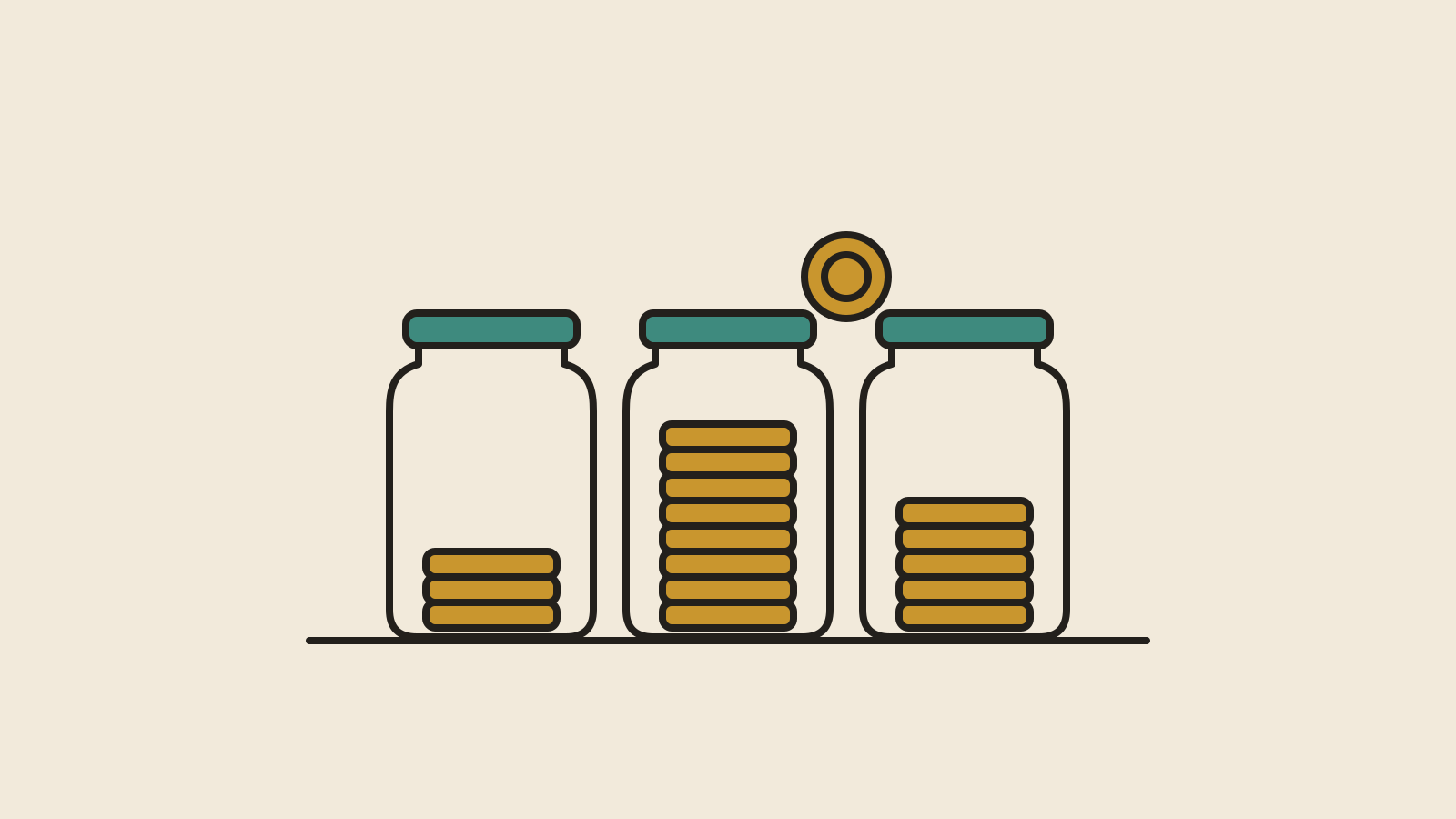
Mental accounting is the claim that people keep money in separate pots in their heads. Each pot is labelled by where the money came from and what it is for, and a dollar in one pot is treated differently from a dollar in another. Economic theory says money is fungible: any dollar can stand in for any other, so only the total should matter.
Lunar New Year shows the habit. Money from a red packet goes on a treat that the same person would never buy out of salary. A tax refund pays for a holiday while a credit card balance sits unpaid at 20 per cent interest, beside a savings account earning two. That second habit costs real money every month.
Richard Thaler argued that the pots are a kind of household bookkeeping. They make spending decisions simpler and keep temptation away from the rent money, at some cost in waste.
Richard Thaler
The American economist who catalogued the regular ways real choices depart from economic theory and turned the findings into nudge policy.
Diagram
Theory treats money as one pool, while people keep it in labelled pots
Read as text
Two columns divided on how money is treated. In economic theory money is one pool, every dollar is interchangeable and only the total matters. In mental accounting money sits in separate pots, each labelled by its source, with a budget for each use.
Key features
- Money is labelled by source, so a windfall or a bonus is spent more freely than wages.
- Money is labelled by use, with rough budgets for food, rent or fun that people are slow to raid.
- Accounts are opened and closed, and people hate to close one at a loss, which keeps them holding falling shares and sitting through bad films they have paid for.
- People judge a price against what seems fair and enjoy a bargain apart from the goods.
- The budgets double as self-control, protecting savings from impulse.
Not to be confused with
| Look-alike | The difference | Differs on |
|---|---|---|
| Framing effect | A framing effect is a switch in one choice when someone else rewords the options. Mental accounting is a person's own lasting system for labelling money, which shapes many choices over months and years. | Differs onScope |
| Prospect theory | Prospect theory says how a single gain or loss is valued against a reference point. Mental accounting says how outcomes are grouped and labelled before that valuing happens. | Differs onScope |
| Endowment effect | Both are Thaler's. The endowment effect says that owning a thing raises its value to you. Mental accounting says that the label on money changes how you spend it. | Differs onClaim |
| Budgeting | A written budget is a plan a household chooses to follow. Mental accounts are habits, often unnoticed, that researchers describe. | Differs onDescriptive or normative |
- Differs onScope
A framing effect is a switch in one choice when someone else rewords the options. Mental accounting is a person's own lasting system for labelling money, which shapes many choices over months and years.
- Differs onScope
Prospect theory says how a single gain or loss is valued against a reference point. Mental accounting says how outcomes are grouped and labelled before that valuing happens.
- Differs onClaim
Both are Thaler's. The endowment effect says that owning a thing raises its value to you. Mental accounting says that the label on money changes how you spend it.
- Differs onDescriptive or normative
Budgeting
A written budget is a plan a household chooses to follow. Mental accounts are habits, often unnoticed, that researchers describe.
Origins and development
Thaler described the pattern in 1980 and named it in a 1985 article in Marketing Science, which drew on prospect theory. Tversky and Kahneman had written of a "psychological account" in 1981, in a puzzle about a lost theatre ticket. Chip Heath and Jack Soll found in 1996 that people who had just spent on one kind of entertainment cut back on others of the same kind. Justine Hastings and Jesse Shapiro showed in 2013 that when petrol prices rose, American drivers switched to cheaper grades far more than the squeeze on their budgets could explain.
Prospect theory
People judge risky options as gains or losses from a reference point, and a loss hurts more than an equal gain pleases.
Why it matters
Governments use it. A payment labelled as child benefit or a winter fuel allowance is spent on children or heating more than ordinary income would be. Banks and budgeting apps sell "pots" and "envelopes" that turn the habit into a savings tool. Casinos rely on gamblers treating winnings as house money. Investors who watch each share separately hold losers too long, and shoppers buy things they don't need because the discount feels like income.
Critiques and limits
Henry Farber re-examined a much-cited field case, New York taxi drivers said to stop work on reaching a daily income target, and found that they mostly stop when tired. The sociologist Viviana Zelizer argues that earmarking is social before it is mental: families and communities mark money as wages, gifts or housekeeping. Individuals follow. The evidence that labels alter spending is good, in the laboratory and in shop data. How people form their accounts, and when they merge them, is unsettled.
Connections
Belongs to
It is one of the school's standard findings on how real spending and saving depart from the textbook.
Originated by
Thaler described the habit in 1980 and named it in a 1985 article on how consumers judge purchases.
Extends
It applies prospect theory's value function to everyday purchases and adds rules for how outcomes are grouped.
Influenced by
Daniel KahnemanPsychology
Tversky and Kahneman's 1981 puzzle of the lost theatre ticket gave the idea its best-known experiment.
Critiques
Economic man treats every dollar alike, while real people let its label decide how it is spent.
Contrasts with
Differs on claim. The endowment effect says owning a thing raises its value, mental accounting that a label on money changes how it is spent.
Framing effectPsychology
Differs on scope. A framing effect is one choice swayed by someone's wording, while mental accounting is a person's own lasting system of labels.
Differs on scope. Prospect theory values a single gain or loss, while mental accounting says how outcomes are grouped before they are valued.
Applied in
Benefits paid under a label such as child benefit are spent on the named purpose more than plain income is.
Further reading
- Hastings, J. S., & Shapiro, J. M. (2013). Fungibility and consumer choice: Evidence from commodity price shocks. The Quarterly Journal of Economics, 128(4), 1449–1498. https://doi.org/10.1093/qje/qjt018
- Thaler, R. (1985). Mental accounting and consumer choice. Marketing Science, 4(3), 199–214. https://doi.org/10.1287/mksc.4.3.199
- Thaler, R. H. (1999). Mental accounting matters. Journal of Behavioral Decision Making, 12(3), 183–206. https://doi.org/10.1002/(SICI)1099-0771(199909)12:3<183::AID-BDM318>3.0.CO;2-F
- Thaler, R. H. (2015). Misbehaving: The making of behavioral economics. W. W. Norton.
Cite this entry
Scholia. (2026). Mental accounting. In Scholia: Notes in the margin of the human sciences. Retrieved November 28, 2026, from https://scholia.zennia.sg/ideas/mental-accounting