IdeaPhilosophy
Nominalism
The view that only particular things exist, and that general words such as "red" or "justice" name no extra shared entity.
The idea
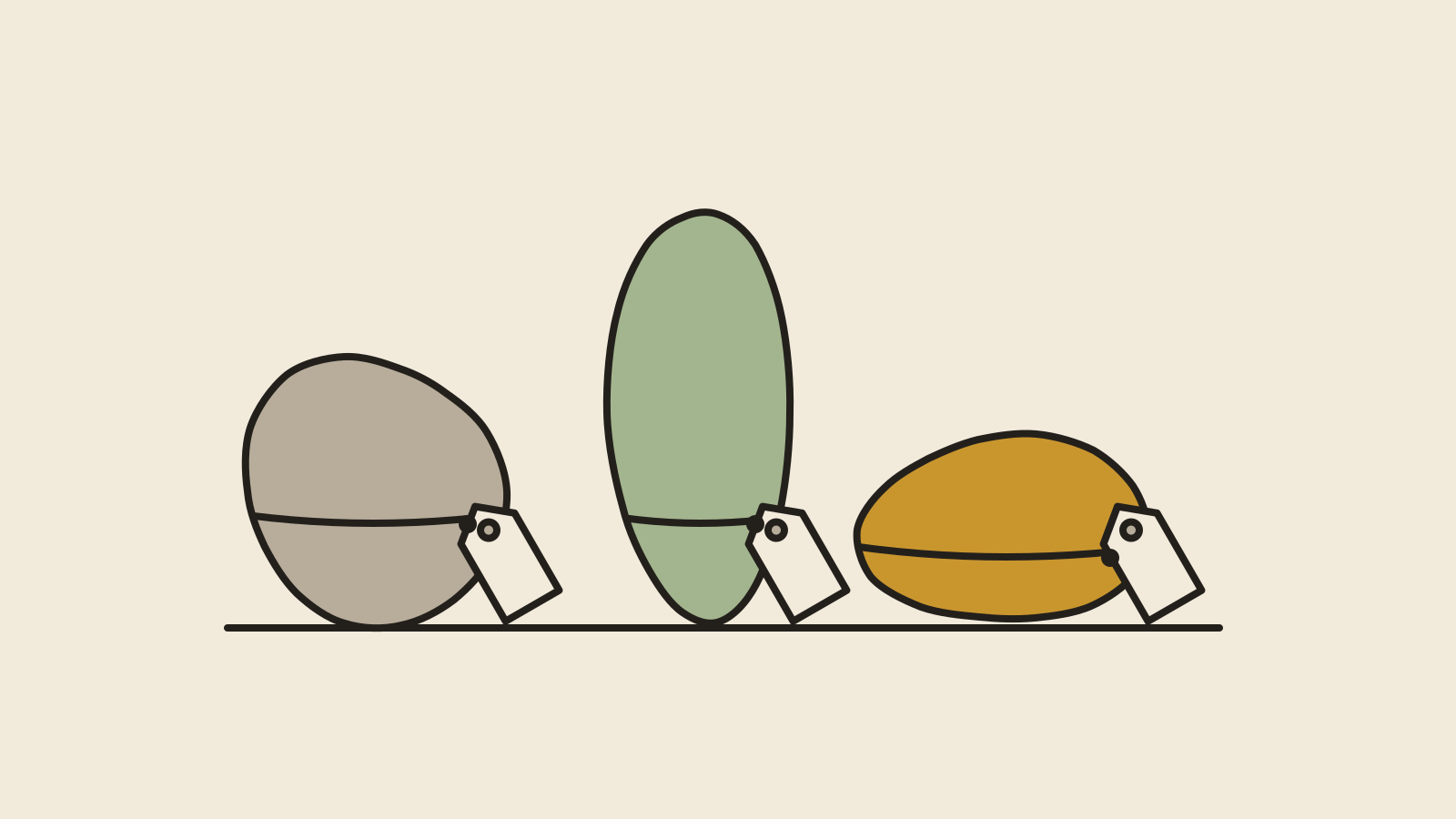
Three post boxes on three streets are all red. A realist about universals says they share something, redness, which is one thing present in all three. The nominalist says there are just the three boxes. We call each of them red because they look alike to us, and the single word gives the impression of a single thing behind it. Nomen is Latin for name, and on this view a name is all that general things have in common.
Universals
A universal is a feature that many different things can share, such as redness or being human, as opposed to a particular thing.
The position extends to every general term. There is no humanity over and above individual humans, and no justice apart from particular decisions and arrangements. A second, modern use of the word is wider: it denies abstract objects of any sort, numbers and sets included, then tries to show that science and mathematics can be understood without them. Both versions prefer a world made only of concrete, particular things.
Diagram
Nominalism is the far end of a range of views about universals
Read as text
A line running from the view that universals are fully real to the view that only particulars exist. Platonic realism sits at the far left, placing universals apart from things. Aristotelian realism comes next, placing them in things. Conceptualism places them in the mind. Nominalism sits at the far right and denies them altogether.
Key features
- Everything that exists is particular: located somewhere, unrepeatable and one of a kind.
- General words work by applying to many things, and they need no shared entity to stand for.
- Sameness of kind is explained by resemblance among things, by membership of a class or by our habits of grouping.
- The view prizes economy and refuses to posit entities that explanation can do without.
- Modern nominalists extend the refusal to numbers and other abstract objects.
Not to be confused with
| Look-alike | The difference | Differs on |
|---|---|---|
| Theory of Forms | Plato holds that Beauty itself exists apart from beautiful things and is more real than they are. Nominalists hold that only the particular beautiful things exist. | Differs onClaim |
| Universals | "Universals" names the shared features that realists believe in. Nominalism is the claim that there are none, only particulars and the words we group them with. | Differs onClaim |
| Occam's razor | The razor is a general rule against needless assumptions and can be turned on any subject. Nominalism is one doctrine about what exists, which Ockham defended with that rule. | Differs onScope |
| Conceptualism | Conceptualists agree that nothing general exists outside the mind and add that general concepts in the mind are real. Strict nominalists allow only words. Ockham is often placed here. | Differs onClaim |
- Differs onClaim
Plato holds that Beauty itself exists apart from beautiful things and is more real than they are. Nominalists hold that only the particular beautiful things exist.
- Differs onClaim
"Universals" names the shared features that realists believe in. Nominalism is the claim that there are none, only particulars and the words we group them with.
- Differs onScope
The razor is a general rule against needless assumptions and can be turned on any subject. Nominalism is one doctrine about what exists, which Ockham defended with that rule.
- Differs onClaim
Conceptualism
Conceptualists agree that nothing general exists outside the mind and add that general concepts in the mind are real. Strict nominalists allow only words. Ockham is often placed here.
Origins and development
The medieval debate grew from a question Porphyry posed around 270 CE and declined to answer: are genera and species real? Roscelin of Compiègne, teaching in the late eleventh century, is reported to have called universals mere breath of the voice. His pupil Peter Abelard gave a subtler version, and William of Ockham made the view influential in the fourteenth century. In India, Buddhist logicians from Dignaga onward denied universals on similar grounds. The modern form dates from a 1947 paper by Nelson Goodman and W. V. O. Quine.
Why it matters
The dispute returns whenever people ask whether a category is found or made. Biologists ask whether species are real divisions in nature or convenient labels, and social scientists who hold that society is nothing beyond the individuals in it are sometimes called nominalists. Arguments over whether races, mental disorders or social classes are natural kinds replay the medieval quarrel in new terms.
Critiques and limits
Bertrand Russell argued in 1912 that the nominalist's own tool undoes the view: if red things merely resemble one another, resemblance is itself something many pairs share, which makes it a universal. David Armstrong called the refusal to explain why different things are the same in kind "ostrich nominalism". Quine later gave up the project and argued, as Hilary Putnam also did, that science cannot do without numbers. The question is settled by argument, since no experiment bears on it, and nominalism remains a live minority position.
Bertrand Russell
The British logician who made the analysis of language philosophy's main method and became one of his century's best-known public intellectuals.
W. V. O. Quine
An American logician and philosopher who denied that any truths hold by meaning alone and treated philosophy as continuous with science.
Connections
Belongs to
It answers one of metaphysics' oldest questions, whether anything exists besides particular things.
The medieval schools' long quarrel over universals gave the position its name and its classic arguments.
Critiques
It denies that Beauty or Justice exists as a separate object and keeps only beautiful things and just acts.
Contrasts with
Differs on claim. Plato holds that Beauty itself exists apart from beautiful things, where nominalists hold that only the particular things exist.
Differs on claim. Universals are the shared features realists believe in, and nominalism is the claim that there are none.
Differs on scope. Nominalism is one doctrine about what exists, where the razor is the general rule Ockham used to argue for it.
Applied in
Social theorySociology
Social nominalists treat society as a name for individuals and their dealings, against views that treat it as a thing.
Cross with
Two distant entries to read beside this one, each with the question the pairing opens.
Prototype theoryCognitive science & linguistics
If people sort things by resemblance to best examples, does that favour the nominalist or just move universals into the mind? Set them side by side
Social factSociology
Durkheim held that a language or a law exists outside any one person: would a nominalist have to deny that social facts exist? Set them side by side
Further reading
- Armstrong, D. M. (1989). Universals: An opinionated introduction. Westview Press.
- Russell, B. (1912). The problems of philosophy. Williams and Norgate.
- William of Ockham. (1990). Philosophical writings: A selection (Rev. ed.). Hackett. (Original work published 1957)
Cite this entry
Scholia. (2026). Nominalism. In Scholia: Notes in the margin of the human sciences. Retrieved November 28, 2026, from https://scholia.zennia.sg/ideas/nominalism