IdeaCognitive science & linguisticsAlso in Psychology, Philosophy
Prototype theory
People sort the world by resemblance to a category's best examples, so some members are more typical than others and boundaries are fuzzy.
The idea
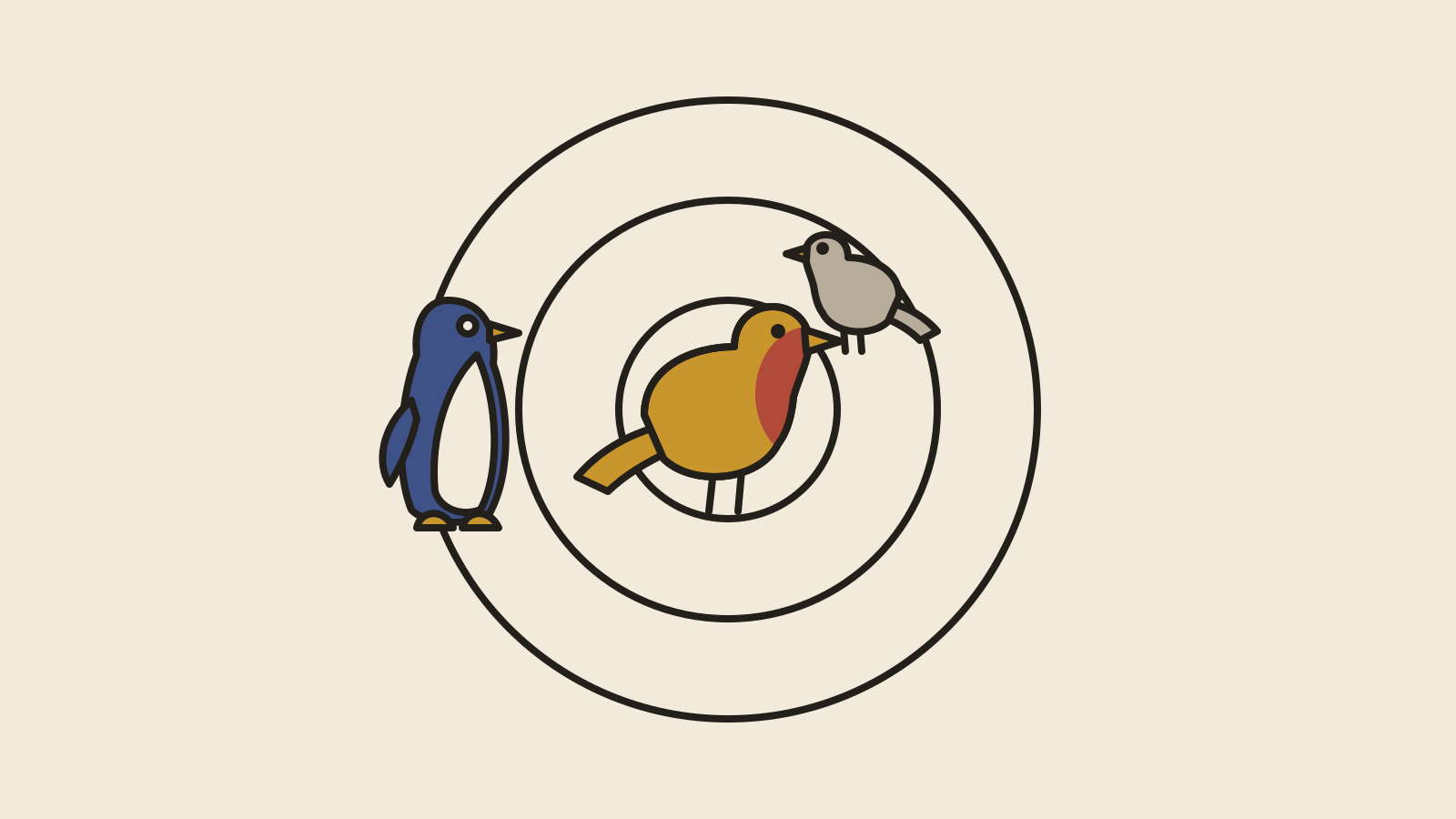
Ask people to name a bird and most say something like a robin or a sparrow. Few say penguin. Everyone agrees that a penguin is a bird, yet it seems a less birdlike bird. Prototype theory takes that feeling seriously. It holds that a category in the mind is organised round its most typical members, and that new things are sorted by how closely they resemble that centre.
The older view, traced to Aristotle, treated a concept as a definition: a list of features that every member has and no outsider has. On that view all members are equal. Eleanor Rosch's experiments in the 1970s showed they are not. People rate a chair as better furniture than a clock and agree closely with each other in such ratings. They also confirm that a robin is a bird faster than they confirm that a chicken is one. Boundaries are fuzzy too. Is a tomato a fruit, or a rug furniture?
Diagram
Some birds are judged better examples of the category than others
Read as text
A line running from best example of a bird on the left to poorest example on the right. Robin sits at the far left, with sparrow just beside it. Eagle comes next, then owl. Chicken and penguin sit well past the middle, towards the poor end. All six are birds, yet they are not judged equally good ones. The positions follow ratings given by American students and are approximate.
Key features
- Typicality is graded, and some members of a category are consistently judged better examples than others.
- A prototype is a summary of the features that members tend to share, such as flying, singing and nesting for birds, and no single feature is required.
- Typical members are named first, learned earlier by children and verified faster.
- Category edges are blurred, so borderline cases get slow and inconsistent answers.
- Categories have a basic level, such as dog between animal and spaniel, which people use by default.
Not to be confused with
| Look-alike | The difference | Differs on |
|---|---|---|
| Exemplar theory | Both explain typicality by similarity. Prototype theory says the mind stores one summary of the category. Exemplar theory says it stores remembered individual cases and compares a new item with those. | Differs onMechanism |
| Stereotype | A stereotype is a widely shared belief about the members of a social group, often carrying a judgement. A prototype is the typical case of any category at all and carries no judgement. | Differs onScope |
| Ideal type | Max Weber's ideal type is a deliberately exaggerated model that a researcher builds in order to compare real cases against it. A prototype forms in ordinary minds without anyone designing it. | Differs onMethod |
| Conceptual metaphor theory | Prototype theory describes how one category is organised round its best examples. Conceptual metaphor theory claims that one whole domain is understood through another. | Differs onClaim |
- Differs onMechanism
Exemplar theory
Both explain typicality by similarity. Prototype theory says the mind stores one summary of the category. Exemplar theory says it stores remembered individual cases and compares a new item with those.
- Differs onScope
A stereotype is a widely shared belief about the members of a social group, often carrying a judgement. A prototype is the typical case of any category at all and carries no judgement.
- Differs onMethod
Max Weber's ideal type is a deliberately exaggerated model that a researcher builds in order to compare real cases against it. A prototype forms in ordinary minds without anyone designing it.
- Differs onClaim
Prototype theory describes how one category is organised round its best examples. Conceptual metaphor theory claims that one whole domain is understood through another.
Origins and development
Ludwig Wittgenstein had observed in 1953 that games share no single feature, only a web of family resemblances. Rosch turned the remark into experiments. Her early studies among the Dani of New Guinea found that focal colours were learned and remembered more easily even without names for them. Papers from 1973 to 1978 measured typicality across everyday categories. By 1978 she was warning that prototype effects are findings and do not by themselves show how concepts are stored. George Lakoff later carried the idea into linguistics.
Ludwig Wittgenstein
The Austrian philosopher who wrote two opposed accounts of language, first as a picture of facts and later as a set of shared practices.
George Lakoff
American linguist who argued that everyday thought runs on metaphor and the body, and who applied the idea to political language.
Why it matters
Typicality shapes judgement outside the laboratory. Doctors recognise textbook presentations of a disease more readily than unusual ones, which is one reason heart attacks with atypical symptoms get missed. Dictionaries, search engines and image classifiers all have to cope with categories that have clear centres and vague edges. Legal disputes over whether a scooter counts as a vehicle are disputes about category boundaries of just this kind.
Critiques and limits
Sharon Armstrong and Lila and Henry Gleitman showed in 1983 that people rate some odd numbers as better examples than others, though odd number has a strict definition, so typicality cannot reveal how a concept is defined. Daniel Osherson and Edward Smith noted that prototypes do not combine: a guppy is a typical pet fish but neither a typical pet nor a typical fish. Jerry Fodor pressed the same point. Typicality effects are among the best replicated in psychology. The account of what produces them is still disputed.
Jerry Fodor
An American philosopher who argued that thinking is computation in an inner language and that parts of the mind work as sealed modules.
Connections
Belongs to
Cognitive psychologyPsychology
Rosch's experiments on typicality made concepts and categories a core topic of cognitive psychology.
Cognitive linguists adopted prototypes to explain word meanings that have a clear core and fuzzy edges.
Influenced by
Ludwig WittgensteinPhilosophy
Rosch tested his remark that things called games share overlapping likenesses and no single common feature.
Gestalt principles of perceptionPsychology
Rosch's first prototype experiments used Gestalt 'good forms' such as the circle and square as natural best examples that categories form around.
Critiques
AristotlePhilosophy
Rosch's graded categories overturned the definitional view of concepts, traced to Aristotle, in which necessary and sufficient features fix membership.
Contrasts with
Differs on claim. Prototype theory says a category is organised round best examples, where this theory says one domain is understood through another.
StereotypePsychology
Differs on scope. A stereotype is a shared belief about a social group, where a prototype is the typical case of any category.
Ideal typeSociology
Differs on method. An ideal type is an exaggerated model a researcher builds for comparison, where a prototype forms in ordinary minds unplanned.
ArchetypePsychology
Differs on mechanism. A prototype is built from examples a person has met, while an archetype is said to come before experience.
Applied in
Psychological and cognitive anthropologyAnthropology
Its first evidence came from colour categories among the Dani of New Guinea, and anthropologists use it to compare folk categories.
Influenced
Rosch's experiments on best examples gave him the model of categories he extended to grammar and metaphor.
Rosch's finding that categories have best examples and fuzzy edges became the school's model of word meaning.
Cross with
Two distant entries to read beside this one, each with the question the pairing opens.
DemocracyPolitical theory & science
Do people judge whether a country is a democracy by resemblance to a best example, and whose country serves as that example? Set them side by side
Band, tribe, chiefdom, stateAnthropology
Service sorted societies into four types: are band, tribe, chiefdom and state prototypes with fuzzy borders, or classes with defining features? Set them side by side
Further reading
- Murphy, G. L. (2002). The big book of concepts. MIT Press. https://doi.org/10.7551/mitpress/1602.001.0001
- Rosch, E. H. (1973). Natural categories. Cognitive Psychology, 4(3), 328–350. https://doi.org/10.1016/0010-0285(73)90017-0
- Rosch, E. (1975). Cognitive representations of semantic categories. Journal of Experimental Psychology: General, 104(3), 192–233. https://doi.org/10.1037/0096-3445.104.3.192
Cite this entry
Scholia. (2026). Prototype theory. In Scholia: Notes in the margin of the human sciences. Retrieved November 28, 2026, from https://scholia.zennia.sg/ideas/prototype-theory