IdeaEconomicsAlso in Sociology, Political theory & science
Path dependence
Where a technology or an institution ends up depends on the route it took, and early accidents can lock in lasting outcomes.
The idea
Path dependence is the claim that history is not washed out by competition. Small, early events can push a technology or an institution down one track, and each step along it makes switching to another track more costly. The result may be an arrangement nobody would choose if starting afresh.
The keyboard is the standard case. The QWERTY layout was settled in the 1870s, on the usual account for machines whose metal type bars could jam. The type bars are long gone. The layout stayed, because typists had learned it, manufacturers built for trained typists, and new typists learned what the machines offered. Each group's choice reinforced the others'.
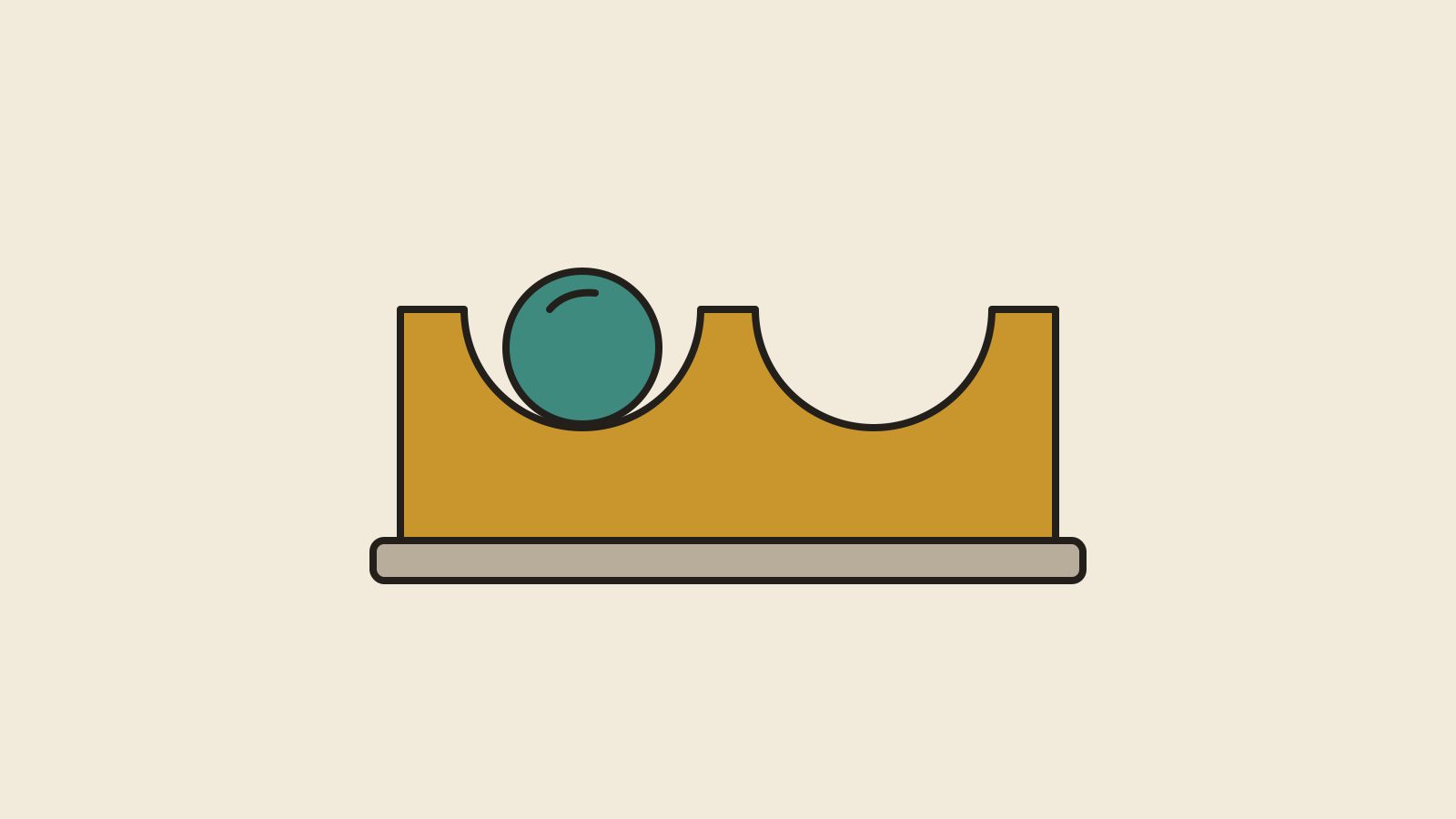
Standard economic theory expects markets to converge on the best option whatever the starting point. Path dependence says there can be several possible resting points, and which one a society reaches may turn on timing and chance.
Diagram
An early lead feeds on itself until switching costs too much
Read as text
Four boxes joined by arrows. A small early lead for one option brings more people to adopt it. More adopters make adopting pay more, through learning, compatible products and a larger network. Higher pay-offs bring still more adopters, a reinforcing loop labelled increasing returns. As adopters grow, the cost of switching to a rival rises, which locks the option in.
Key features
- The process feeds on itself: the more people adopt an option, the more it pays the next person to adopt it too.
- Such increasing returns come from learning by use, from networks of users, from compatible products and from the cost of retraining.
- Early moves count for most, and a small or accidental lead can decide the outcome.
- Once ahead, an option becomes locked in, and a better rival may fail to dislodge it.
- The outcome cannot be predicted from the merits of the options alone, so an explanation has to include the sequence of events.
Not to be confused with
| Look-alike | The difference | Differs on |
|---|---|---|
| Spontaneous order | Both describe arrangements that nobody designed. Spontaneous order holds that such arrangements tend to embody useful, tested knowledge. Path dependence holds that they can equally preserve an early accident, so survival is no proof of merit. | Differs onClaim |
| Creative destruction | Creative destruction has better products and methods sweeping away old ones. Path dependence explains the cases where they don't, because the old option's base of users outweighs the newcomer's quality. | Differs onClaim |
| Network effects | A network effect means a product gains value as more people use it. It is one cause of path dependence among several, alongside learning and sunk investments. | Differs onScope |
| Status quo bias | The bias is a habit of individual minds, a preference for what one already has. Path dependence works through costs and incentives and would hold among perfectly calculating people. | Differs onLevel |
- Differs onClaim
Both describe arrangements that nobody designed. Spontaneous order holds that such arrangements tend to embody useful, tested knowledge. Path dependence holds that they can equally preserve an early accident, so survival is no proof of merit.
- Differs onClaim
Creative destruction has better products and methods sweeping away old ones. Path dependence explains the cases where they don't, because the old option's base of users outweighs the newcomer's quality.
- Differs onScope
Network effects
A network effect means a product gains value as more people use it. It is one cause of path dependence among several, alongside learning and sunk investments.
- Differs onLevel
Status quo bias
The bias is a habit of individual minds, a preference for what one already has. Path dependence works through costs and incentives and would hold among perfectly calculating people.
Origins and development
The economic historian Paul David brought the term into economics in 1985 with a short paper on QWERTY. Brian Arthur supplied the mathematics, published in 1989 after years in circulation, showing how increasing returns let chance events select a winner. Douglass North carried the idea from technologies to institutions in 1990, to explain why poor countries keep rules that hold them back. Paul Pierson brought it into political science in 2000, and James Mahoney into historical sociology in the same year.
Douglass North
An American economic historian who argued that institutions, the rules of the game, decide whether economies grow or stagnate.
Institutions (economics)
The rules of the game in a society: the laws, customs and enforcement that shape how people deal with one another.
Why it matters
The idea explains much that looks irrational in daily life: why Britain, Japan and Singapore drive on the left, why railways in neighbouring countries differ in gauge, why a clumsy file format outlives better ones. It bears on policy too. If early choices lock in, then standards for electric car chargers or digital payments deserve care at the start. And a poor country cannot copy a rich one's laws and expect its results.
Critiques and limits
Stan Liebowitz and Stephen Margolis (1990) went back to the QWERTY evidence and found the tests that favoured the rival Dvorak layout flawed, some of them run by Dvorak himself. They accept that history shapes outcomes and deny that markets often lock in a product known to be worse when switching would pay. The strong form is contested, with few agreed cases. The weak form, that sequence and timing matter, is widely accepted. Pierson warned that the term is often stretched to mean only that the past matters.
Connections
Belongs to
North made it a core idea of the new institutional economics, as the reason poor rules persist.
Critiques
It denies that competition leads to the same best outcome whatever the starting point.
Contrasts with
Differs on claim. Spontaneous order holds that undesigned arrangements carry tested knowledge, while path dependence holds that they can preserve an early accident.
Differs on claim. Creative destruction has better products sweeping away old ones, and path dependence explains the cases where an entrenched option survives.
Applied in
Comparative politicsPolitical theory & science
Historical institutionalists use it to explain why policies and constitutions resist change once groups have organised around them.
It underlies the argument that institutions set up centuries ago still shape which countries are rich.
Further reading
- Arthur, W. B. (1989). Competing technologies, increasing returns, and lock-in by historical events. The Economic Journal, 99(394), 116–131. https://doi.org/10.2307/2234208
- David, P. A. (1985). Clio and the economics of QWERTY. The American Economic Review, 75(2), 332–337.
- Liebowitz, S. J., & Margolis, S. E. (1990). The fable of the keys. The Journal of Law and Economics, 33(1), 1–25. https://doi.org/10.1086/467198
- Pierson, P. (2000). Increasing returns, path dependence, and the study of politics. American Political Science Review, 94(2), 251–267. https://doi.org/10.2307/2586011
Cite this entry
Scholia. (2026). Path dependence. In Scholia: Notes in the margin of the human sciences. Retrieved November 28, 2026, from https://scholia.zennia.sg/ideas/path-dependence