IdeaPsychologyAlso in Cognitive science & linguistics
Phrenology
A refuted nineteenth-century doctrine that character can be read from the bumps of the skull, because each mental faculty has its own brain organ.
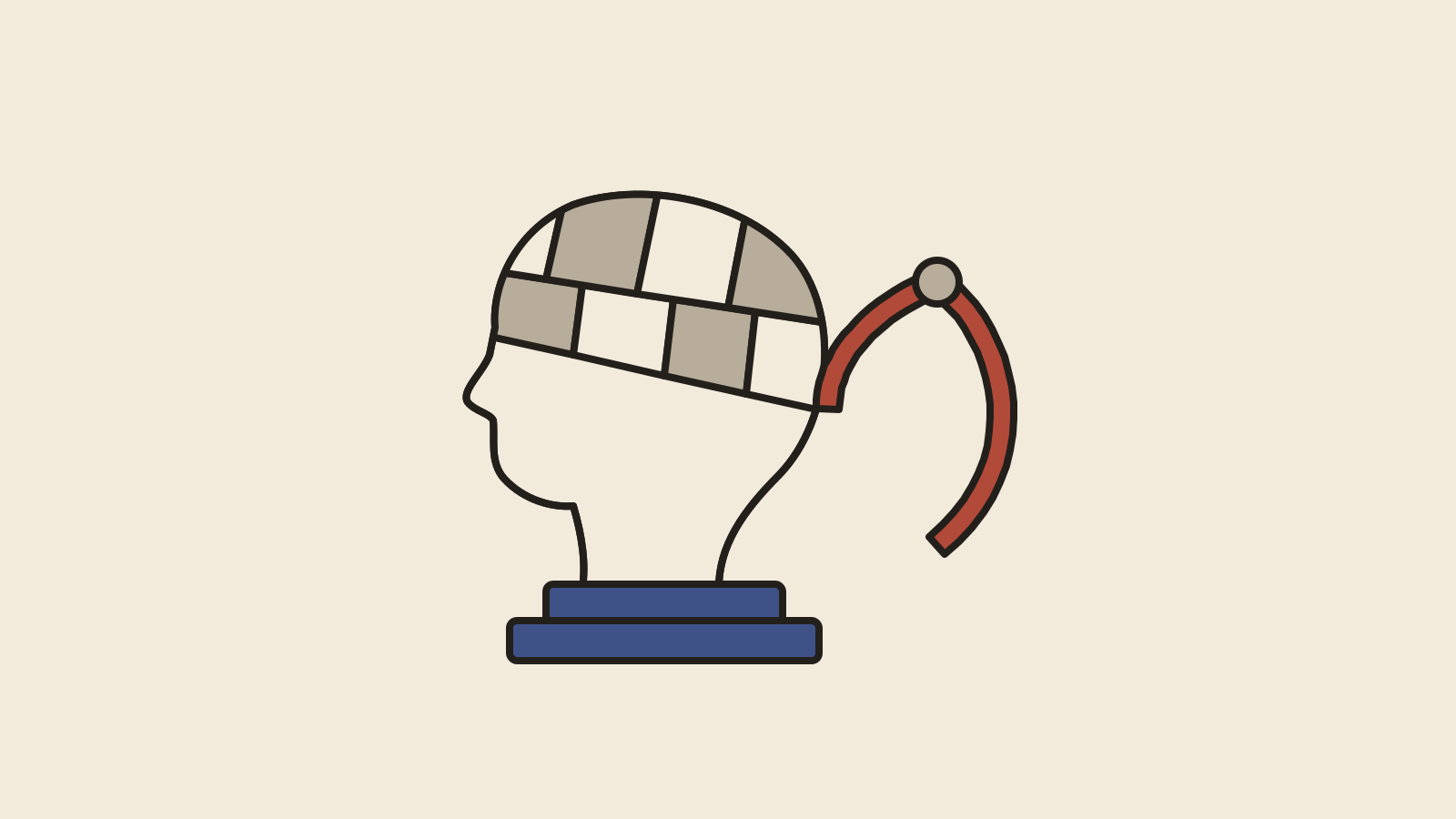
The idea
Phrenology claimed that a person's character and talents could be read from the outside of the head. The reasoning ran in steps. The mind is made up of separate inborn faculties, such as cautiousness, love of children or a talent for numbers. Each faculty has its own organ on the surface of the brain, and a strong faculty means a large organ. The skull takes the shape of the brain beneath it, so a practised hand can feel which organs are well developed.
In the 1830s and 1840s this was a consumer service. A clerk in Edinburgh or Boston could pay for a reading before applying for a post and carry away a printed chart scoring his faculties. Some employers asked for such charts, couples compared them before marrying and parents had children's heads examined to choose a trade.
The first two steps were partly right, and they mattered. Everything after them was wrong.
Diagram
Phrenology rested on a chain of claims, and the last three failed
Read as text
Five steps in a row, each leading to the next. The mind has separate inborn faculties. Each faculty has its own organ in the brain. A bigger organ means a stronger faculty. The skull follows the shape of the brain. So the bumps of the skull reveal character. The first two steps survive, in altered form, as localisation of function. The last three were shown to be false.
Key features
- Franz Joseph Gall listed 27 faculties, and his followers raised the number to 35 or more.
- The brain is the organ of the mind, a view Gall defended when it was still disputed.
- The size of an organ measures the power of its faculty.
- The outer surface of the skull is taken to mirror the surface of the brain.
- Evidence came from striking cases: Gall felt the heads of gifted people, criminals and asylum patients and looked for a bump they shared.
Not to be confused with
| Look-alike | The difference | Differs on |
|---|---|---|
| Localisation of function | Phrenology also placed faculties in separate brain organs, but it inferred them from the shape of the skull and from striking anecdotes. Localisation rests on damage, stimulation and imaging. Its functions are far humbler than "benevolence" or "hope". | Differs onMethod |
| Modularity of mind | Jerry Fodor's modularity revives Gall's separate, special-purpose faculties and openly credits him. It makes no claim that faculties show in the size of an organ or the shape of the skull, which is the part of phrenology that failed. | Differs onClaim |
| Physiognomy | The much older practice of judging character from the face: the set of the eyes, the nose, the jaw. Phrenology claimed a basis in brain organs under the skull, which physiognomy never offered. | Differs onClaim |
- Differs onMethod
Phrenology also placed faculties in separate brain organs, but it inferred them from the shape of the skull and from striking anecdotes. Localisation rests on damage, stimulation and imaging. Its functions are far humbler than "benevolence" or "hope".
- Differs onClaim
Jerry Fodor's modularity revives Gall's separate, special-purpose faculties and openly credits him. It makes no claim that faculties show in the size of an organ or the shape of the skull, which is the part of phrenology that failed.
- Differs onClaim
Physiognomy
The much older practice of judging character from the face: the set of the eyes, the nose, the jaw. Phrenology claimed a basis in brain organs under the skull, which physiognomy never offered.
Origins and development
Gall, a physician from Baden working in Vienna, began lecturing on what he called organology in 1796. The emperor banned the lectures in 1801 as a danger to religion and morals, and Gall settled in Paris in 1807. His assistant Johann Spurzheim popularised the name phrenology, which Gall himself did not use, and took the doctrine to Britain and America. George Combe's Edinburgh society, founded in 1820, and the Fowler brothers' business in New York turned it into a mass movement. Most scientists had abandoned it by the 1840s, though popular practice lasted into the twentieth century.
Why it matters
Phrenology is the textbook case of a theory that looked like science and failed, and a warning about evidence gathered only to confirm. It was also used to argue that some races and classes were inferior by nature. Yet it left real gains. Gall was a fine anatomist, he helped fix the mind in the brain's cortex and his guess that functions have separate seats returned in a different form as localisation of function.
Localisation of function
Different parts of the brain do different jobs, so damage to one area can knock out one ability and leave the rest intact.
Critiques and limits
The physiologist Pierre Flourens removed parts of animal brains in the 1820s, found no sign of Gall's organs and published a book-length attack in 1842. François Magendie dismissed phrenology as a pseudo-science. Anatomists pointed out that the skull varies in thickness, so its outside doesn't follow the brain. In 2018 Oiwi Parker Jones and colleagues tested the doctrine on brain scans of more than 5,700 people and found that the shape of the scalp predicted none of the traits they measured. The doctrine is refuted, and nothing has revived the skull reading.
Connections
Belongs to
A discarded forerunner whose premise that the brain is the organ of mind became the branch's starting point.
Critiques
Tabula rasaPhilosophy
Gall held that talents and dispositions are inborn and differ between people, against the view that experience writes everything.
Contrasts with
Differs on method. Phrenology inferred brain organs from skull shape and anecdote, where localisation rests on damage, stimulation and imaging.
Modularity of mindCognitive science & linguistics
Differs on claim. Gall claimed that mental faculties show in the shape of the skull, while Fodor revived the faculties and dropped the skull reading.
Applied in
Deviance and social controlSociology
Nineteenth-century prison reformers and early criminologists used phrenological readings to classify offenders and argue for reform.
Influenced
Gall's claim that faculties have separate seats in the brain survived the collapse of his skull reading.
Cross with
Two distant entries to read beside this one, each with the question the pairing opens.
FalsificationismPhilosophy
Phrenology was tested and refuted: does that make it a science by Popper's test, unlike theories that no observation could contradict? Set them side by side
Coloniality of powerSociology
Phrenology was used to argue some races were inferior: did skull science supply rankings of the kind Quijano says outlived colonial rule? Set them side by side
Further reading
- Finger, S. (1994). Origins of neuroscience: A history of explorations into brain function. Oxford University Press. https://doi.org/10.1093/oso/9780195065039.001.0001
- Gall, F. J. (1835). On the functions of the brain and of each of its parts (W. Lewis, Trans., Vols. 1–6). Marsh, Capen & Lyon. (Original work published 1822)
- Parker Jones, O., Alfaro-Almagro, F., & Jbabdi, S. (2018). An empirical, 21st century evaluation of phrenology. Cortex, 106, 26–35. https://doi.org/10.1016/j.cortex.2018.04.011
- van Wyhe, J. (2004). Phrenology and the origins of Victorian scientific naturalism. Ashgate.
Cite this entry
Scholia. (2026). Phrenology. In Scholia: Notes in the margin of the human sciences. Retrieved November 28, 2026, from https://scholia.zennia.sg/ideas/phrenology