IdeaCognitive science & linguisticsAlso in Philosophy, Psychology
Physical symbol system hypothesis
A machine that stores and manipulates physical symbols has everything needed for general intelligence, and nothing can be intelligent without doing so.
The idea
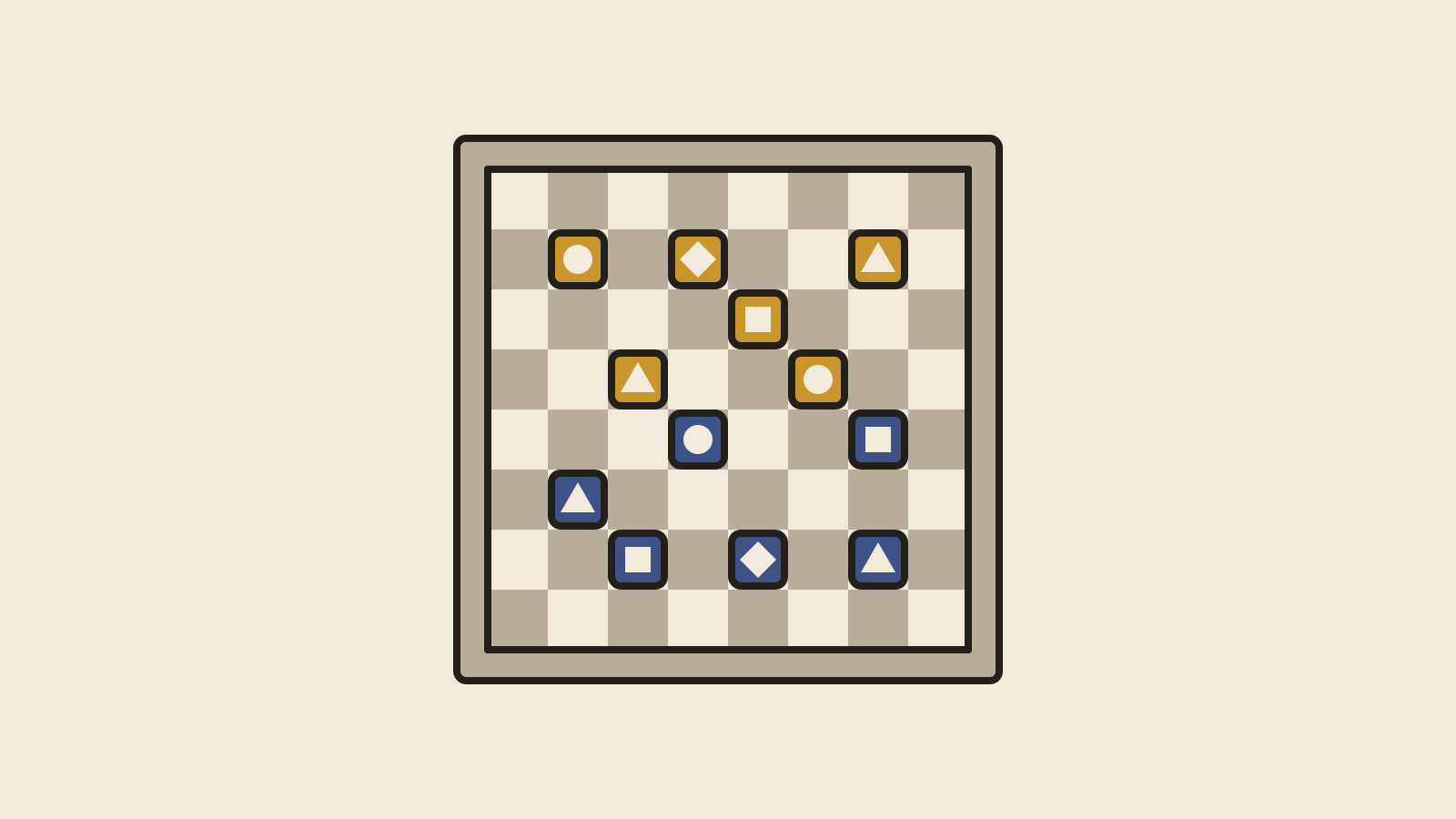
A chess program holds the board as a pattern of symbols in memory. It generates further patterns for the moves it might make, compares them and picks one. Allen Newell and Herbert Simon claimed in 1976 that this is what intelligence is, in machines and in people alike. Their hypothesis says that a physical symbol system "has the necessary and sufficient means for general intelligent action".
Herbert Simon
An American social scientist who argued that real decision-makers aim for good enough within limits, and who helped found artificial intelligence.
A symbol here is a physical pattern, such as a charge in a chip or a mark on paper, that can be combined with others into structures and that points to something else. A symbol system is a machine that builds, copies, alters and acts on such structures. Necessary means that anything intelligent, a human brain included, will turn out on inspection to be such a system. Sufficient means that any such system, made large enough and organised well, can be intelligent. The authors offered this as a scientific bet, open to refutation.
Diagram
The hypothesis makes two claims, one about all minds and one about machines
Read as text
The claim that symbol systems have the means for general intelligence, split into two halves. On the left, necessary: every intelligent system is a symbol system, brains included. On the right, sufficient: any symbol system of adequate size can be made intelligent, computers included.
Key features
- Symbols are physical, patterns in some material that a machine can detect, store and rearrange.
- Symbols designate, so that a structure can stand for an object or for a process the system can then carry out.
- Intelligence works by heuristic search: the system generates candidate solutions and uses rules of thumb to choose which to pursue.
Heuristic
A simple rule for judging or deciding that uses only part of the information, trading thoroughness for speed.
- The claim is empirical, a hypothesis that the record of artificial intelligence and psychology can support or sink.
- The material does not matter, so brains and digital computers count as two instances of one kind of system.
Not to be confused with
| Look-alike | The difference | Differs on |
|---|---|---|
| Computational theory of mind | The computational theory is a claim about what human mental states and processes are. The hypothesis concerns intelligence wherever it occurs, and adds that symbol processing is enough to produce it in a machine. | Differs onScope |
| Connectionism | The hypothesis puts intelligence in explicit symbol structures and rules for searching them. Connectionism puts it in the connection strengths of a trained network, where no single unit need stand for anything. | Differs onMechanism |
| Symbol grounding problem | Stevan Harnad's problem asks how the symbols in such a system come to mean anything to the system itself. It is an objection the hypothesis must answer and offers no rival account of intelligence. | Differs onClaim |
| Church–Turing thesis | The thesis says which functions can be computed at all, those a Turing machine can compute. It is silent on whether computing them amounts to intelligence. Newell and Simon's hypothesis is a claim about exactly that. | Differs onClaim |
- Differs onScope
The computational theory is a claim about what human mental states and processes are. The hypothesis concerns intelligence wherever it occurs, and adds that symbol processing is enough to produce it in a machine.
- Differs onMechanism
The hypothesis puts intelligence in explicit symbol structures and rules for searching them. Connectionism puts it in the connection strengths of a trained network, where no single unit need stand for anything.
- Differs onClaim
Symbol grounding problem
Stevan Harnad's problem asks how the symbols in such a system come to mean anything to the system itself. It is an objection the hypothesis must answer and offers no rival account of intelligence.
- Differs onClaim
Church–Turing thesis
The thesis says which functions can be computed at all, those a Turing machine can compute. It is silent on whether computing them amounts to intelligence. Newell and Simon's hypothesis is a claim about exactly that.
Origins and development
Newell and Simon stated the hypothesis in their 1975 Turing Award lecture, published the following year. It summed up twenty years of their own work, beginning with the Logic Theorist of 1956, a program that proved theorems in logic, and the General Problem Solver that followed. The idea guided what was later called symbolic artificial intelligence, including expert systems and the Soar cognitive architecture. From the mid-1980s neural networks offered another route, and since 2012 they have produced most of the field's successes.
Cognitive architecture
The branch that tries to specify one fixed design for the whole mind, built as a running program whose parts must work together.
Why it matters
The hypothesis is the clearest statement of the bet behind the first thirty years of artificial intelligence, and the reason early researchers expected thinking machines within a generation. It also frames a live question about present systems. Language models are trained networks with no hand-written symbol structures, yet they handle words, which are symbols. Whether adding explicit symbolic reasoning would make them more reliable is now an engineering dispute with money riding on it.
Critiques and limits
Hubert Dreyfus argued in 1972 that expertise rests on bodily skill and a feel for context that cannot be spelt out as symbols and rules. John Searle's Chinese room targets sufficiency: a system can process symbols and understand nothing. Rodney Brooks built robots that coped with real rooms using no central symbolic model. The hypothesis is contested. Symbol systems excel at logic and planning, but learning networks now perform many intelligent tasks, which strains the necessity claim. Gary Marcus replies that such networks still fail where structured symbols are needed.
Chinese room
A thought experiment arguing that a computer running a program can produce fluent answers without understanding a word of them.
Connections
Belongs to
It is the branch's boldest empirical claim and the charter of symbolic artificial intelligence.
Originated by
Herbert SimonEconomics
Simon and Allen Newell stated it in their 1975 Turing Award lecture, summing up two decades of their program-building.
Influenced by
Turing's universal machine showed that one device can manipulate any symbols by rule, the capacity the hypothesis equates with intelligence.
Bounded rationalityEconomics
Heuristic search turns bounded rationality into a method, since a limited system looks only where rules of thumb point.
Contrasts with
Differs on mechanism. The hypothesis puts intelligence in explicit symbol structures, where connectionism puts it in the connection strengths of a trained network.
Differs on scope. The theory says what human mental processes are, while the hypothesis says what any intelligence, natural or artificial, requires.
Applied in
Cognitive psychologyPsychology
Newell and Simon's studies of problem solving modelled people as symbol systems searching a space of possible moves.
Influenced
Soar was built as a direct test of the hypothesis that a symbol system suffices for general intelligence.
Critiqued by
Chinese roomPhilosophy
Searle's room manipulates symbols flawlessly yet understands nothing, so symbol manipulation cannot be sufficient for intelligence, as Newell and Simon held.
Cross with
Two distant entries to read beside this one, each with the question the pairing opens.
BureaucracySociology
A bureaucracy stores and transforms written symbols by rule: by Newell and Simon's hypothesis, does it have the means for general intelligence? Set them side by side
VerstehenSociology
If symbol manipulation suffices for intelligence, can a symbol system achieve verstehen, grasping what an action means to the person doing it? Set them side by side
Further reading
- Boden, M. A. (2006). Mind as machine: A history of cognitive science. Oxford University Press.
- Brooks, R. A. (1990). Elephants don't play chess. Robotics and Autonomous Systems, 6(1–2), 3–15. https://doi.org/10.1016/S0921-8890(05)80025-9
- Harnad, S. (1990). The symbol grounding problem. Physica D: Nonlinear Phenomena, 42(1–3), 335–346. https://doi.org/10.1016/0167-2789(90)90087-6
- Newell, A., & Simon, H. A. (1976). Computer science as empirical inquiry: Symbols and search. Communications of the ACM, 19(3), 113–126. https://doi.org/10.1145/360018.360022
Cite this entry
Scholia. (2026). Physical symbol system hypothesis. In Scholia: Notes in the margin of the human sciences. Retrieved November 28, 2026, from https://scholia.zennia.sg/ideas/physical-symbol-system-hypothesis