PersonCognitive science & linguisticsAlso in Philosophy
Alan Turing
The English mathematician who defined what computing is, helped break wartime Enigma ciphers and asked whether a machine could think.
Why they matter
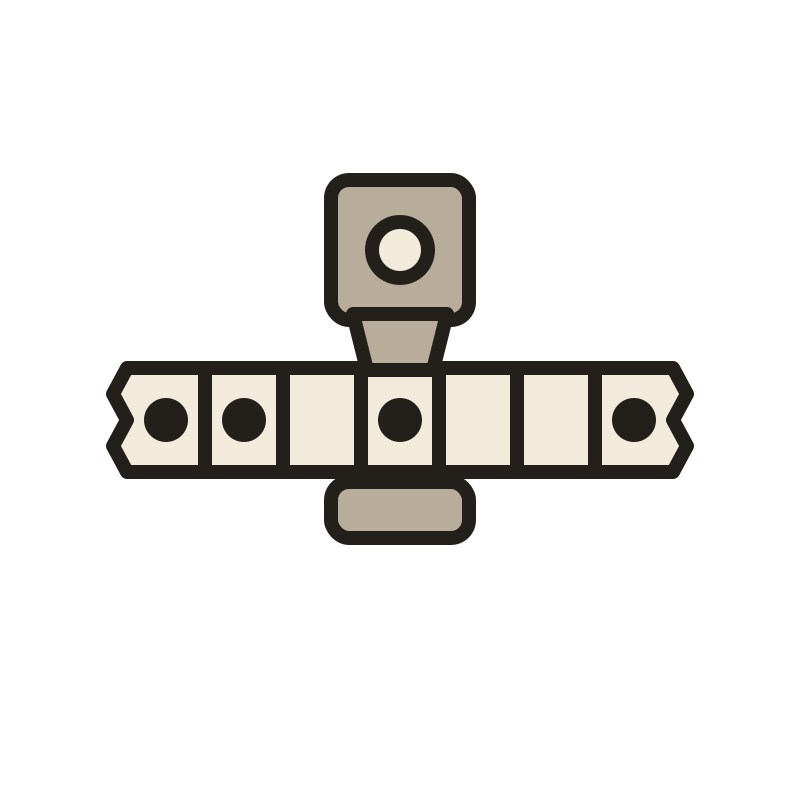
Alan Turing gave the word computation an exact meaning. In 1936, aged twenty-three, he described an imaginary machine that reads and writes symbols on a paper tape, one square at a time, following a fixed table of rules. He argued that anything a person could work out by following rules with pencil and paper, such a machine could work out too. He then showed that a single machine of this kind, given the right instructions, can imitate every other one.
That is the idea behind every phone and laptop. A phone is a calculator, a camera and a map because one general machine runs different programs, and nobody rebuilds it for each job. Turing also proved that some well-defined problems lie beyond any such machine. In 1950 he turned to the mind and asked whether a machine that computes could be said to think. Cognitive science has argued over his answer ever since.
Key ideas
- The Turing machine: an abstract device of tape, symbols and rules that fixes what it means to compute something step by step.
- The universal machine: one machine can carry out any computation if the task is described to it as data, the principle behind the stored program.
- Uncomputability: some exact questions have no mechanical answer, a result later retold as the halting problem.
- The imitation game: the Turing test replaces the question of whether machines think with whether one can pass for a person in typed conversation.
Turing test
Turing's proposal that a machine which cannot be told apart from a person in written conversation should be credited with thinking.
- Morphogenesis: chemicals that react and spread at different rates could produce the spots, stripes and spirals of living things.
Not to be confused with
| Look-alike | The difference | Differs on |
|---|---|---|
| John von Neumann | Turing defined the universal machine as a piece of mathematics in 1936. Von Neumann's 1945 report set out a practical layout for an electronic stored-program computer, still called the von Neumann architecture. Turing's own detailed design, the ACE, followed months later. | Differs onLevel |
| Kurt Gödel | Gödel proved in 1931 that any consistent formal system rich enough for arithmetic contains true statements it cannot prove. Turing showed that no mechanical procedure can sort the provable statements from the rest. | Differs onClaim |
| Alonzo Church | Church reached the same negative result a few months earlier in 1936, using a notation for functions called the lambda calculus. Turing's route through an imagined machine convinced logicians, Gödel among them, that computability had been captured. | Differs onMethod |
- Differs onLevel
John von Neumann
Turing defined the universal machine as a piece of mathematics in 1936. Von Neumann's 1945 report set out a practical layout for an electronic stored-program computer, still called the von Neumann architecture. Turing's own detailed design, the ACE, followed months later.
- Differs onClaim
Kurt Gödel
Gödel proved in 1931 that any consistent formal system rich enough for arithmetic contains true statements it cannot prove. Turing showed that no mechanical procedure can sort the provable statements from the rest.
- Differs onMethod
Alonzo Church
Church reached the same negative result a few months earlier in 1936, using a notation for functions called the lambda calculus. Turing's route through an imagined machine convinced logicians, Gödel among them, that computability had been captured.
Life and context
Turing was born in London in 1912 and read mathematics at King's College, Cambridge. His 1936 paper answered a question posed by the German mathematician David Hilbert: whether a mechanical method could decide, for any mathematical statement, if it can be proved. Turing showed there is none. After a doctorate at Princeton under Alonzo Church he joined the government codebreakers at Bletchley Park in 1939. There he led the section working on German naval Enigma messages and, building on Polish work, designed the Bombe, a machine that searched for each day's cipher settings. After the war he drew up plans for an electronic computer, then moved to Manchester to program one of the first that ran. In 1952 he was convicted of gross indecency for a relationship with a man and accepted hormone treatment in place of prison. He died of cyanide poisoning in 1954, and the inquest recorded suicide.
Life strip
- 1912 Born
- 1912 Born in Maida Vale, London
- 1931 Enters King's College to read mathematics, Cambridge
- 1936 Writes On Computable Numbers, Cambridge
- 1938 Completes his doctorate under Alonzo Church, Princeton
- 1939 Joins the codebreakers at Bletchley Park, Buckinghamshire
- 1945 Joins the National Physical Laboratory to design a computer, Teddington
- 1950 Publishes Computing Machinery and Intelligence, Manchester
- 1952 Convicted of gross indecency, Knutsford
- 1954 Dies of cyanide poisoning aged 41, Wilmslow
- 1954 Died
Legacy
Computer science treats the Turing machine as its basic model of what can and cannot be computed, and its highest honour is the Turing Award. The computational theory of mind borrows his definition to say what thinking might be. Each new chatbot revives the argument over his test. The British government apologised in 2009 for his treatment, a royal pardon followed in 2013 and his portrait has appeared on the Bank of England's £50 note since 2021.
Computational theory of mind
The mind is a computing system: thinking is the rule-governed processing of inner symbols that stand for things in the world.
Critiques and limits
John Searle's Chinese room holds that a machine could pass Turing's test by shuffling symbols it does not understand, so the test measures imitation and leaves thought untouched. Roger Penrose, following John Lucas, claims that Gödel's theorem shows human mathematical insight outruns any Turing machine. Turing had answered a version of that objection in 1950, and most logicians remain unpersuaded. John Ferris, the authorised historian of British signals intelligence, cautions that the codebreaking was a team effort. He judged in 2020 that it shortened the war by months, where others have said years.
Chinese room
A thought experiment arguing that a computer running a program can produce fluent answers without understanding a word of them.
Lineage
Influenced by



Connections
Belongs to
His definition of computation and his question about thinking machines are the two starting points of the branch.
LogicPhilosophy
His 1936 paper settled a central question of mathematical logic by showing that no mechanical method decides every statement.
Influenced by
Bertrand RussellPhilosophy
Russell's project of deriving mathematics from formal logic set up the question about mechanical proof that Turing answered.
Critiques
Mind–body dualismPhilosophy
His 1950 paper rejects the objection that thinking requires an immortal soul which no machine could have.
Originated
His 1936 definition of computation and his 1950 paper on machine intelligence gave the branch its founding ideas.
Turing proposed it in 1950 as the imitation game, to replace the vague question of whether machines can think.
Influenced
Daniel DennettPhilosophy
He took from Turing the idea that competence can be built from mindless mechanical steps, with no comprehension required.
Turing's machines showed him how a physical device can follow reasons while responding only to the shape of symbols.
Turing's 1936 definition of computation supplied the exact notion of rule-following that the theory applies to thought.
Functionalism (philosophy of mind)Philosophy
Putnam modelled mental states on the states of a Turing machine, which are defined by what they do with an input.
Physical symbol system hypothesis
Turing's universal machine showed that one device can manipulate any symbols by rule, the capacity the hypothesis equates with intelligence.
Critiqued by
Chinese roomPhilosophy
Searle's room would pass Turing's imitation game while understanding nothing, so passing it cannot show that a machine thinks.
Further reading
Read first
Turing, A. M. (1950). Computing machinery and intelligence. Mind, 59(236), 433–460. https://doi.org/10.1093/mind/LIX.236.433
- Hodges, A. (1983). Alan Turing: The enigma. Burnett Books.
- Turing, A. M. (1936). On computable numbers, with an application to the Entscheidungsproblem. Proceedings of the London Mathematical Society, s2-42(1), 230–265. https://doi.org/10.1112/plms/s2-42.1.230
Cite this entry
Scholia. (2026). Alan Turing. In Scholia: Notes in the margin of the human sciences. Retrieved November 28, 2026, from https://scholia.zennia.sg/people/alan-turing