IdeaPsychologyAlso in Sociology
Psychosocial stages
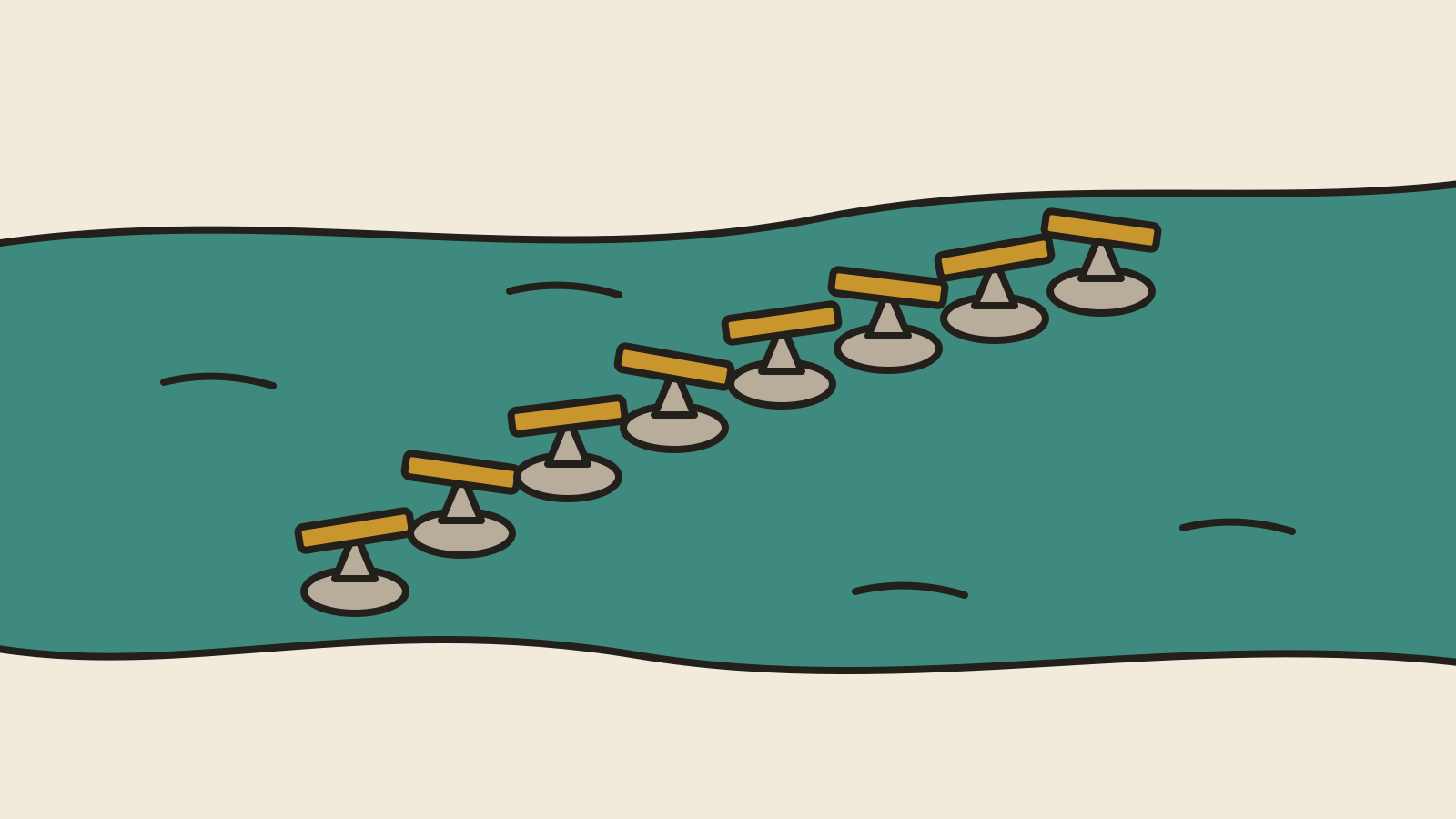
Erikson's claim that life unfolds in eight stages, each built around a conflict between the growing person and what society asks of them.
The idea
Erik Erikson claimed that a human life passes through eight stages in a fixed order, from birth to old age. Each stage sets a conflict between two pulls, such as trust and mistrust in the first year. The conflict arises because a growing body and mind meet new demands from other people. How it is settled leaves a lasting strength or a weak spot, and later stages build on earlier ones.
Take a fifteen-year-old who drops the piano, dyes her hair, joins a climbing club and falls out with her oldest friends, all in one term. Her parents see chaos. Erikson would see the work of the fifth stage, identity against role confusion. She is trying on possible selves to find one that fits and that others will recognise.
No stage is won outright. A healthy outcome is a favourable balance: enough trust to hope, with enough mistrust left to stay careful.
Diagram
Erikson gave each age of life its own conflict
Read as text
A timeline of eight stages of life, each with its conflict. In infancy, trust against mistrust. In early childhood, autonomy against shame and doubt. At the play age, initiative against guilt. At school age, industry against inferiority. In adolescence, identity against role confusion, which is emphasised. In young adulthood, intimacy against isolation. In adulthood, generativity against stagnation. In old age, integrity against despair.
Key features
- The eight conflicts run from trust against mistrust in infancy to integrity against despair in old age, with identity against role confusion at adolescence.
- Erikson called the order epigenetic: as with the organs of an embryo, each part has its own time to come to the fore.
- A conflict settled well leaves a strength he called a virtue, such as hope, competence, fidelity or care.
- A stage handled badly isn't lost for good, because its conflict can be reopened and reworked later.
- Society meets each stage with an institution, as schools meet the child's need to feel capable.
Not to be confused with
| Look-alike | The difference | Differs on |
|---|---|---|
| Psychosexual stages | Freud's stages follow the body's shifting sources of pleasure and are largely over by adolescence. Erikson's are set by what other people and institutions ask of a person, and they run to old age. | Differs onMechanism |
| Stages of cognitive development | Piaget's four stages chart how a child's reasoning matures and end in adolescence. Erikson's cover emotional and social life across the whole lifespan and say nothing about logic. | Differs onScope |
| Stages of moral development | Kohlberg's stages track one thing, how people justify moral decisions, and few adults reach the top. Erikson's describe conflicts that everyone meets simply by growing older. | Differs onScope |
| Rites of passage | A rite of passage is a ceremony by which a group moves a person into a new status. Erikson's stages are conflicts within the person, whether or not any ceremony marks them. | Differs onUnit of analysis |
- Differs onMechanism
Freud's stages follow the body's shifting sources of pleasure and are largely over by adolescence. Erikson's are set by what other people and institutions ask of a person, and they run to old age.
- Differs onScope
Stages of cognitive development
Piaget's four stages chart how a child's reasoning matures and end in adolescence. Erikson's cover emotional and social life across the whole lifespan and say nothing about logic.
- Differs onScope
Kohlberg's stages track one thing, how people justify moral decisions, and few adults reach the top. Erikson's describe conflicts that everyone meets simply by growing older.
- Differs onUnit of analysis
A rite of passage is a ceremony by which a group moves a person into a new status. Erikson's stages are conflicts within the person, whether or not any ceremony marks them.
Origins and development
Erikson trained as a child analyst in Anna Freud's Vienna circle and emigrated to the United States in 1933. Fieldwork among the Sioux and the Yurok showed him how differently societies handle the same ages. He set out the eight stages in Childhood and Society (1950), having worked them out with his wife Joan for a White House conference on children that year. In 1966 James Marcia turned the identity stage into four statuses that can be assessed by interview. Joan Erikson proposed a ninth stage, for extreme old age, in 1997.
Anna Freud
Freud's youngest daughter, who helped found child psychoanalysis and mapped the defences the ego uses to protect itself.
Why it matters
The phrase "identity crisis" comes from this theory. So does the habit of seeing midlife and old age as stages with tasks of their own, since most earlier theories of development stopped at adolescence. Social workers, nurses and counsellors still learn the stages as a first map of what a client of a given age may face. A gap year spent trying things out is what Erikson called a psychosocial moratorium.
Critiques and limits
Carol Gilligan argued in 1982 that the sequence describes men. Erikson put identity before intimacy, and she found that for many women the two develop together. The evidence is mixed. Studies by Marcia and by Dan McAdams support the importance of identity and of generativity, the adult concern for the next generation. The strict order of eight stages has little support, and societies time work and marriage too differently for one timetable to fit them all.
Carol Gilligan
The American psychologist who argued that moral theory had ignored a voice of care and relationship, one she heard most often from women.
In education and policy
Erikson gave schools a central part. Between about six and twelve the conflict is industry against inferiority: children need to find that they can make and do things well. A pupil who meets only failure may carry a sense of inferiority forward. Teachers of adolescents use the fifth stage to explain why pupils test roles and challenge rules, and why they need time to explore before a course or career is fixed.
Connections
Belongs to
It gave the field its first widely used map of development across the whole of life.
Originated by
Erikson set out the eight stages in Childhood and Society in 1950, having worked them out with his wife Joan.
Extends
Erikson kept Freud's five stages, recast each as a social conflict and added three more for adult life.
Contrasts with
Differs on mechanism. Freud's stages follow the body's shifting sources of pleasure, while Erikson's follow the demands of other people and institutions.
Stages of cognitive development
Differs on scope. Piaget charted how reasoning matures up to adolescence, where Erikson charted emotional and social conflicts across the whole of life.
Differs on scope. Kohlberg's stages track moral reasoning alone, where Erikson's cover the conflicts everyone meets simply by growing older.
Rites of passageAnthropology
Differs on unit of analysis. A rite of passage is a ceremony a group stages, where an Erikson stage is a conflict inside the person.
Further reading
- Erikson, E. H. (1950). Childhood and society. W. W. Norton.
- Erikson, E. H. (1968). Identity: Youth and crisis. W. W. Norton.
- Gilligan, C. (1982). In a different voice: Psychological theory and women's development. Harvard University Press.
- Marcia, J. E. (1966). Development and validation of ego-identity status. Journal of Personality and Social Psychology, 3(5), 551–558. https://doi.org/10.1037/h0023281
Cite this entry
Scholia. (2026). Psychosocial stages. In Scholia: Notes in the margin of the human sciences. Retrieved November 28, 2026, from https://scholia.zennia.sg/ideas/psychosocial-stages