IdeaEconomics
Say's law
The claim that producing goods generates the income to buy them, so an economy cannot suffer a lasting glut of everything.
The idea
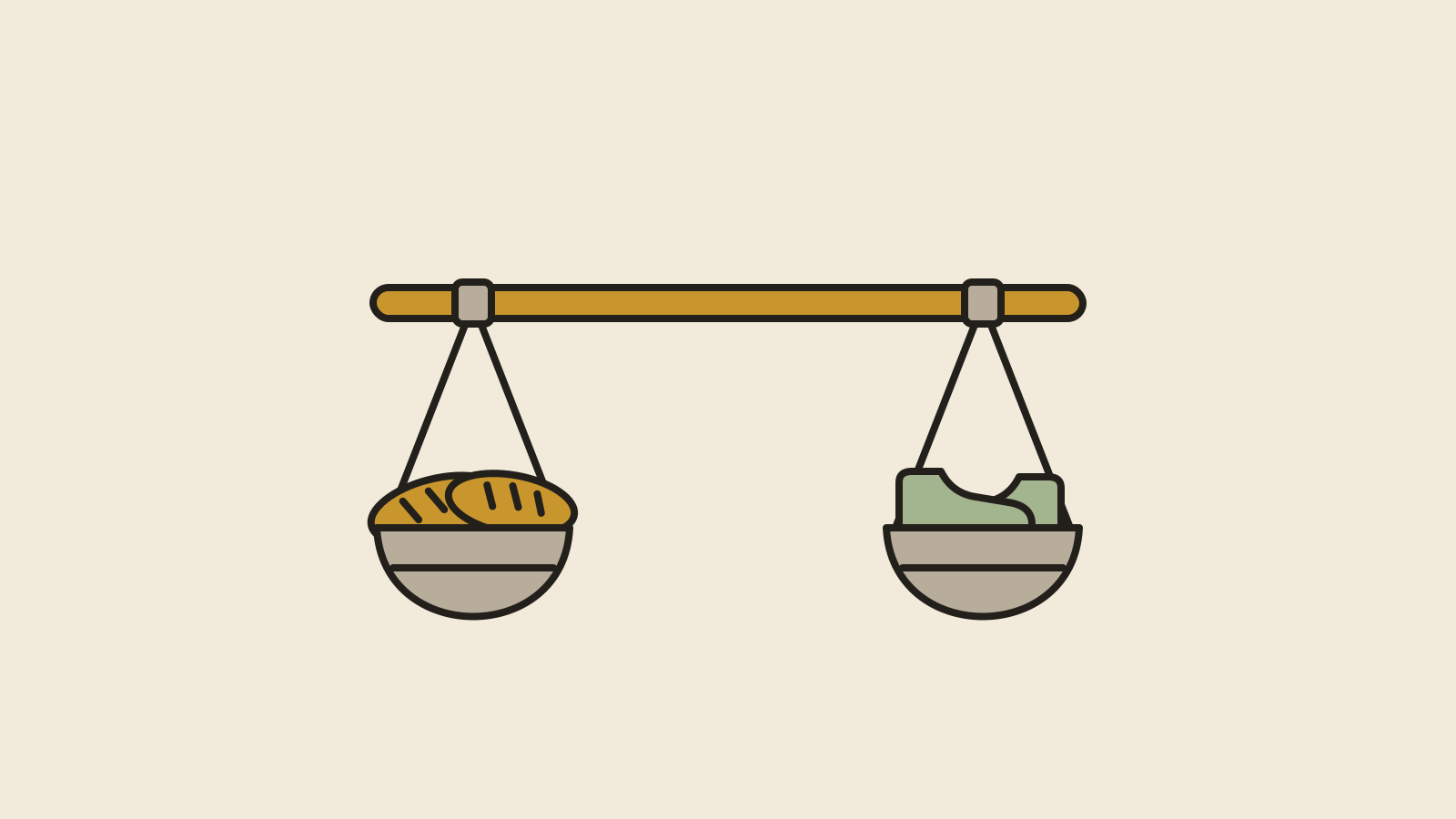
Say's law holds that production is the source of demand. People make and sell things in order to buy other things, so supplying goods to the market generates the income needed to purchase goods of equal value. It follows that an economy cannot suffer a general glut, a lasting excess of everything at once. Too many shoes may be made and too few hats, but that is a mismatch between industries, which prices and profits will correct.
Take a baker who sells 200 dollars of bread in a day. She does not want the coins for themselves. She wants flour, a roof over the shop, shoes for her children and perhaps some savings, which her bank lends to a carpenter who is building a workshop. Her bread has become 200 dollars of demand for other people's products. Money, on this view, is only a vehicle that carries one product to another.
Diagram
In Say's law, production generates the income that buys the output
Read as text
Four steps in a chain, with the third emphasised. First, goods are produced. Second, producing and selling them pays out incomes of equal value as wages, rents and profits. Third, that income is either spent on goods or saved and lent to someone who spends it. Fourth, other goods therefore find buyers, and no general glut can last. The emphasised third step is the one critics dispute, because income can also be held as money.
Key features
- For the economy as a whole, supply and demand are two sides of the same transactions, so total demand cannot fall short of total supply for long.
- A glut of particular goods is possible and signals that too little of something else was made.
- Money is a means of exchange that people normally pass on, with little reason to hoard it.
- Saving is not lost spending, because the interest rate channels it into investment.
- The cure for a slump is to free production, never to stimulate consumption.
Not to be confused with
| Look-alike | The difference | Differs on |
|---|---|---|
| Supply and demand | Supply and demand explains the price of one good in one market, where the two forces are separate. Say's law concerns the whole economy, where it claims the two cannot come apart. | Differs onLevel |
| Laissez-faire | Say's law describes how markets are supposed to behave. Laissez-faire is a rule for governments: leave them alone. The law is often used to support the rule, yet a reader could accept one without the other. | Differs onDescriptive or normative |
| Keynesian multiplier | The two run in opposite directions. Under Say's law production generates the spending that buys it. Under the multiplier spending decides how much is produced, and a fall in spending shrinks output. | Differs onClaim |
| Supply-side economics | Say's law says a general glut cannot last. Supply-side economics, a policy movement of the 1970s and 1980s, says that lower tax rates raise output. It borrows Say's emphasis on production and adds a claim about taxes that he never made. | Differs onClaim |
- Differs onLevel
Supply and demand explains the price of one good in one market, where the two forces are separate. Say's law concerns the whole economy, where it claims the two cannot come apart.
- Differs onDescriptive or normative
Say's law describes how markets are supposed to behave. Laissez-faire is a rule for governments: leave them alone. The law is often used to support the rule, yet a reader could accept one without the other.
- Differs onClaim
The two run in opposite directions. Under Say's law production generates the spending that buys it. Under the multiplier spending decides how much is produced, and a fall in spending shrinks output.
- Differs onClaim
Supply-side economics
Say's law says a general glut cannot last. Supply-side economics, a policy movement of the 1970s and 1980s, says that lower tax rates raise output. It borrows Say's emphasis on production and adds a claim about taxes that he never made.
Origins and development
Jean-Baptiste Say, a French economist and cotton manufacturer, set out the argument in his Traité d'économie politique (1803) and sharpened it in later editions. James Mill stated it more bluntly in 1808. David Ricardo defended it against Thomas Malthus, who thought the slump after 1815 showed a general glut. The name came about a century later from the American economist Fred Taylor. The slogan "supply creates its own demand" is Keynes's summary from 1936, written in order to reject it. Say never used those words.
David Ricardo
A London stockbroker turned economist who gave classical economics its rigour and explained why trade benefits even a country that is worse at everything.
Thomas Malthus
The English clergyman and economist who argued that population tends to outgrow the food supply, keeping most people poor.
Why it matters
The law marks the dividing line between two views of recessions. If it holds, slumps come from something blocking production, and the cure lies in freer markets, lower costs and patience. If it fails, spending itself can be deficient and governments can help by spending more. Debates over stimulus, austerity and tax cuts replay this disagreement, usually without naming it.
Critiques and limits
John Maynard Keynes argued that people may hold money instead of spending or lending it when the future looks uncertain, and then total demand does fall short. Malthus and Karl Marx had made related objections. Defenders such as William Hutt and Steven Kates reply that Keynes attacked a caricature, since Say and Mill discussed crises and the hoarding of money. Most economists now accept the law as a long-run tendency and reject it for the short run. How long the short run lasts is still contested.
John Maynard Keynes
The British economist who argued that economies can get stuck in mass unemployment and that governments should spend to pull them out.
Karl Marx
The German thinker who argued that the way a society produces its living shapes its classes, its conflicts and its ideas.
Connections
Belongs to
Ricardo and the Mills made it a fixed point of classical doctrine, used to rule out general overproduction.
Whether total demand can fall short of total supply is the question the field was founded to settle.
Influenced by
Say built on Smith's view that saving is spent on investment and so does not reduce total spending.
Contrasts with
Differs on claim. Say's law has production generating spending, and the multiplier has spending deciding how much is produced.
Differs on level. Supply and demand prices one good in one market, while Say's law is a claim about the economy's totals.
Differs on descriptive or normative. Say's law describes how markets clear, and laissez-faire is the policy rule often drawn from it.
Critiqued by
He denied that producing goods guarantees the spending needed to buy them, since income can be held as idle money.
Karl MarxSociology
Marx argued that money separates selling from buying, so sellers can hold cash and a general glut becomes possible.
He argued against Say and Ricardo that a general glut is possible when people save too much and spend too little.
Keynes denied that production generates enough spending to buy it, since income can be held as idle money.
Marx denied that supply creates its own demand, since money lets sellers hold back from buying.
Cross with
Two distant entries to read beside this one, each with the question the pairing opens.
Analytic–synthetic distinctionPhilosophy
Is Say's law true by the meaning of income and output, or a claim about the world that a slump could refute? Set them side by side
ReciprocityAnthropology
If everything received must be answered in kind, can an economy of gifts suffer a general glut, or only unpaid debts? Set them side by side
Further reading
- Baumol, W. J. (1999). Retrospectives: Say's law. Journal of Economic Perspectives, 13(1), 195–204. https://doi.org/10.1257/jep.13.1.195
- Keynes, J. M. (1936). The general theory of employment, interest and money. Macmillan.
- Say, J.-B. (1803). Traité d'économie politique. Deterville.
- Sowell, T. (1972). Say's law: An historical analysis. Princeton University Press.
Cite this entry
Scholia. (2026). Say's law. In Scholia: Notes in the margin of the human sciences. Retrieved November 28, 2026, from https://scholia.zennia.sg/ideas/says-law
This topic is contested. The entry sets out the main positions rather than settling them.