School or branchEconomicsAlso in Sociology, Political theory & science, Philosophy
Marxian economics
The school of economics, founded on Marx's Capital, that explains profit, growth and crisis through the relation between owners and wage workers.
Overview
Marxian economics analyses capitalism as a system with a history, a characteristic conflict and built-in tendencies to crisis. Its founding text is Capital by Karl Marx, whose first volume appeared in 1867. Most economics begins with individuals trading goods. This school begins with production and asks who owns the equipment, who does the work and who keeps what is left over.
Karl Marx
The German thinker who argued that the way a society produces its living shapes its classes, its conflicts and its ideas.
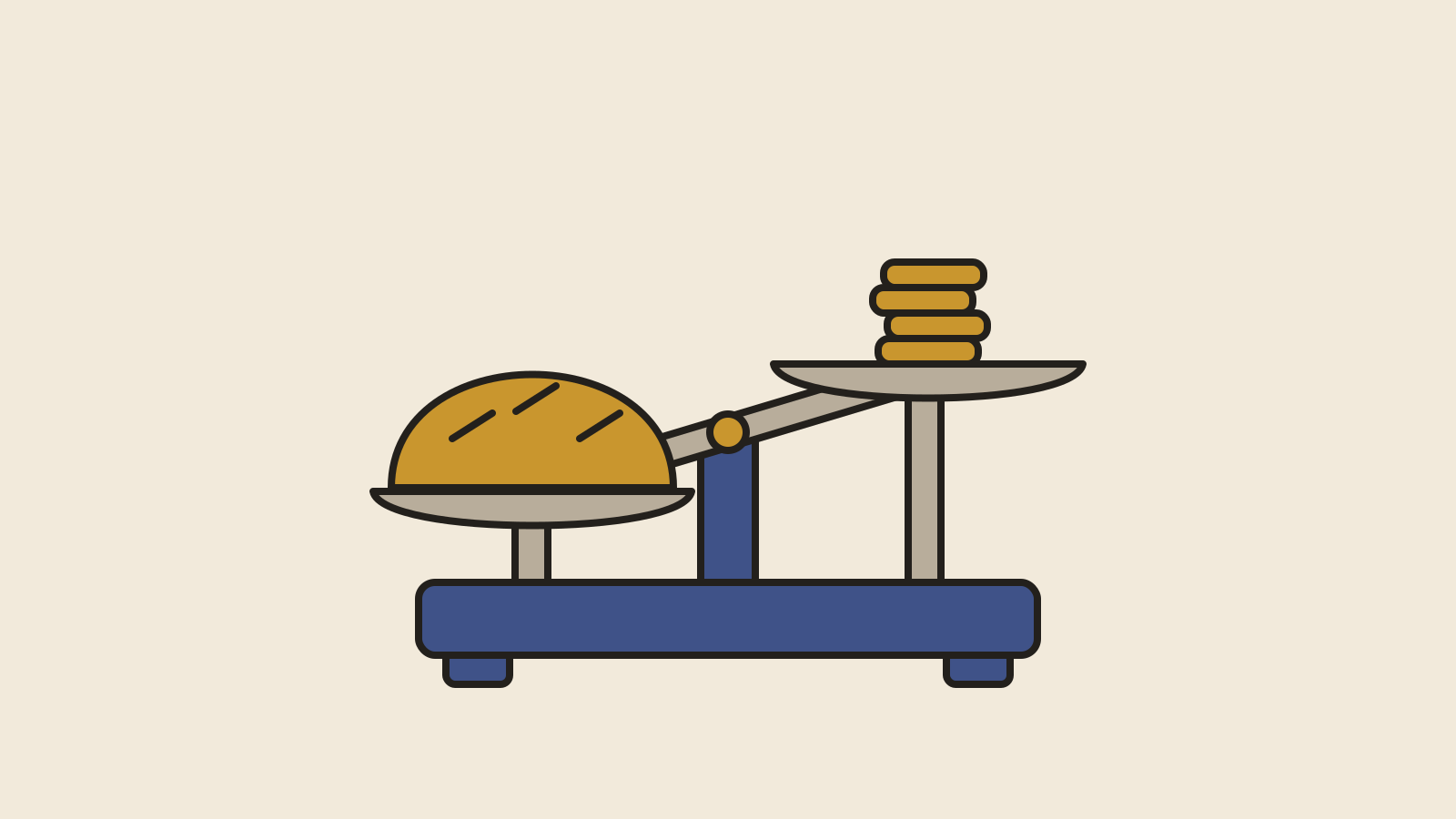
A bakery shows the central argument. Suppose a baker's day of work adds 200 dollars of value to the flour, and the wage for that day is 80. The remaining 120 goes to the owner. Marx called this gap surplus value and held that it is the source of profit across the whole economy. The worker agrees freely, he argued, only because someone who owns no bakery has to work for someone who does.
From there the school studies why firms must keep growing, why machines replace workers and why booms end in slumps.
Diagram
Capital is money advanced in order to return as more money
Read as text
A cycle of five stages around the words surplus value. An owner advances money. The money buys labour power and materials. In production the workers add more value than their wages cost. The goods that result are worth more than the money advanced. They are sold for more money, and the larger sum is advanced again. The surplus value created in production is what makes the sum grow on each turn.
Core commitments
- The value of commodities rests on the labour needed to produce them, the labour theory of value taken over from Ricardo.
Labour theory of value
The claim that a good's value in exchange comes from the labour needed to produce it.
- Profit originates in surplus value, the difference between the value workers create and the wages they receive.
- Competition forces every firm to reinvest and mechanise, so capital accumulates and concentrates in fewer hands.
- Crises arise from the system's own workings, since nothing guarantees that everything produced can be sold at a profit.
- Capital and wage labour belong to one historical period and will not last for ever.
Not to be confused with
| Look-alike | The difference | Differs on |
|---|---|---|
| Marxism | Marxism is the whole tradition: a theory of history, a politics and a movement. Marxian economics is its economic analysis, and people who reject the politics can still study or use it. | Differs onScope |
| Classical economics | Marx kept the labour theory of value that Smith and Ricardo had used. He rejected their view that capitalism is the natural form of economic life, and argued that profit comes from exploitation and that the system will pass. | Differs onClaim |
| Socialism | Marxian economics is an analysis of how capitalism works. Capital says almost nothing about how a planned economy should run. Socialism is the programme, and its economics was mostly worked out by others. | Differs onDescriptive or normative |
- Differs onScope
Marxism is the whole tradition: a theory of history, a politics and a movement. Marxian economics is its economic analysis, and people who reject the politics can still study or use it.
- Differs onClaim
Marx kept the labour theory of value that Smith and Ricardo had used. He rejected their view that capitalism is the natural form of economic life, and argued that profit comes from exploitation and that the system will pass.
- Differs onDescriptive or normative
Marxian economics is an analysis of how capitalism works. Capital says almost nothing about how a planned economy should run. Socialism is the programme, and its economics was mostly worked out by others.
Origins and development
Marx built on David Ricardo and worked on Capital for two decades in the British Museum. Engels published its second and third volumes in 1885 and 1894. Rudolf Hilferding and Rosa Luxemburg extended the analysis to finance and empire before 1914. By then mainstream economics had adopted marginal utility and set the labour theory aside. Paul Sweezy restated the theory for English readers in 1942. The school continues as a heterodox current, meaning one outside the mainstream. It drew fresh interest after the financial crisis of 2008.
David Ricardo
A London stockbroker turned economist who gave classical economics its rigour and explained why trade benefits even a country that is worse at everything.
Why it matters
Talk of exploitation, the reserve army of the unemployed and the concentration of capital comes from this school. Economists who reject its value theory still credit Marx with early insight into business cycles, technological unemployment and the growth of giant firms. Joseph Schumpeter wrote his account of creative destruction in open dialogue with him. Studies of globalisation and inequality, including world-systems theory, draw on its framework.
Joseph Schumpeter
An Austrian-born economist who saw capitalism as a restless process in which innovation keeps destroying old firms and industries to build new ones.
Creative destruction
Economic growth comes from new products and methods that keep driving out old ones, so progress and loss arrive together.
Critiques and limits
Eugen von Böhm-Bawerk argued in 1896 that Marx's labour values cannot be reconciled with the market prices described in his own third volume. This is known as the transformation problem. Paul Samuelson concluded in 1971 that the value calculations are an unnecessary detour, since prices and profits can be derived without them. Nobuo Okishio showed in 1961 that cost-cutting technical change raises the profit rate if real wages stay fixed, against Marx's law of a falling rate. Marxian economists dispute each result, and the debate continues.
Key figures
- Karl Marx1818–1883
- Friedrich Engels
- Rudolf Hilferding
- Rosa Luxemburg
- Paul Sweezy
- Nobuo Okishio
- Ernest Mandel
- Anwar Shaikh

Connections
Originated by
Karl MarxSociology
Marx founded the school with Capital, his analysis of how capitalist production creates and distributes value.
Extends
Marx turned the classical value theory into an account of profit as unpaid labour time.
Influenced by
Ricardo's analysis of value and of the division of income between classes was Marx's point of departure.
Critiques
Marx denied that supply creates its own demand, since money lets sellers hold back from buying.
Contrasts with
Differs on claim. Both use a labour theory of value, but Marx concluded that profit is unpaid labour and capitalism temporary.
MarxismPolitical theory & science
Differs on scope. Marxian economics is the economic analysis alone, while Marxism adds a philosophy of history and a politics.
SocialismPolitical theory & science
Differs on descriptive or normative. Marxian economics analyses how capitalism works, while socialism is a programme for how an economy should be owned.
Contains
He reworked Marx's theory of value for a world economy in which wages differ far more than productivity.
Critiqued by
Samuelson argued in 1971 that Marx's labour values are an unnecessary detour on the way to prices and profits.
Böhm-Bawerk's 1896 critique held that Marx's labour theory of value contradicts his own account of prices.
It rejects Marx's materialism and collective ownership while sharing his objection to income earned without work or risk.
Mises aimed at Marxist plans to replace money prices with accounts kept in labour hours or physical quantities.
Applications
Historical materialismSociology
Marxian economists treat capitalism as one historically specific mode of production with a beginning and an end.
Cross with
Two distant entries to read beside this one, each with the question the pairing opens.
PsychoanalysisPsychology
Marxian economics and psychoanalysis both explain surface behaviour by a hidden conflict, so what evidence could each accept that the hidden layer is absent? Set them side by side
Cultural materialismAnthropology
Harris explained customs by the practical problems of subsistence, so what does Marxian economics add by insisting on the relation between owners and workers? Set them side by side
Further reading
- Harvey, D. (2010). A companion to Marx's Capital. Verso.
- Marx, K. (1976). Capital: A critique of political economy (Vol. 1). Penguin Books. (Original work published 1867)
- Samuelson, P. A. (1971). Understanding the Marxian notion of exploitation: A summary of the so-called transformation problem between Marxian values and competitive prices. Journal of Economic Literature, 9(2), 399–431.
- Sweezy, P. M. (1942). The theory of capitalist development: Principles of Marxian political economy. Oxford University Press.
Cite this entry
Scholia. (2026). Marxian economics. In Scholia: Notes in the margin of the human sciences. Retrieved November 28, 2026, from https://scholia.zennia.sg/schools/marxian-economics
This topic is contested. The entry sets out the main positions rather than settling them.