IdeaPhilosophyAlso in Cognitive science & linguistics
Sorites paradox
No single grain of rice turns a non-heap into a heap, yet enough grains plainly make one, so vague words seem to defy logic.
The idea
Start with a single grain of rice, which is certainly not a heap. Add one grain, and you still do not have a heap, since a single grain cannot make that difference. Keep going, one grain at a time. Each step seems perfectly safe, yet after a million grains you are plainly looking at a heap. Somewhere along the way the word changed from false to true, and yet no single step seems to be the one that did it.
The name comes from the Greek soros, meaning a heap, and the same chain of reasoning works for any vague word. A man with a full head of hair is not bald, and losing one hair never makes a man bald, yet men do go bald. Two premises that look obviously true, combined with ordinary logic, lead to a conclusion that is plainly false. Something has to give, and philosophers still disagree about which assumption should be abandoned.
Diagram
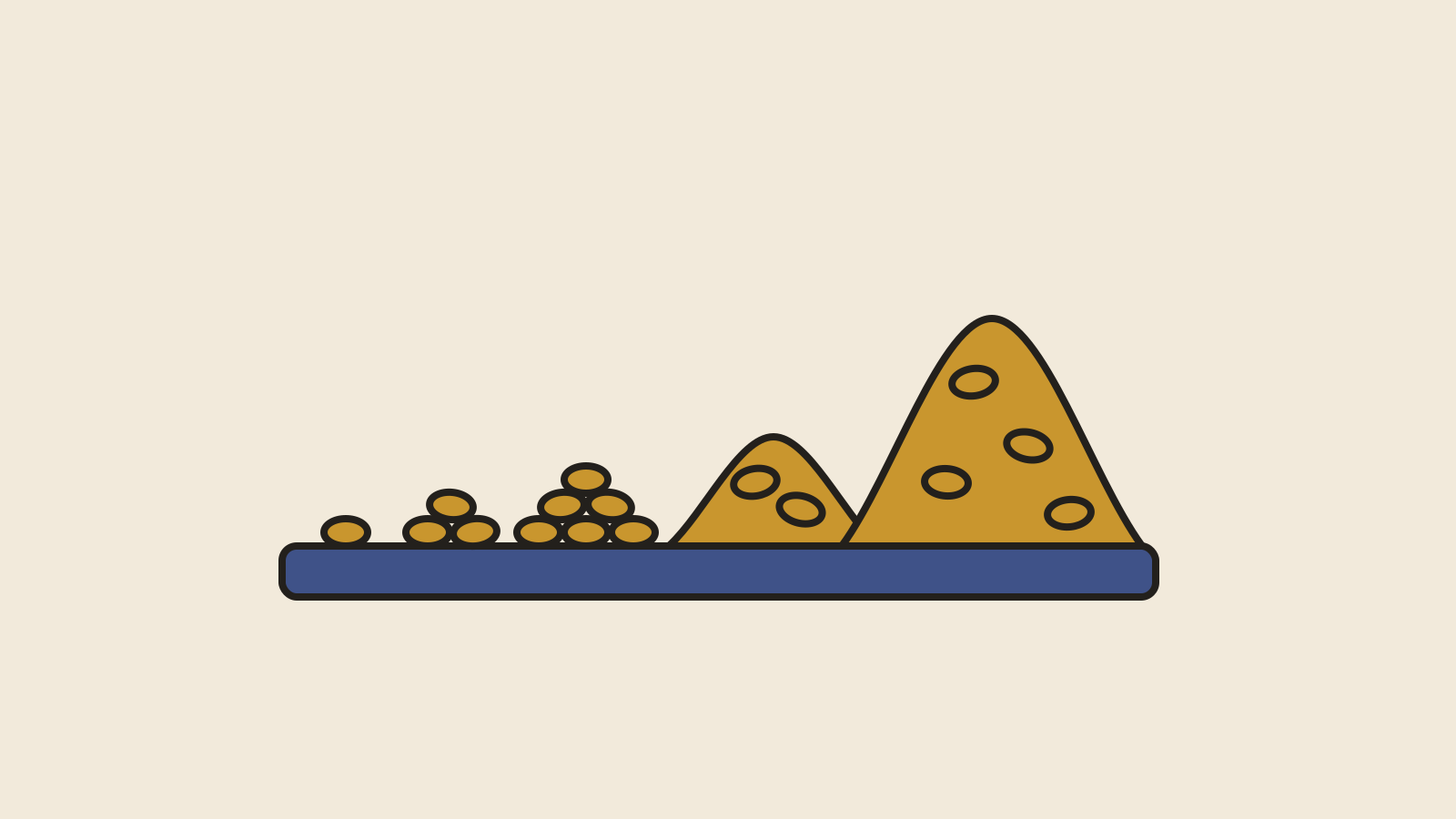
No single grain marks where a heap begins
Read as text
A line runs from one grain of rice on the left to a million grains on the right. Near the left end the pile is clearly not a heap. Near the right end it clearly is a heap. In the middle lies a region of borderline cases, where neither answer seems right, and no single grain along the line marks the change.
Key features
- The paradox relies on a principle of tolerance: a change too small to notice cannot change whether a vague word applies.
- Vague words have borderline cases, such as a pile of a few dozen grains, where neither yes nor no seems correct.
- The borderline region is itself blurred, so no sharp line marks where the clear cases stop and the doubtful ones begin.
- It threatens the classical rule of logic that every statement is either true or false, with nothing in between.
Not to be confused with
| Look-alike | The difference | Differs on |
|---|---|---|
| Liar paradox | The sorites builds its contradiction from many small steps applied to a vague word. The liar needs no vagueness at all: one sentence that speaks of its own falsity is enough. | Differs onMechanism |
| Fallacy | A slippery slope argument, often listed as a fallacy, has a weak link one can name. In the sorites every single step looks sound, which is what makes it a paradox. | Differs onClaim |
| Zeno's paradoxes | Zeno's puzzles also run through many small steps, but they turn on dividing space and time without end. The sorites turns on how far a vague word can stretch. | Differs onMechanism |
- Differs onMechanism
The sorites builds its contradiction from many small steps applied to a vague word. The liar needs no vagueness at all: one sentence that speaks of its own falsity is enough.
- Differs onClaim
A slippery slope argument, often listed as a fallacy, has a weak link one can name. In the sorites every single step looks sound, which is what makes it a paradox.
- Differs onMechanism
Zeno's puzzles also run through many small steps, but they turn on dividing space and time without end. The sorites turns on how far a vague word can stretch.
Origins and development
Ancient sources credit Eubulides of Miletus, of the Megarian school, with the heap and the bald man in the fourth century BCE. The Stoic Chrysippus answered by falling silent before the borderline cases. Philosophical interest revived in the 1970s, when logicians looked again at vague language. Kit Fine proposed in 1975 that a vague sentence is true if it comes out true on every acceptable way of drawing a sharp line. Timothy Williamson argued in 1994 that there is a sharp line, which we cannot know.
Why it matters
Laws, medicine and everyday rules are full of vague words such as adult, poor, obese and reasonable. Any sharp threshold, such as a voting age or an income cut-off, puts two nearly identical cases on different sides. The sorites explains why such lines feel arbitrary and still seem necessary.
Critiques and limits
Every proposed answer costs something. Williamson's view saves classical logic but asks us to believe that one grain or one hair really does make the difference. Rosanna Keefe, among others, finds that hard to accept. Degree theories, which let a statement be true to a degree, face the charge of false precision, since a borderline heap would need an exact degree of truth. The paradox is a matter of logic, and no solution has won general agreement.
In education and policy
Policy has to turn vague ideas into sharp rules: an age when a person may vote, a blood alcohol limit for drivers, an income line for benefits. The sorites does not make such lines wrong. It does show that a case just over the line differs very little from one just under it, so the line needs a reason beyond the word itself. Appeals, discretion and sliding scales are ways institutions soften that edge.
Connections
Belongs to
The sorites asks whether classical logic, with every statement true or false, can survive vague words.
It is the classic puzzle about vagueness, the blurred edges of ordinary words such as heap, bald and tall.
Contrasts with
Differs on mechanism. The liar's contradiction comes from a sentence turning back on itself, the sorites' from small steps applied to a vague word.
Differs on claim. A slippery slope fallacy has a step one can fault, while every single step of the sorites looks sound.
Differs on mechanism. Zeno's puzzles turn on dividing space and time without end, the sorites on how far a vague word stretches.
Parallels
Prototype theoryCognitive science & linguistics
Prototype theory found graded membership in everyday categories, a psychological counterpart of the blurred boundaries the sorites exploits.
Further reading
- Fine, K. (1975). Vagueness, truth and logic. Synthese, 30(3–4), 265–300. https://doi.org/10.1007/BF00485047
- Keefe, R. (2000). Theories of vagueness. Cambridge University Press.
- Sainsbury, R. M. (2009). Paradoxes (3rd ed.). Cambridge University Press. https://doi.org/10.1017/CBO9780511812576 (Original work published 1988)
- Williamson, T. (1994). Vagueness. Routledge.
Cite this entry
Scholia. (2026). Sorites paradox. In Scholia: Notes in the margin of the human sciences. Retrieved November 28, 2026, from https://scholia.zennia.sg/ideas/sorites-paradox