IdeaPhilosophy
Speciesism
The charge that giving a being's interests less weight merely because of its species is a prejudice, comparable to racism or sexism.
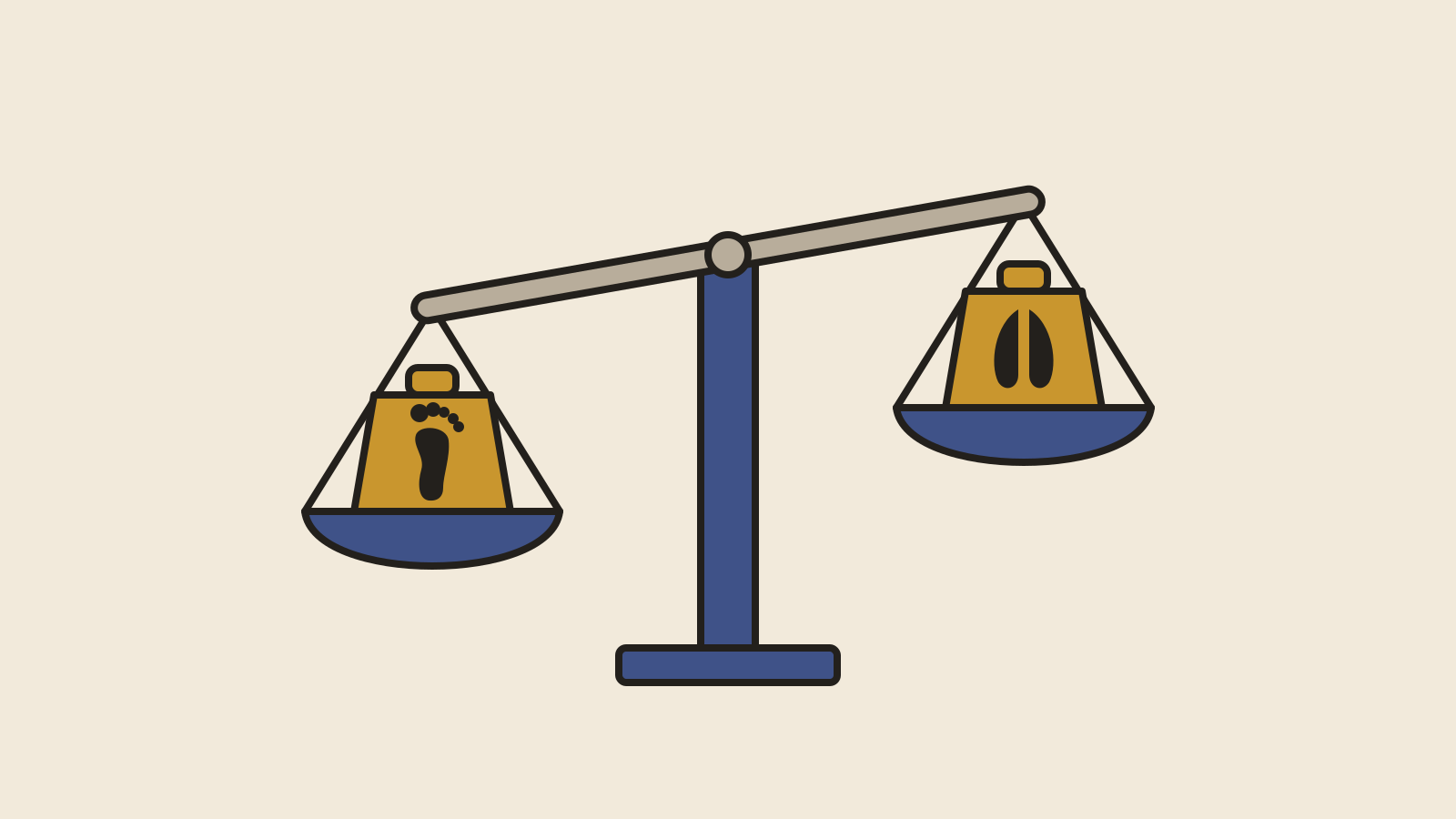
The idea
Most people think it wrong to kick a dog for fun, yet eat pork from farms that keep sows in crates too small to turn round in. By most tests pigs are as clever as dogs and as sensitive to pain. Ask why an animal may be treated as no person may, and the usual answer comes down to this: they are only animals, and we are human. Speciesism is the name critics give to that answer. The charge is that species membership, taken alone, is a biological fact with no more moral weight than skin colour or sex. What matters is whether a being can suffer and has interests of its own.
The word was built to sit beside racism and sexism. A racist gives extra weight to the interests of their own race. A speciesist, on this view, does the same for their own species. Opponents reply that the comparison fails, and the argument is still live.
Diagram
The dispute is over where the line of moral concern is drawn
Read as text
Two columns show two ways of deciding whose interests get equal consideration. On the left the line is drawn by species: all humans fall inside it and all other animals fall outside. On the right the line is drawn by sentience: any being that can suffer falls inside, and like interests weigh alike whichever species has them. Critics of speciesism defend the right-hand line. Their opponents defend the left, or a line drawn by personhood.
Key features
- The target is the reason given, species alone, so treating beings differently because their capacities differ is not speciesist.
- Equal consideration means like interests get like weight: a pig has no interest in voting, but it has one in not being hurt.
- The view does not hold all lives equal in value, and Singer thinks killing a self-aware person usually worse than killing a fish.
- The standard test is the case of humans who lack the capacities said to set humans apart, such as newborn babies.
- Utilitarians, rights theorists and some Kantians all use the idea, so it belongs to no single moral theory.
Not to be confused with
| Look-alike | The difference | Differs on |
|---|---|---|
| Prejudice | In psychology, prejudice describes an attitude towards people because of their group. Speciesism is a moral charge: it asserts that a common attitude towards animals cannot be justified. | Differs onDescriptive or normative |
| Utilitarianism | Utilitarianism is a whole theory of right action. Speciesism is one claim about whose interests count. Singer joins the two, but Tom Regan rejected utilitarianism and still condemned speciesism. | Differs onScope |
| Animal rights | Rights views hold that animals may never be used as mere resources. Rejecting speciesism requires only equal weight for equal interests, which could permit some uses of animals if the gains were great enough. | Differs onClaim |
| Anthropocentrism | The wider outlook that treats humans as the centre of value in all of nature, rivers and forests included. Speciesism concerns individual animals that can feel. | Differs onScope |
- Differs onDescriptive or normative
In psychology, prejudice describes an attitude towards people because of their group. Speciesism is a moral charge: it asserts that a common attitude towards animals cannot be justified.
- Differs onScope
Utilitarianism is a whole theory of right action. Speciesism is one claim about whose interests count. Singer joins the two, but Tom Regan rejected utilitarianism and still condemned speciesism.
- Differs onClaim
Animal rights
Rights views hold that animals may never be used as mere resources. Rejecting speciesism requires only equal weight for equal interests, which could permit some uses of animals if the gains were great enough.
- Differs onScope
Anthropocentrism
The wider outlook that treats humans as the centre of value in all of nature, rivers and forests included. Speciesism concerns individual animals that can feel.
Origins and development
The British psychologist Richard Ryder coined the word in 1970, in a leaflet against animal experiments that he printed and handed round Oxford. He was drawing on an old thought. Jeremy Bentham had written in 1789 that the question about animals is whether they can suffer. Peter Singer took up Ryder's word in a 1973 book review and made it the centre of Animal Liberation (1975). Psychologists now study it as an attitude. Lucius Caviola and colleagues reported in 2019 that people who score high on it tend to score higher on prejudice against human groups.
Peter Singer
Australian philosopher who argues that suffering counts equally whoever feels it, and draws hard conclusions about animals, poverty and medicine.
Why it matters
The idea stands behind most modern arguments about factory farming, animal testing and the legal standing of great apes. The European Union's ban on cosmetics tested on animals and its ban on battery cages came out of the movement the idea helped start. Readers will also meet it turned round, in debates about whether an artificial mind that could suffer would have claims on us.
Critiques and limits
Bernard Williams argued that favouring one's own kind is a loyalty of the same kind as loyalty to family and needs no further ground. Carl Cohen held that rights belong to a kind of being capable of moral agency, so all humans have them and animals do not. Shelly Kagan argued in 2016 that most people are better described as favouring persons than as favouring a species. Disability advocates object to arguments that compare animals with impaired humans. The idea is a conceptual and moral claim, tested by argument. Philosophers remain divided on it.
Bernard Williams
The English philosopher who argued that moral theories ignore the projects, loyalties and luck that make up a human life.
Connections
Belongs to
It is a claim about moral standing, the question of whose interests must be counted at all.
Originated by
Richard Ryder coined the word in 1970, and Singer gave it its philosophical argument in Animal Liberation five years later.
Influenced by
Bentham wrote in 1789 that the question about animals is whether they can suffer, which became the idea's test.
Critiques
Rejects Kant's view that we owe animals nothing directly because they lack reason, and that cruelty is wrong only for its effect on people.
Contrasts with
PrejudicePsychology
Differs on descriptive or normative. Psychologists use prejudice to describe an attitude towards human groups, where speciesism is a moral charge that an attitude is unjustified.
Differs on scope. Utilitarianism is a whole theory of right action, and speciesism is one claim about whose interests count that non-utilitarians also hold.
Applied in
Social psychologyPsychology
Psychologists measure speciesism as an attitude and report that it tends to go with prejudice against human groups.
Critiqued by
In The Human Prejudice he argued that favouring one's own kind is a loyalty like loyalty to family and needs no further ground.
Further reading
- Gruen, L. (2011). Ethics and animals: An introduction. Cambridge University Press. https://doi.org/10.1017/cbo9780511976162
- Kagan, S. (2016). What's wrong with speciesism?. Journal of Applied Philosophy, 33(1), 1–21. https://doi.org/10.1111/japp.12164
- Ryder, R. D. (1975). Victims of science: The use of animals in research. Davis-Poynter.
- Singer, P. (1975). Animal liberation: A new ethics for our treatment of animals. New York Review.
Cite this entry
Scholia. (2026). Speciesism. In Scholia: Notes in the margin of the human sciences. Retrieved November 28, 2026, from https://scholia.zennia.sg/ideas/speciesism
This topic is contested. The entry sets out the main positions rather than settling them.