IdeaPhilosophy
The absurd
Camus's name for the clash between the human need for meaning and a world that gives no answer, which he said we must live with.
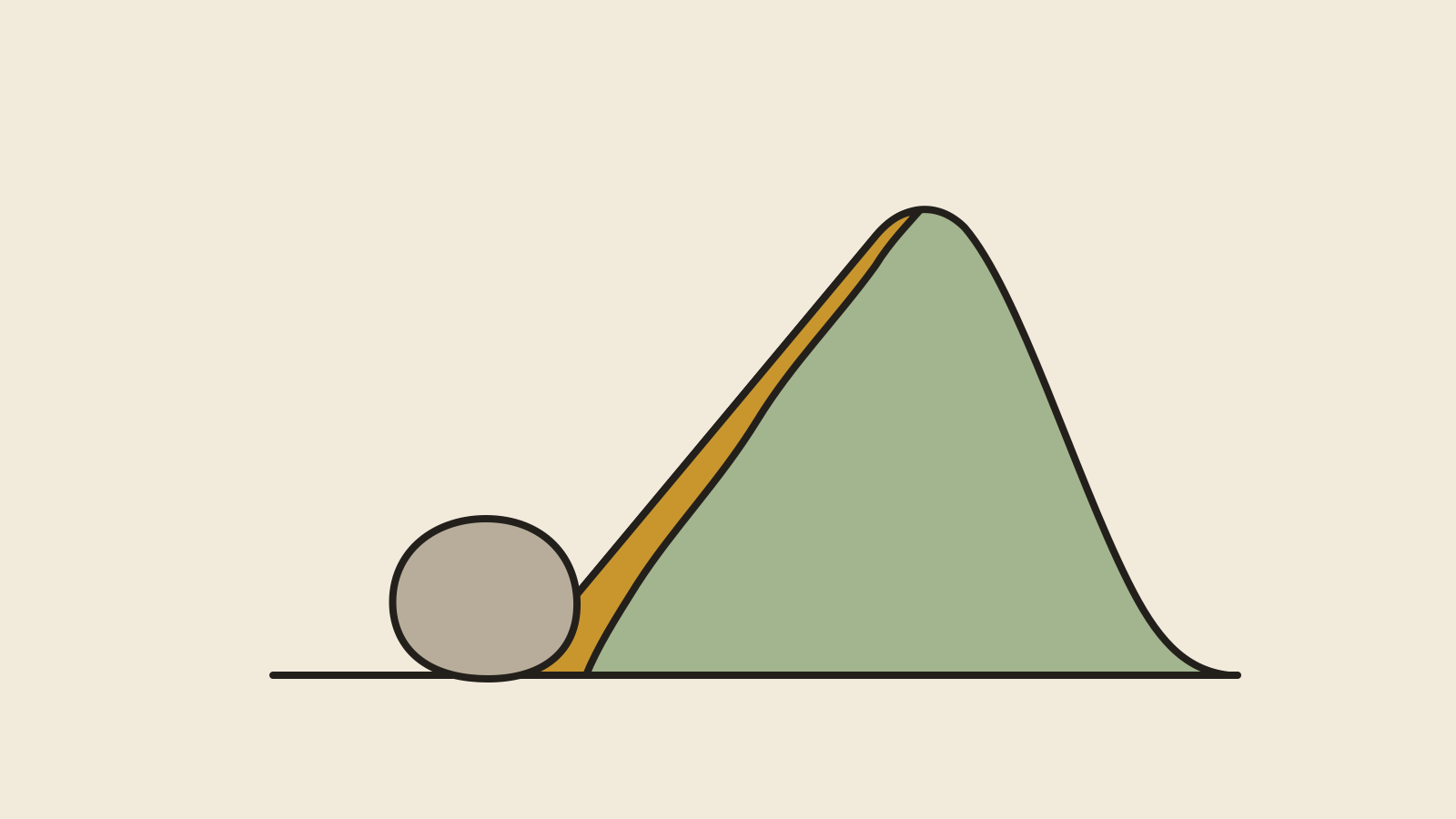
The idea
The absurd is Albert Camus's name for a mismatch. Human beings want the world to make sense: to have reasons, an order, a point. The world gives no reply, and Camus wrote of "the unreasonable silence of the world". Neither side is absurd alone, because the absurd lies in the meeting of the two, much as a quarrel needs two parties.
Most people meet it in a small way. You are on the usual morning train and the question "why?" arrives. Tomorrow will bring the same round of commuting, working, eating and sleeping, and the routine that carried you yesterday suddenly looks like stage scenery.
Camus held that this recognition is true and should not be argued away. He then asked what follows from it, and his answer was that nothing forces despair. A person can live fully while keeping the mismatch in view and without hoping for rescue.
Diagram
The absurd arises only where the need for meaning meets a silent world
Read as text
Two factors meet. On one side is the human need, which wants reasons and wants a purpose. On the other is the world, which gives no reply and has no given purpose. Where the two collide, the outcome is the absurd. Neither factor is absurd alone.
Key features
- It is a relation: it needs both a mind that asks for meaning and a world that does not supply it.
- It can't be cured, since removing either side means ending the asker or inventing an answer.
- Camus rejects two exits: suicide, which ends the question, and religious or philosophical hope, which he calls a leap.
- What remains is revolt: living on with open eyes, which he says brings freedom and intensity.
- Sisyphus is the model, a man who knows his labour is endless and makes it his own.
Not to be confused with
| Look-alike | The difference | Differs on |
|---|---|---|
| Nihilism | Nihilism concludes that nothing matters or has value. Camus starts from the same missing guarantee and argues the other way: life is worth living, and cruelty is still wrong. | Differs onClaim |
| Existence precedes essence | Sartre says people fill the gap by choosing values and so creating meaning. Camus says the gap stays open. The honest course is to live with it, and no choice closes it. | Differs onClaim |
| Philosophical pessimism | The pessimist weighs life and finds that suffering outweighs its goods. The absurd passes no verdict on how life feels. It concerns sense, and Camus ends by imagining Sisyphus happy. | Differs onClaim |
| Leap of faith | Kierkegaard also finds the world closed to reason and answers by trusting God beyond it. Camus calls this philosophical suicide, since it removes one side of the mismatch. | Differs onClaim |
- Differs onClaim
Nihilism concludes that nothing matters or has value. Camus starts from the same missing guarantee and argues the other way: life is worth living, and cruelty is still wrong.
- Differs onClaim
Sartre says people fill the gap by choosing values and so creating meaning. Camus says the gap stays open. The honest course is to live with it, and no choice closes it.
- Differs onClaim
The pessimist weighs life and finds that suffering outweighs its goods. The absurd passes no verdict on how life feels. It concerns sense, and Camus ends by imagining Sisyphus happy.
- Differs onClaim
Kierkegaard also finds the world closed to reason and answers by trusting God beyond it. Camus calls this philosophical suicide, since it removes one side of the mismatch.
Origins and development
Camus set the idea out in The Myth of Sisyphus, finished early in 1941 and published in occupied Paris in 1942, the year of his novel The Stranger. Kierkegaard had used the word a century earlier for the paradox of faith, though the mood owes more to Nietzsche's godless world. Camus soon judged the essay a beginning only. The Plague (1947) and The Rebel (1951) ask what people who share the absurd owe one another. In 1961 the critic Martin Esslin borrowed the word for the Theatre of the Absurd of Beckett and Ionesco.
Søren Kierkegaard
A Danish thinker who made the single individual's choices, anxiety and faith the centre of philosophy and is often called the father of existentialism.
Friedrich Nietzsche
A German philosopher who declared the death of God, traced the hidden history of moral values and asked what could replace them.
Why it matters
The feeling the idea names is common after a bereavement, a redundancy or a long illness, when the reasons a person lived by stop working, and existential psychotherapists treat that loss of meaning as a human problem and not a symptom. Camus's essay is often the first philosophy people read, because its opening is so blunt: the one serious question is whether to go on living. Journalists reach for Sisyphus whenever work looks endless.
Critiques and limits
Thomas Nagel argued in 1971 that Camus misplaced the absurd. It arises inside us, from our ability to step back and doubt the things we go on taking seriously, and a universe with a purpose would not remove it. He found defiance overdramatic and recommended irony. R. M. Hare replied to a young reader of Camus that mattering is something people do, so the world's silence proves nothing. The idea is a philosophical position, to be settled by argument and not by evidence, and the argument continues.
Thomas Nagel
An American philosopher who argued that objective science leaves out what experience is like for the one who has it.
Connections
Belongs to
Camus refused the label, but the absurd is taught as an existentialist theme beside anxiety, freedom and authenticity.
Originated by
Camus set the idea out in The Myth of Sisyphus in 1942 and gave it a face in the novel The Stranger.
Influenced by
Nietzsche's world without God or built-in purpose is the silent world that Camus's seeker of meaning runs up against.
Critiques
Camus calls the leap philosophical suicide, since it ends the absurd by giving up the reason that noticed it.
Contrasts with
Differs on claim. Camus's Sisyphus repeats a pointless task and answers with defiance, where Nietzsche asks for love of a life that repeats.
Differs on claim. Kierkegaard leapt towards a faith he called absurd, where Camus called that leap an evasion and stayed with the absurd.
Differs on claim. Pessimism weighs suffering against happiness, where the absurd is the gap between our demand for meaning and a silent world.
Differs on claim. Nihilism concludes that nothing matters, where Camus starts from the same missing guarantee and argues that life is worth living.
Differs on claim. Sartre says people create meaning by choosing, where Camus says the gap between need and world stays open.
Critiqued by
He located absurdity in our own power to step back and doubt, and recommended irony where Camus urged defiance.
Further reading
- Camus, A. (1955). The myth of Sisyphus and other essays. Alfred A. Knopf. (Original work published 1942)
- Nagel, T. (1971). The absurd. The Journal of Philosophy, 68(20), 716–727. https://doi.org/10.2307/2024942
- Zaretsky, R. (2013). A life worth living: Albert Camus and the quest for meaning. Harvard University Press. https://doi.org/10.2307/j.ctt6wpp9f
Cite this entry
Scholia. (2026). The absurd. In Scholia: Notes in the margin of the human sciences. Retrieved November 28, 2026, from https://scholia.zennia.sg/ideas/the-absurd