PersonCognitive science & linguistics
Claude Shannon
The American engineer who founded information theory by showing that any message can be measured in bits, whatever it means.
Why they matter
Claude Shannon showed that information can be measured as weight and distance are measured. The measure has nothing to do with what a message means. His unit was the bit, a single choice between two alternatives. A 1948 paper written at Bell Telephone Laboratories used it to prove two things. Any message can be squeezed down to a smallest size, set by how predictable it is. And any channel, however noisy, has a top speed below which messages can be sent with almost no errors, if they are coded cleverly enough.
Every text message relies on both results. A phone shortens the message before sending it, then adds carefully chosen extra bits so that the receiver can repair whatever the radio link garbles. Eleven years earlier, in a master's thesis, Shannon had shown that circuits of on-off switches can carry out logic. Digital electronics rests on that thesis, and digital communication on the 1948 paper.
Key ideas
- Information as surprise: a message carries more information the less predictable it is, whatever it happens to say.
- The bit: the unit of information is one choice between two equally likely alternatives, a word Shannon credited to his colleague John Tukey.
- Entropy: the average surprise of a source sets the smallest size to which its messages can be compressed.
- Channel capacity: every noisy channel has a maximum rate, and below it good coding can make errors as rare as one likes.
- Switching logic: networks of on-off switches can work out any expression in George Boole's algebra of true and false.
Not to be confused with
| Look-alike | The difference | Differs on |
|---|---|---|
| Norbert Wiener | Both men measured information in the 1940s, and each credited the other. Shannon kept to an engineering problem: sending coded messages reliably over a noisy channel. Wiener made information part of cybernetics, a general science of control in animals, machines and societies. | Differs onScope |
| Alan Turing | The two met at Bell Labs in 1943 and talked about thinking machines. Turing's theorems say what can be computed at all. Shannon's say how much can be communicated and how compactly it can be stored. | Differs onClaim |
| Warren Weaver | Communication textbooks speak of a Shannon–Weaver model. The mathematics is Shannon's. Weaver wrote the plain-language essay printed beside it in 1949 and stretched the theory towards meaning and persuasion, which Shannon had set aside. | Differs onScope |
- Differs onScope
Both men measured information in the 1940s, and each credited the other. Shannon kept to an engineering problem: sending coded messages reliably over a noisy channel. Wiener made information part of cybernetics, a general science of control in animals, machines and societies.
- Differs onClaim
The two met at Bell Labs in 1943 and talked about thinking machines. Turing's theorems say what can be computed at all. Shannon's say how much can be communicated and how compactly it can be stored.
- Differs onScope
Warren Weaver
Communication textbooks speak of a Shannon–Weaver model. The mathematics is Shannon's. Weaver wrote the plain-language essay printed beside it in 1949 and stretched the theory towards meaning and persuasion, which Shannon had set aside.
Life and context
Shannon was born in Michigan in 1916 and grew up in the town of Gaylord, where he ran a telegraph along a barbed-wire fence to a friend's house. He studied electrical engineering and mathematics at the University of Michigan, then moved to the Massachusetts Institute of Technology (MIT). His 1937 master's thesis there applied Boole's algebra to telephone relays. During the Second World War he worked at Bell Labs on gun aiming and on secret codes, and the study of codes fed straight into his theory of communication.
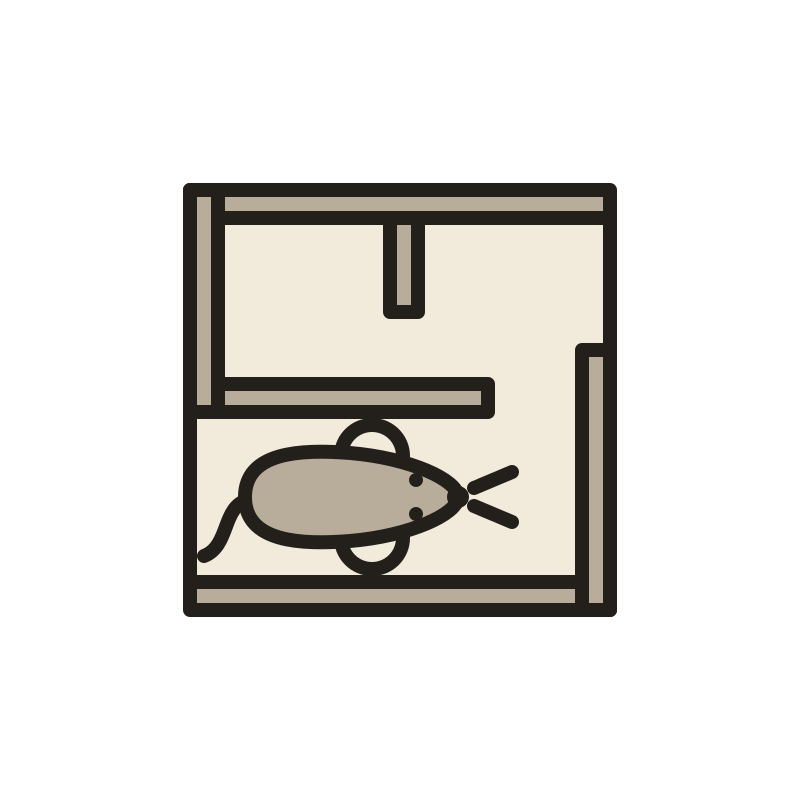
He was also a tinkerer. In 1950 he built Theseus, a mechanical mouse that learned its way through a maze by trial and error, with the route stored in telephone relays under the floor. He wrote one of the first papers on programming a computer to play chess. He joined the MIT faculty in 1956 and died in 2001 after years of Alzheimer's disease.
Life strip
- 1916 Born
- 1916 Born in Petoskey and raised in nearby Gaylord, Michigan
- 1936 Graduates in electrical engineering and mathematics, Ann Arbor
- 1937 Writes a master's thesis applying Boolean algebra to relay circuits, Cambridge, Massachusetts
- 1941 Joins Bell Telephone Laboratories, New York
- 1948 Publishes A Mathematical Theory of Communication, Murray Hill
- 1950 Builds Theseus, a maze-solving mechanical mouse, Murray Hill
- 1956 Co-organises the Dartmouth workshop on artificial intelligence, Hanover
- 1956 Joins the faculty of the Massachusetts Institute of Technology, Cambridge, Massachusetts
- 2001 Dies after years of Alzheimer's disease, Medford
- 2001 Died
Legacy
Compressed music and video files, error correction in mobile networks and the square codes scanned at shop tills all descend from the 1948 paper. Psychology borrowed its vocabulary within a few years. George Miller's 1956 paper on the limits of memory used Shannon's measures, and cognitive psychology came to describe the mind as a processor of information. Entropy in his sense is now a standard tool in genetics, linguistics and machine learning.
Cognitive psychology
The branch of psychology that studies mental processes such as attention, memory, language and reasoning by experiment.
Critiques and limits
The theory leaves out meaning by design, and critics have asked what that costs. Yehoshua Bar-Hillel and Rudolf Carnap argued in 1952 that a measure of signal statistics says nothing about what a sentence asserts. They tried to build a separate theory of semantic information. Shannon shared the worry. In a 1956 editorial, The Bandwagon, he warned that his theory was being oversold in psychology, economics and the social sciences. George Miller's own 1956 paper found that immediate memory holds about seven items however many bits each carries, so it is no channel of fixed capacity.
Rudolf Carnap
The German-born logician of the Vienna Circle who treated philosophical disputes as choices between languages, to be judged by their usefulness.
Lineage
Influenced by


Influenced

Connections
Belongs to
His 1950 chess-programming paper and the 1956 Dartmouth workshop he co-organised helped start research on machines that think.
Influenced by
The 1948 paper says communication theory owes much of its basic philosophy to Wiener's wartime work on signals and noise.
LogicPhilosophy
A philosophy class on George Boole's algebra of true and false gave him the tool for his thesis on switching circuits.
The two met at Bell Labs in 1943 and traded ideas on machines that might think and play chess.
Contrasts with
Differs on scope. Shannon solved an engineering problem of coded messages, where Wiener built information into a general science of control.
Differs on claim. Turing's theorems say what can be computed at all, where Shannon's say how much can be communicated.
Influenced
He worked under Shannon at Bell Labs in 1952 and organised the 1956 Dartmouth workshop with him.
Cognitive psychologyPsychology
George Miller and others borrowed Shannon's measures of information, and the field came to describe the mind as a processor of information.
Further reading
Read first
Shannon, C. E. (1948). A mathematical theory of communication. The Bell System Technical Journal, 27(3), 379–423. https://doi.org/10.1002/j.1538-7305.1948.tb01338.x
- Gleick, J. (2011). The information: A history, a theory, a flood. Pantheon Books.
- Shannon, C. E. (1938). A symbolic analysis of relay and switching circuits. Transactions of the American Institute of Electrical Engineers, 57(12), 713–723. https://doi.org/10.1109/T-AIEE.1938.5057767
- Soni, J., & Goodman, R. (2017). A mind at play: How Claude Shannon invented the information age. Simon & Schuster.
Cite this entry
Scholia. (2026). Claude Shannon. In Scholia: Notes in the margin of the human sciences. Retrieved November 28, 2026, from https://scholia.zennia.sg/people/claude-shannon