PersonPhilosophy
Francis Bacon
An English lawyer and statesman who argued that science should rest on organised experiment and serve the relief of human hardship.
Why they matter
Francis Bacon argued that knowledge of nature has to be built from organised observation and experiment, and that its purpose is to improve human life. The learning of his day rested on ancient books and on clever argument from first principles. Bacon thought this bred disputes and no discoveries. He proposed a new method: collect cases, compare them in tables, rule out the explanations that fail and climb slowly to general laws.
A cook who wants to know why a cake sank does something similar. She changes one thing at a time, the oven heat or the flour or the eggs, and notes what happens with each change. She doesn't look the answer up in Aristotle. Bacon wanted all of natural science run this way, by teams, with public money and written records. He made no major discovery himself. His gift was the programme, and the Royal Society adopted it a generation after his death.
Key ideas
- Idols of the mind: four standing sources of error, from human nature, personal quirks, loose words and received systems, an early map of cognitive bias.
Cognitive bias
A regular lean in human judgement: an error that most people make in the same direction and that can be predicted in advance.
- Induction by elimination: list the cases where a quality is present, absent and present in degrees, then strike out every explanation the tables contradict.
Deduction and induction
Deduction draws conclusions that must be true if the premises are, while induction draws conclusions that the evidence makes probable.
- Experiment: nature shows more under deliberate trial than when it is simply watched.
- Knowledge for use: science should yield inventions that relieve hardship, so that knowing and doing become one power.
- Science as shared work: his New Atlantis imagines a state research college with laboratories and a division of tasks.
Not to be confused with
| Look-alike | The difference | Differs on |
|---|---|---|
| René Descartes | Both wanted to rebuild knowledge from the ground. Descartes began from truths that reason finds certain and deduced the rest. Bacon began from many observations and worked upward, and he distrusted the mind left to itself. | Differs onMethod |
| Empiricism | Bacon is often called the father of empiricism. That school offers a theory of where all ideas come from. Bacon offered a working method for science, and he warned that raw experience without method only piles up facts, as ants do. | Differs onScope |
| Roger Bacon | A Franciscan friar of thirteenth-century Oxford who also praised experience over authority. The two were not related, and three and a half centuries lie between them. | Differs onEra |
- Differs onMethod
Both wanted to rebuild knowledge from the ground. Descartes began from truths that reason finds certain and deduced the rest. Bacon began from many observations and worked upward, and he distrusted the mind left to itself.
- Differs onScope
Bacon is often called the father of empiricism. That school offers a theory of where all ideas come from. Bacon offered a working method for science, and he warned that raw experience without method only piles up facts, as ants do.
- Differs onEra
Roger Bacon
A Franciscan friar of thirteenth-century Oxford who also praised experience over authority. The two were not related, and three and a half centuries lie between them.
Life and context
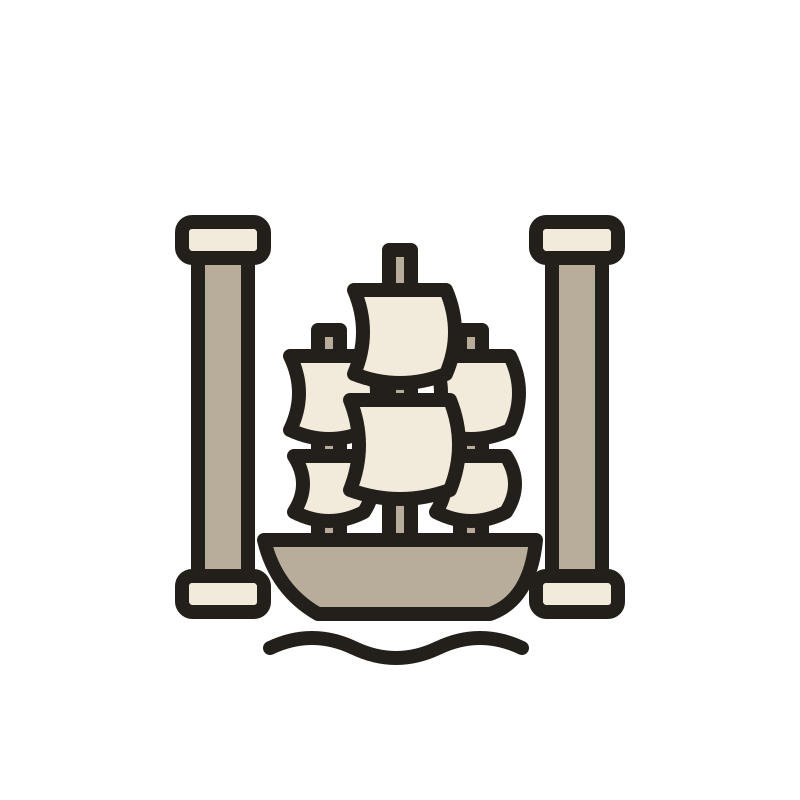
Bacon was born in London in 1561, the younger son of Queen Elizabeth's Lord Keeper. He went up to Trinity College, Cambridge at twelve and came away with a low opinion of Aristotle's followers. His father died in 1579 and left him little, so he trained in law at Gray's Inn and sat in Parliament from 1581. He rose slowly under Elizabeth and fast under James I, becoming Attorney General in 1613 and Lord Chancellor in 1618. He wrote in the hours left over: the Essays from 1597, The Advancement of Learning in 1605 and the New Organon in 1620. The title page of that volume shows a ship sailing out past the Pillars of Hercules, the old limit of the known world. In 1621 Parliament convicted him of taking gifts from litigants, and he lost office. He spent his last five years writing and died in 1626.
Life strip
- 1561 Born
- 1561 Born at York House on the Strand, London
- 1576 Enters Gray's Inn to train in law, London
- 1597 Publishes the first edition of the Essays, London
- 1605 Publishes The Advancement of Learning, London
- 1618 Becomes Lord Chancellor, London
- 1620 Publishes the New Organon, London
- 1621 Convicted of corruption and removed from office, London
- 1626 Dies of a chill, Highgate
- 1626 Died
Legacy
The Royal Society, founded in 1660, took Bacon as its guide, and Diderot and d'Alembert based the plan of the Encyclopédie on his map of the sciences. Kant took the motto of the Critique of Pure Reason from him. His picture of research as funded, organised teamwork describes every modern laboratory and science ministry. The slogan that knowledge is power condenses a Latin line from his religious meditations of 1597.
Immanuel Kant
A Prussian philosopher who argued that the mind shapes the world we experience and that morality is a law reason gives itself.
Critiques and limits
William Harvey, who discovered the circulation of the blood and was Bacon's physician, said that he wrote philosophy like a Lord Chancellor. Historians such as Alexandre Koyré add that Bacon gave mathematics and bold hypotheses too small a part. He also rejected Copernicus. David Hume argued that no number of cases can prove a general law, the problem of induction. Karl Popper concluded that science proceeds by guesses and tests, with no Baconian ascent from data. Carolyn Merchant argued in 1980 that his images of mastering nature licensed its exploitation.
David Hume
A Scottish philosopher who argued that our beliefs about causes, the self and morality rest on habit and feeling more than on reason.
Problem of induction
Past experience cannot prove that the future will resemble it, so reasoning from observed cases to unobserved ones has no justification that avoids circularity.
Lineage
Influenced by

Influenced
Connections
Belongs to
His New Organon is the first modern attempt to write rules for how scientific inquiry should proceed.
Influenced by
He took the title and the short, personal form of his Essays from Montaigne, whose own had appeared in 1580.
Critiques
He charged the schoolmen with spinning systems out of Aristotle's texts like spiders, with no fresh contact with nature.
The New Organon is named against Aristotle's Organon and argues that the syllogism can arrange knowledge but never find any.
Contrasts with
Differs on method. Bacon built knowledge upward from many observations, where Descartes deduced it from truths that reason finds certain.
Differs on scope. Bacon gave a method for doing science, where empiricism is a theory that all ideas and knowledge come from experience.
Influenced
He counted Bacon among his four masters and borrowed the ambition of a new science built from collected evidence.
He took the inductive method of Bacon and Newton as the model for a science of the mind free of hypotheses.
Bacon's New Organon of 1620 urged a science built on organised observation, for which Locke's Essay later supplied the philosophy.
Further reading
Read first
Bacon, F. (2000). The new organon. Cambridge University Press. https://doi.org/10.1017/CBO9781139164030 (Original work published 1620)
- Gaukroger, S. (2001). Francis Bacon and the transformation of early-modern philosophy. Cambridge University Press. https://doi.org/10.1017/CBO9780511612688
- Zagorin, P. (1998). Francis Bacon. Princeton University Press. https://doi.org/10.1515/9780691221625
Cite this entry
Scholia. (2026). Francis Bacon. In Scholia: Notes in the margin of the human sciences. Retrieved November 28, 2026, from https://scholia.zennia.sg/people/francis-bacon