IdeaPhilosophy
Problem of induction
Past experience cannot prove that the future will resemble it, so reasoning from observed cases to unobserved ones has no justification that avoids circularity.
The idea
Every morning you turn the tap and expect water, because water is what has always come out. The expectation feels like knowledge. David Hume asked what entitles us to it. Nothing contradictory follows from supposing the tap runs dry tomorrow, so logic alone cannot rule that out. Experience tells us only about cases already observed. To get from "it always has" to "it will" we need a further premise, that the future will resemble the past. The only support for that premise is that the future has resembled the past so far, which is the very kind of reasoning under question.
David Hume
A Scottish philosopher who argued that our beliefs about causes, the self and morality rest on habit and feeling more than on reason.
Induction is the step from observed cases to unobserved ones, and Hume's argument shows it cannot be justified without being assumed. He did not advise anyone to stop expecting water. Habit, he thought, carries us where argument cannot. The trouble is that science rests on the same step.
Diagram
Induction can be justified only by assuming what it needs to prove
Read as text
A cycle of four steps round the words circular justification. Induction has worked before. So induction will keep working. That follows only if the future resembles the past. And that the future resembles the past is known only by induction, which returns the argument to its starting point.
Key features
- The target is justification: nobody doubts that people reason inductively, and the question is what makes doing so reasonable.
- The argument is a dilemma: a proof by logic alone fails because nature could change course without contradiction, and an argument from experience runs in a circle.
- Past success offers no escape, since "induction has worked so far" is itself an inductive argument.
- Retreating to "probably" does not help, because judgements of probability also project past frequencies onto unseen cases.
Not to be confused with
| Look-alike | The difference | Differs on |
|---|---|---|
| Deduction and induction | The term names two kinds of inference and says how each works. The problem is a challenge to one of them: it asks what could justify trusting induction at all. | Differs onScope |
| Falsificationism | Popper accepted Hume's argument and claimed that science can do without induction, by testing guesses and discarding the failures. The problem itself says only that induction lacks a justification. | Differs onClaim |
| Philosophical scepticism | Scepticism in general doubts whether we know anything, present perceptions included. Hume's problem grants what has been observed and questions only the step beyond it. | Differs onScope |
| Goodman's new riddle | Nelson Goodman asked in 1955 which regularities deserve projecting, since the same evidence fits endlessly many patterns. His riddle takes projection for granted and asks how to choose. | Differs onClaim |
- Differs onScope
The term names two kinds of inference and says how each works. The problem is a challenge to one of them: it asks what could justify trusting induction at all.
- Differs onClaim
Popper accepted Hume's argument and claimed that science can do without induction, by testing guesses and discarding the failures. The problem itself says only that induction lacks a justification.
- Differs onScope
Scepticism in general doubts whether we know anything, present perceptions included. Hume's problem grants what has been observed and questions only the step beyond it.
- Differs onClaim
Goodman's new riddle
Nelson Goodman asked in 1955 which regularities deserve projecting, since the same evidence fits endlessly many patterns. His riddle takes projection for granted and asks how to choose.
Origins and development
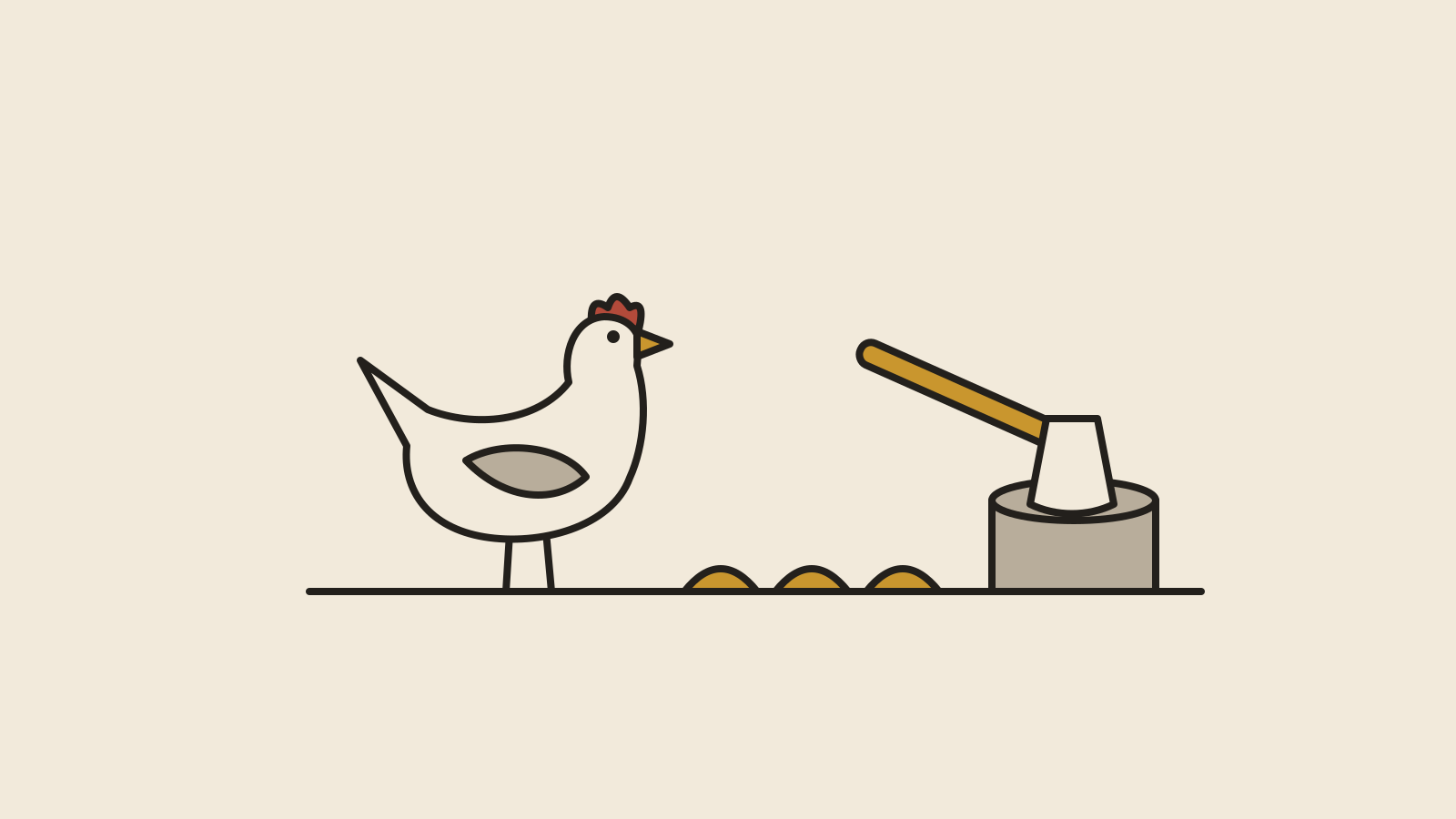
Hume gave the argument in A Treatise of Human Nature (1739) and again, more plainly, in his Enquiry of 1748. He never used the label, which came later. Immanuel Kant replied that the mind itself imposes causal order on experience. Bertrand Russell supplied the best-known picture in 1912: a chicken fed every morning by the farmer who one day wrings its neck. Hans Reichenbach argued that if any method of prediction works, induction will. Karl Popper claimed in 1934 that science had no need of it.
Immanuel Kant
A Prussian philosopher who argued that the mind shapes the world we experience and that morality is a law reason gives itself.
Bertrand Russell
The British logician who made the analysis of language philosophy's main method and became one of his century's best-known public intellectuals.
Why it matters
A drug trial is run on a few thousand people and the result is applied to millions of future patients. Investment adverts warn that past performance is no guide to future returns. A machine learning system trained on last year's data fails when the world shifts. Each is Hume's step from the observed to the unobserved, taken daily and usually safely, with no guarantee attached.
Critiques and limits
P. F. Strawson argued in 1952 that the demand for a justification is confused. Asking whether it is reasonable to rely on induction is like asking whether the law is legal, since relying on experience is part of what "reasonable" means. Popper held that the problem is real but harmless, because science proceeds by refutation. Critics of both reply that the puzzle returns whenever a well-tested theory is trusted in practice. The argument is logical, so evidence cannot settle it, and no reply commands general assent.
Connections
Belongs to
It asks what, if anything, justifies beliefs about things nobody has yet observed.
Every scientific law goes beyond the observations behind it, so accounts of scientific method must answer or sidestep Hume.
Originated by
Hume set out the argument in the Treatise of 1739 and restated it in the first Enquiry.
Contrasts with
Differs on claim. The problem says induction lacks a justification, where Popper adds that science never needed induction in the first place.
Differs on claim. Induction's gap lies between observed and unobserved facts, where this gap lies between facts of any kind and values.
Differs on scope. The term describes two kinds of inference, where the problem challenges the justification of one of them.
Differs on scope. General scepticism doubts all knowledge, where Hume's problem grants past observations and doubts only the step beyond them.
Parallels
Sextus Empiricus had argued that generalising from some cases is unsafe and that surveying every case is impossible.
Applied in
Methods and measurement in psychologyPsychology
Inferring from a sample to a population is induction at work, and statistics manages that risk without removing it.
Cross with
Two distant entries to read beside this one, each with the question the pairing opens.
Phillips curveEconomics
The Phillips trade-off held until people came to expect it: is that Hume's problem, or a further one that only social science faces? Set them side by side
Classical conditioningPsychology
Pavlov's dog expects food after the signal without any argument: does conditioning explain why we trust induction without justifying it? Set them side by side
Further reading
- Goodman, N. (1955). Fact, fiction, and forecast. Harvard University Press.
- Hume, D. (2000). A treatise of human nature. Oxford University Press. (Original work published 1739)
- Hume, D. (1999). An enquiry concerning human understanding. Oxford University Press. (Original work published 1748)
- Russell, B. (1912). The problems of philosophy. Williams and Norgate.
Cite this entry
Scholia. (2026). Problem of induction. In Scholia: Notes in the margin of the human sciences. Retrieved November 28, 2026, from https://scholia.zennia.sg/ideas/problem-of-induction