QuestionPhilosophyAlso in Sociology, Economics, Anthropology
What is value?
Value can mean price, usefulness, standing, a bond between people or moral worth, and each discipline measures a different one.
The question
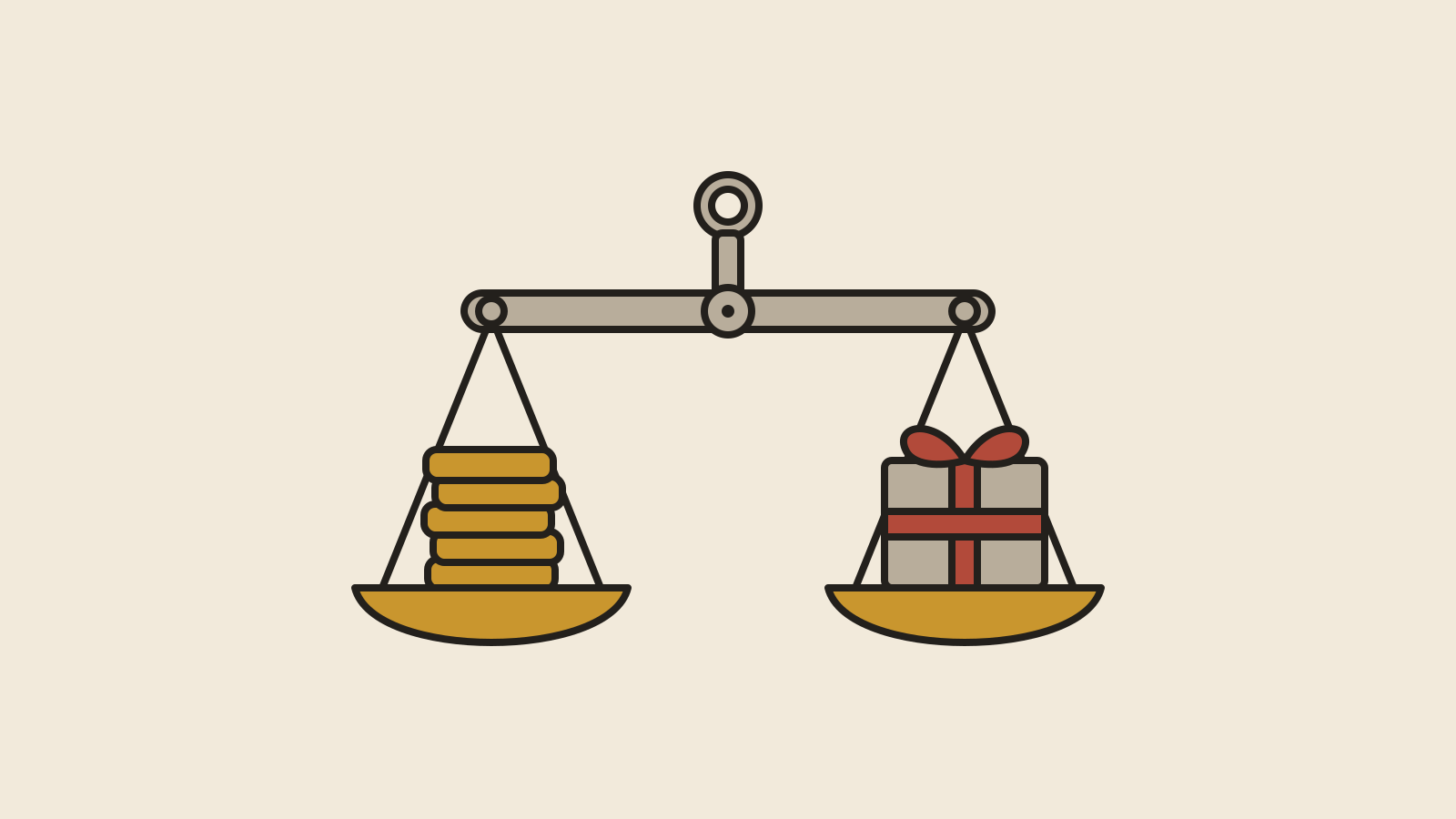
A wedding ring might cost a month's pay, yet its owner would not sell it for ten times that. A glass of water costs almost nothing and nobody can live without it. The word value covers all of this: what a thing fetches, what it is good for, what it means and what is good in itself. The difficulty is deciding whether these are one thing seen four ways or four things sharing a name. Each discipline starts from a different sense.
Diagram
What is value?
- PhilosophyUtilitarianism
- SociologyCultural capital
- EconomicsLabour theory of value
- AnthropologyGift exchange
Read as text
What is value? Philosophy answers with Utilitarianism. Sociology answers with Cultural capital. Economics answers with Labour theory of value. Anthropology answers with Gift exchange.
How each discipline answers
Philosophy
Philosophers ask what is good in itself, apart from any price. Utilitarianism answers that only well-being has that standing, and that everything else matters so far as it adds to the total. Moral realism concerns the status of such claims. It holds that some judgements of worth are true as matters of fact, whatever any person or culture believes. Its opponents treat them as expressions of feeling, or as truths that hold for one way of life and not another.
Utilitarianism
The moral theory that the right act is the one producing the greatest total well-being, with everyone's interests counted equally.
Moral realism
The view that some moral claims are true as matters of fact, whatever any person or culture happens to believe.
Sociology
Sociologists treat value as something groups confer on certain kinds of knowledge and behaviour. Pierre Bourdieu's cultural capital is the knowledge, taste and manners that bring advantage, and it counts only where people with the power to reward it treat it as a sign of worth. The same ease with wine or art is an asset in one room and nothing in the next. Worth, on this account, is a matter of recognition by others.
Cultural capital
The knowledge, tastes, manners and qualifications that bring a person social advantage and can be passed on like wealth.
Economics
Economics has given two rival accounts of price. The labour theory of value traces a good's worth to the work needed to make it. From the 1870s diminishing marginal utility displaced it in the mainstream by arguing that price follows what one more unit is worth to the buyer, which is why plentiful water is cheap while scarce diamonds are dear. Utility is now a number that ranks options by preference. Thorstein Veblen's conspicuous consumption complicates both, since some goods are wanted because they are costly.
Labour theory of value
The claim that a good's value in exchange comes from the labour needed to produce it.
Diminishing marginal utility
Each extra unit of a good adds less satisfaction than the one before, which is why abundant things like water are cheap.
Anthropology
Marcel Mauss's account of gift exchange describes a value no price captures. A gift carries something of its giver and creates a debt, and that debt is the relationship. Offering cash for your share of a round of drinks would settle the account and offend your friends. Chris Gregory put the contrast as a formula: commodities set up a relation between objects, and gifts set up one between people.
Gift exchange
Mauss's claim that gifts only look free: giving, accepting and returning are obligations, and the cycle is what ties people and groups together.
Where the answers conflict
The sharpest dispute is over where value sits. The labour theory places it in the object as stored work, while marginal theory places it in the buyer's wants. Mainstream economics treats the older view as superseded, while Marxian economists defend revised versions. Bourdieu and Veblen place value in other people's eyes, though Bourdieu held that taste marks rank more than price does. Moral realists deny that wants or recognition settle what is good, since a thing could be widely wanted and still bad. A second dispute concerns measurement. Utilitarians need well-being added up across persons, and Lionel Robbins argued that one person's satisfaction can't be compared with another's.
What to read next
- Labour theory of valueThe claim that a good's value in exchange comes from the labour needed to produce it.
- Diminishing marginal utilityEach extra unit of a good adds less satisfaction than the one before, which is why abundant things like water are cheap.
- UtilityEconomists' measure of how much a person gains from something, now usually just a number that ranks options by preference.
- Conspicuous consumptionPeople buy and display costly things partly to show their wealth and standing, so the waste itself can be the point.
- Gift exchangeMauss's claim that gifts only look free: giving, accepting and returning are obligations, and the cycle is what ties people and groups together.
- UtilitarianismThe moral theory that the right act is the one producing the greatest total well-being, with everyone's interests counted equally.
- Moral realismThe view that some moral claims are true as matters of fact, whatever any person or culture happens to believe.
- Cultural capitalThe knowledge, tastes, manners and qualifications that bring a person social advantage and can be passed on like wealth.
Further reading
- Bourdieu, P. (1986). The forms of capital. In J. G. Richardson (Ed.), Handbook of theory and research for the sociology of education (pp. 241–258). Greenwood Press. (Original work published 1983)
- Jevons, W. S. (1871). The theory of political economy. Macmillan.
- Mauss, M. (1990). The gift: The form and reason for exchange in archaic societies. Routledge. (Original work published 1925)
- Ricardo, D. (1817). On the principles of political economy, and taxation. John Murray.
Cite this entry
Scholia. (2026). What is value?. In Scholia: Notes in the margin of the human sciences. Retrieved November 28, 2026, from https://scholia.zennia.sg/questions/what-is-value
This topic is contested. The entry sets out the main positions rather than settling them.