IdeaEconomicsAlso in Philosophy, Political theory & science, Sociology
Labour theory of value
The claim that a good's value in exchange comes from the labour needed to produce it.
The idea
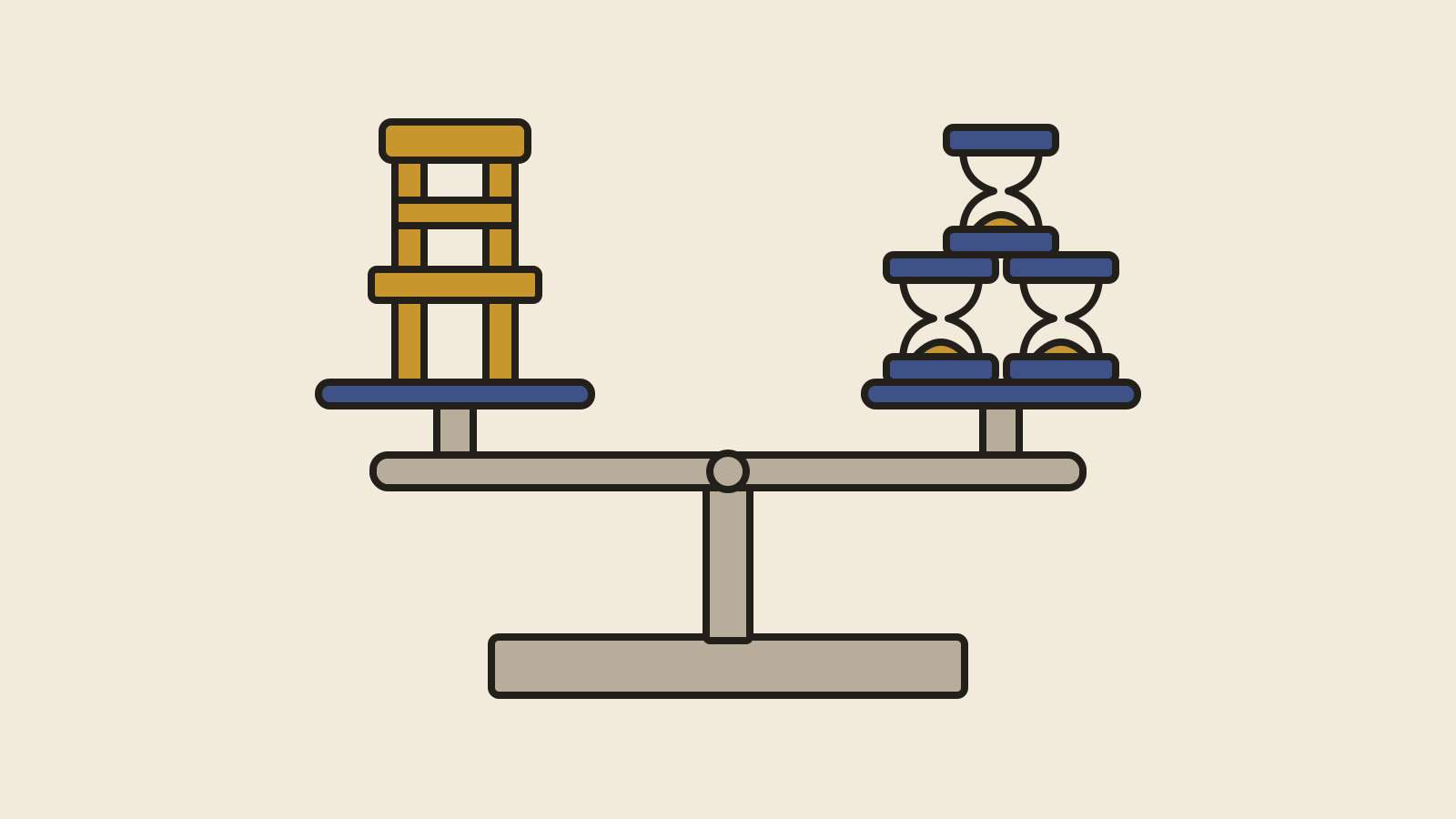
The labour theory of value says that goods exchange in proportion to the labour needed to make them. If a table takes ten hours of work and a chair five, a table should trade for two chairs. Value comes from the effort of production, and how much buyers happen to want the thing only moves the price around that level.
The intuition is familiar. A hand-knitted jumper costs more than a machine-made one, and most people would explain the gap by the hours that went into it. A plumber justifies a bill by time spent.
The theory counts all the labour, including the past work stored in tools and materials. It also counts only the time a typical producer needs. A slow carpenter who takes twenty hours over the table hasn't made it worth four chairs. And it applies to goods that can be made in any quantity, so a rare painting falls outside it.
Diagram
Two theories locate the source of a good's value in different places
Read as text
Two columns compare where value comes from. The labour theory finds it in the labour time needed to produce a good, looks to the seller's side and explains long-run prices. Marginal utility theory finds it in the buyer's want for one more unit, looks to the buyer's side and explains prices at any moment.
Key features
- Value is set on the supply side, by the cost of production measured in labour time.
- Market prices swing with supply and demand but are pulled back towards this labour-based "natural" price.
- Usefulness is necessary for a good to have value, but it does not settle how much.
- Machines and materials pass on the labour already spent on them and add no value of their own.
- Marx's version adds that workers create more value than their wages return, the gap being the source of profit.
Not to be confused with
| Look-alike | The difference | Differs on |
|---|---|---|
| Diminishing marginal utility | This is the rival that displaced it. The labour theory finds value in what a good cost to make. Marginal utility finds it in how much a buyer wants one more unit, which is why water is cheap and diamonds dear. | Differs onClaim |
| Supply and demand | Supply and demand explains the price in the market today. The labour theory was meant to explain the long-run level that those daily prices move around. | Differs onScope |
| Surplus value | Surplus value is one step inside Marx's version: the value workers add beyond their wages. The labour theory is the general account of value on which that step depends. | Differs onScope |
| Labour theory of property | John Locke's theory says who rightfully owns a thing: whoever mixed their labour with it. That is a moral claim about ownership. The labour theory of value is an explanation of prices. | Differs onDescriptive or normative |
- Differs onClaim
This is the rival that displaced it. The labour theory finds value in what a good cost to make. Marginal utility finds it in how much a buyer wants one more unit, which is why water is cheap and diamonds dear.
- Differs onScope
Supply and demand explains the price in the market today. The labour theory was meant to explain the long-run level that those daily prices move around.
- Differs onScope
Surplus value
Surplus value is one step inside Marx's version: the value workers add beyond their wages. The labour theory is the general account of value on which that step depends.
- Differs onDescriptive or normative
Labour theory of property
John Locke's theory says who rightfully owns a thing: whoever mixed their labour with it. That is a moral claim about ownership. The labour theory of value is an explanation of prices.
Origins and development
William Petty and John Locke linked worth to labour in the seventeenth century. Adam Smith held that labour sets prices only in a simple society of hunters, before capital and rent appear. David Ricardo applied it to modern economies in 1817, while admitting exceptions where capital is tied up for different lengths of time. Karl Marx built his theory of exploitation on it in Capital (1867). From the 1870s William Stanley Jevons, Carl Menger and Léon Walras replaced it in mainstream economics with marginal utility.
John Locke
An English philosopher who argued that all our ideas come from experience and that governments rule only by the consent of the governed.
Adam Smith
The Scottish moral philosopher whose Wealth of Nations made economics a subject of its own, built on the division of labour and free exchange.
Why it matters
The theory stands behind the claim that profit is unpaid labour, and so behind much socialist politics of the last two centuries. Its intuition survives in everyday talk of a fair day's pay and in arguments that care work or housework is undervalued. Anyone reading Marx, or the debates over what workers are owed, meets it at once.
Critiques and limits
Eugen von Böhm-Bawerk argued in 1896 that Marx could not turn labour values into actual prices without contradiction, the so-called transformation problem. Jevons objected that labour once spent has no influence on what a thing will fetch: an unwanted product is worthless however long it took. Ricardo's own exceptions led George Stigler to call his a 93% labour theory. The theory is contested. Mainstream economics treats it as superseded, while Marxian economists defend revised versions.
Connections
Belongs to
Value set by the cost of production, above all labour, was the school's shared starting point.
Originated by
Ricardo made labour time the main regulator of long-run prices in his Principles of 1817, tightening Smith's looser version.
Smith held that labour measures value, and that it sets prices only in a simple society without capital or rent.
Influenced by
John LockePhilosophy
Locke's claim that labour gives things most of their worth prepared the ground, though his subject was property.
Contrasts with
Differs on claim. The labour theory traces value to the work a good takes to make, the marginal theory to what one more unit is worth.
Differs on scope. Supply and demand explains today's market price, while the labour theory explains the long-run level that prices move around.
Extended by
Marx turned the classical value theory into an account of profit as unpaid labour time.
Influenced
Karl MarxSociology
Marx took Ricardo's labour theory and added surplus value: workers create more value in a day than their wages return to them.
MarxismPolitical theory & science
Marx turned Ricardo's labour theory of value into a theory of exploitation: workers create more value than their wages return.
SocialismPolitical theory & science
Early English socialists reasoned from Ricardo's value theory that workers were owed the whole product of their labour.
Critiqued by
He argued that labour is valued because its products are wanted, which turns the labour theory upside down.
He held that value comes from scarcity, meaning usefulness combined with limited quantity, and not from labour.
The marginalists traced value to what one more unit is worth to a buyer, and denied that embodied labour sets it.
Cross with
Two distant entries to read beside this one, each with the question the pairing opens.
Cognitive dissonancePsychology
People come to value what they struggled to get, so is that a psychological echo of the labour theory or evidence against it? Set them side by side
Arbitrariness of the signCognitive science & linguistics
If a word's meaning holds only by convention among speakers, could a good's value be equally conventional and owe nothing to labour? Set them side by side
Further reading
- Marx, K. (1976). Capital: A critique of political economy (Vol. 1). Penguin Books. (Original work published 1867)
- Meek, R. L. (1956). Studies in the labour theory of value. Lawrence & Wishart.
- Ricardo, D. (1817). On the principles of political economy, and taxation. John Murray.
- Stigler, G. J. (1958). Ricardo and the 93% labor theory of value. The American Economic Review, 48(3), 357–367.
Cite this entry
Scholia. (2026). Labour theory of value. In Scholia: Notes in the margin of the human sciences. Retrieved November 28, 2026, from https://scholia.zennia.sg/ideas/labour-theory-of-value
This topic is contested. The entry sets out the main positions rather than settling them.