School or branchSociologyAlso in Anthropology, Philosophy
Actor–network theory
An approach, begun in science studies, that treats facts, machines and institutions as outcomes of networks linking people and things alike.
Overview
Actor–network theory, or ANT, is a way of studying how things come to be settled: a scientific fact, a working technology, a stable organisation. Its claim is that people never achieve these alone. Each depends on a web of alliances in which microbes, instruments, documents and machines do as much of the work as humans. Sociologists who look only at the people miss half the cast.
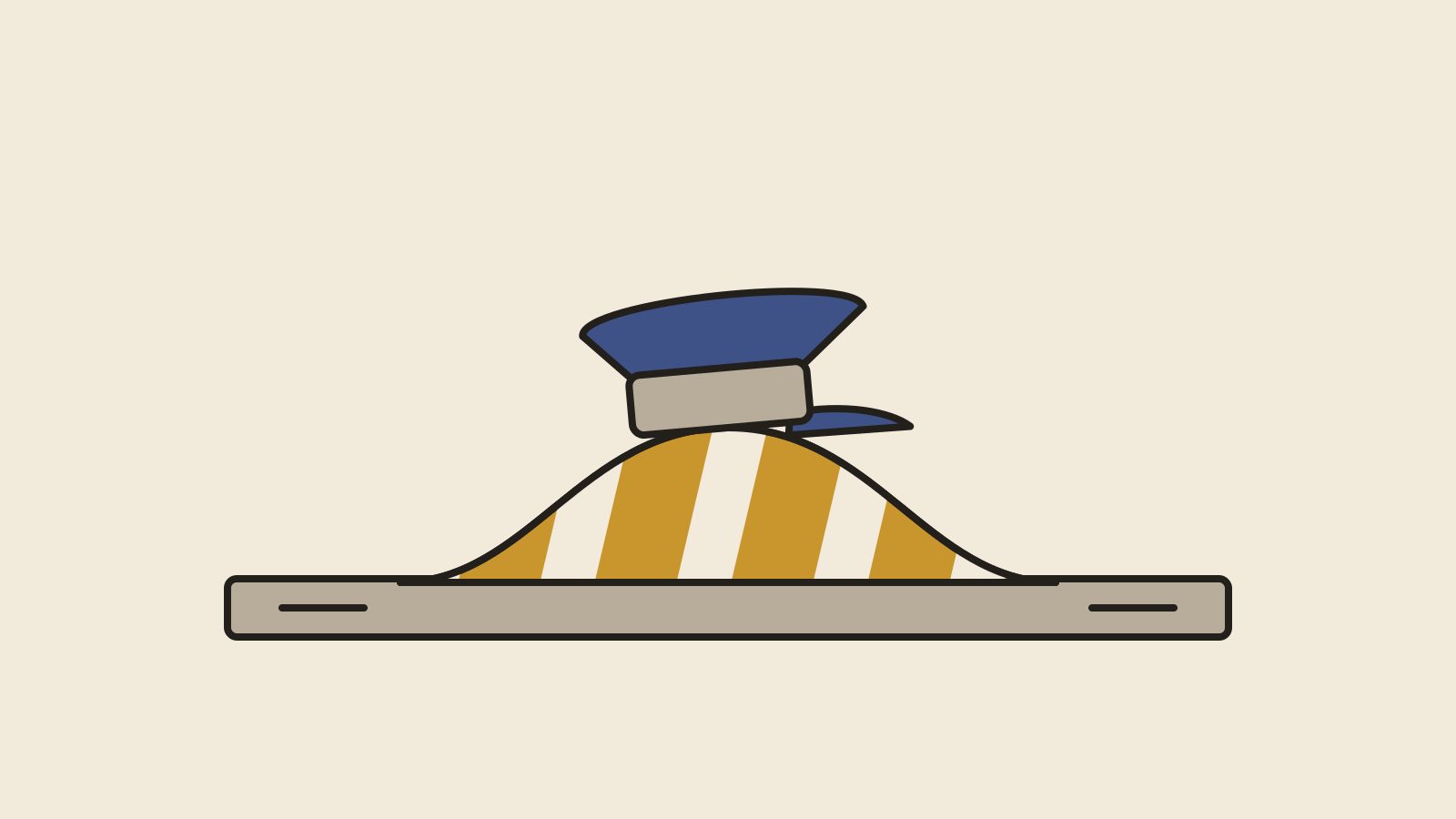
Bruno Latour's best-known example is the speed bump. A town that wants drivers to slow down near a school could post a police officer or put up a sign. A concrete hump does the same job more reliably. It never sleeps, and it works on drivers who care nothing for children and a great deal for their suspension. A moral purpose has been handed over to a lump of concrete. For ANT the bump is an actor in that street, and any account of why the traffic is slow has to include it.
Diagram
Callon's researchers had to enrol scallops, fishermen and colleagues alike
Read as text
A network with three marine biologists at the centre, tied to four other actors. The scallop larvae must anchor on the collectors. The collectors, hung on towlines in the bay, must shelter the larvae. The fishermen must hold off fishing the stock. The scientific colleagues must accept the findings. The project holds only while every tie holds. In Callon's account it later failed, when larvae stopped anchoring and fishermen dredged the protected scallops.
Core commitments
- Anything that makes a difference to a course of events counts as an actor, human or otherwise.
- The same vocabulary must be used for people and for things, a rule called generalised symmetry.
- Actors gain strength only by enrolling others in their projects, a process the school calls translation.
- Society, nature, power and interests are results to be explained and cannot serve as explanations.
- The researcher follows the actors and describes their connections, without deciding in advance which forces matter.
Not to be confused with
| Look-alike | The difference | Differs on |
|---|---|---|
| Social constructionism | Constructionists explain facts and institutions by social causes such as interests and conventions. ANT rejects the word social as an explanation. On its account scallops, germs and instruments help build facts too. | Differs onClaim |
| Social network analysis | Network analysts map ties among people or organisations and measure their pattern. An actor-network mixes humans with objects, texts and organisms. It is described case by case with no measurement of ties. | Differs onUnit of analysis |
| The strong programme | David Bloor's Edinburgh school explains scientific beliefs by the social interests of scientists. ANT objects that this makes society the fixed cause and nature a blank screen. It treats both as products of the same process. | Differs onClaim |
- Differs onClaim
Constructionists explain facts and institutions by social causes such as interests and conventions. ANT rejects the word social as an explanation. On its account scallops, germs and instruments help build facts too.
- Differs onUnit of analysis
Social network analysis
Network analysts map ties among people or organisations and measure their pattern. An actor-network mixes humans with objects, texts and organisms. It is described case by case with no measurement of ties.
- Differs onClaim
The strong programme
David Bloor's Edinburgh school explains scientific beliefs by the social interests of scientists. ANT objects that this makes society the fixed cause and nature a blank screen. It treats both as products of the same process.
Origins and development
The approach grew from studies of laboratories and engineering projects at the École des Mines in Paris around 1980. Michel Callon's 1986 paper on scallop farming in Brittany set out its vocabulary, and the British sociologist John Law helped to develop it. Latour's Science in Action (1987) made it widely known. The term actant came from semiotics, the study of signs, where anything that acts in a story qualifies. From science studies the approach spread to geography, management, anthropology and media research. Latour, who died in 2022, attacked the name in 1999 and had accepted it again by 2005.
Why it matters
ANT gave researchers licence to take objects seriously. Studies of how an algorithm sorts job applicants, how a spreadsheet shapes a company or how a virus and a test kit reorganise a health service all use its approach. It is a standard method in science and technology studies and in research on organisations. Its working question travels well: when something works, list everything, human and otherwise, that has to hold together for it to keep working.
Critiques and limits
Harry Collins and Steven Yearley argued in 1992 that speaking for scallops and microbes hands authority back to the scientists who describe them, since sociologists have no independent access to nature. David Bloor's 1999 essay "Anti-Latour" called the symmetry between humans and things obscure and the attack on his school a misreading. Susan Leigh Star objected that ANT follows the powerful builders of networks and overlooks the people those networks exclude.
Key figures
- Bruno Latour
- Michel Callon
- John Law
- Madeleine Akrich
- Annemarie Mol
Connections
Extends
Sociology of knowledge and science
It grew from laboratory studies and widened the branch's question from scientists' beliefs to the things they work with.
Influenced by
From Garfinkel it took the rule of following how actors themselves build order, without imposing the analyst's categories.
Structuralism (linguistics)Cognitive science & linguistics
Its term actant comes from structural semiotics, where anything that acts in a story counts as an actor.
Post-structuralismPhilosophy
John Law calls it an empirical post-structuralism, in which entities take their form from their relations.
Critiques
Latour rejected Durkheim's use of 'society' as an explanation, reviving Gabriel Tarde's sociology of associations against him.
Contrasts with
Differs on claim. Constructionism explains facts by social causes, while actor–network theory counts objects and organisms among the builders.
Influenced
Ontological turnAnthropology
Latour's refusal to sort the world into nature and society in advance gave the turn an ally in science studies.
Cross with
Two distant entries to read beside this one, each with the question the pairing opens.
Amerindian perspectivismAnthropology
Amazonian perspectivism grants animals a human point of view, actor-network theory grants things a part in networks: one move or two different ones? Set them side by side
Embodied and situated cognitionCognitive science & linguistics
If thinking depends on body and surroundings, and facts on networks of people and things, where does a scientist's knowledge reside? Set them side by side
Further reading
- Bloor, D. (1999). Anti-Latour. Studies in History and Philosophy of Science Part A, 30(1), 81–112. https://doi.org/10.1016/S0039-3681(98)00038-7
- Callon, M. (1986). Some elements of a sociology of translation: Domestication of the scallops and the fishermen of St Brieuc Bay. In J. Law (Ed.), Power, action and belief: A new sociology of knowledge? (pp. 196–233). Routledge & Kegan Paul. https://doi.org/10.1111/j.1467-954X.1984.tb00113.x
- Latour, B. (2005). Reassembling the social: An introduction to actor-network-theory. Oxford University Press. https://doi.org/10.1093/oso/9780199256044.001.0001
- Sismondo, S. (2010). An introduction to science and technology studies (2nd ed.). Wiley-Blackwell.
Cite this entry
Scholia. (2026). Actor–network theory. In Scholia: Notes in the margin of the human sciences. Retrieved November 28, 2026, from https://scholia.zennia.sg/schools/actor-network-theory