School or branchCognitive science & linguisticsAlso in Anthropology, Philosophy, Sociology
Structuralism (linguistics)
The approach that treats a language as a system in which each sound and word is defined by its relations to the others.
Overview
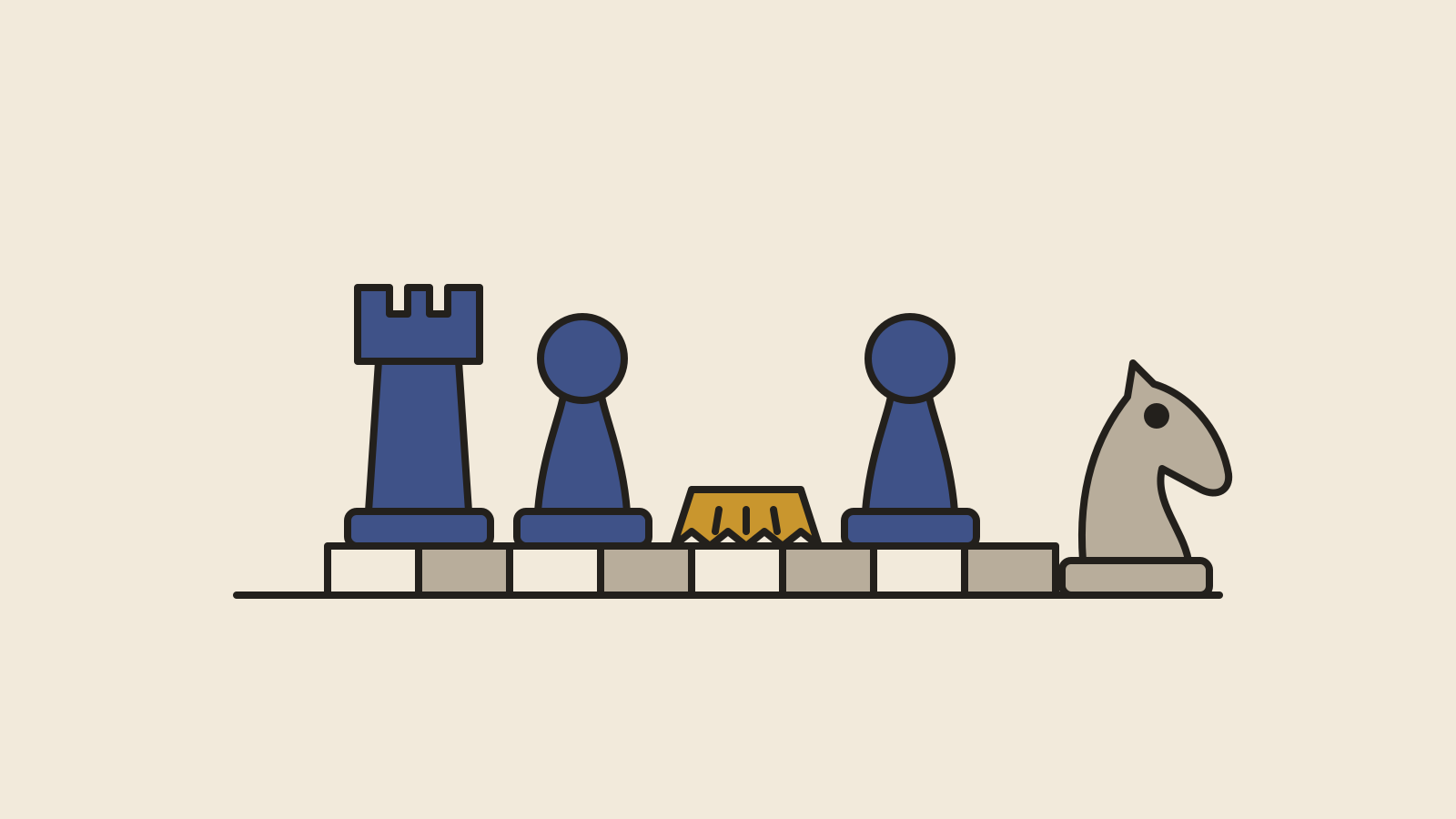
Structural linguistics treats a language as a system. Its units, whether sounds, words or grammatical forms, are defined by how they differ from one another and how they combine, and their physical substance matters little. Ferdinand de Saussure's comparison was chess. Lose a knight and you can play on with any object, a bottle cap say, so long as both players treat it as the knight. What makes the piece a knight is its place in the game.
Before this view took hold, the scientific study of language mostly traced how words and sounds had changed through history. Structuralists argued that the state of a language at one moment could be studied in its own right, as its speakers know it. The approach led linguistics from the 1920s to the 1950s through several schools, in Geneva, Prague, Copenhagen and the United States, which shared a method more than a doctrine.
Diagram
Structural linguistics led the field for three decades, then was absorbed
Read as text
A timeline from 1916 to 1957. In 1916 Saussure's Course in General Linguistics is published in Geneva. In 1926 the Prague Linguistic Circle is founded. In 1933 Bloomfield publishes Language in the United States. In 1939 Trubetzkoy's Principles of Phonology appears. In 1957 Chomsky's Syntactic Structures opens the generative challenge. A bar from 1926 to 1957 marks the years when structuralism was the leading approach. Today its methods are absorbed into general linguistics.
Core commitments
- A language is a system of relations, and a unit is whatever its contrasts with other units make it.
- Describing a language at one time (synchronic study) is separate from tracing its history (diachronic study) and comes first.
- The system shared by a community, its langue, is the object of study, and individual acts of speech are the evidence.
Langue and parole
Langue is the shared system of a language, and parole is each individual act of speaking or writing it.
- Units relate in two ways: to their neighbours in the chain of speech and to the alternatives that could have stood in their place.
- Every language is described in its own terms, with no Latin grammar as the template.
Not to be confused with
| Look-alike | The difference | Differs on |
|---|---|---|
| Generative grammar | Structuralists, the Americans above all, classified the units found in recorded speech by set procedures. Generativists propose rules in the speaker's mind and test them against speakers' judgements of sentences. | Differs onMethod |
| Structuralism (anthropology) | Claude Lévi-Strauss carried the linguists' method beyond language to kinship, myth and cooking. Linguistic structuralism is the source and deals with language only. | Differs onScope |
| Structuralism (psychology) | The structuralism of Wilhelm Wundt's pupil Edward Titchener, a generation earlier, broke conscious experience into elementary sensations. The linguists held the reverse, that elements exist only through the system. The shared name is a coincidence. | Differs onClaim |
- Differs onMethod
Structuralists, the Americans above all, classified the units found in recorded speech by set procedures. Generativists propose rules in the speaker's mind and test them against speakers' judgements of sentences.
- Differs onScope
Claude Lévi-Strauss carried the linguists' method beyond language to kinship, myth and cooking. Linguistic structuralism is the source and deals with language only.
- Differs onClaim
The structuralism of Wilhelm Wundt's pupil Edward Titchener, a generation earlier, broke conscious experience into elementary sensations. The linguists held the reverse, that elements exist only through the system. The shared name is a coincidence.
Origins and development
The starting point is the Course in General Linguistics (1916), put together from students' notes after Saussure's death. He never used the word structuralism. Roman Jakobson gave the approach that name in 1929. He and Nikolai Trubetzkoy, working in the Prague Linguistic Circle, built phonology, the study of sound systems. Louis Hjelmslev pursued a more abstract version in Copenhagen. In the United States a largely separate line began with Franz Boas and his pupil Edward Sapir and was hardened by Leonard Bloomfield, whose Language (1933) set strict methods for describing unwritten languages. Generative grammar displaced it after 1957.
Roman Jakobson
Russian-born linguist who carried structuralism from Moscow to Prague to America and showed that speech sounds are built from a few two-way contrasts.
Franz Boas
The German-born founder of American anthropology, who argued that differences between peoples are learned and replaced racial rankings with the study of cultures.
Why it matters
Its working tools are still the first things a linguistics student learns: the phoneme, the minimal pair, the test of swapping one unit for another. Field linguists use them to record endangered languages. Outside linguistics the method became a model for the human sciences in mid-century France, where anthropologists, literary critics and psychoanalysts tried to read kinship, stories and the unconscious as systems of signs.
Phoneme
The smallest unit of sound that can tell two words apart in a given language, like p and b in pin and bin.
Critiques and limits
Noam Chomsky argued from 1957 that sorting recorded utterances can never explain how speakers produce and understand sentences they have not met before, and that Bloomfield's followers had shut meaning and mind out of the science. Valentin Voloshinov had objected in 1929 that the fixed system is an abstraction, since living language exists only in exchanges between people. Jacques Derrida later held that a system of pure differences can never be closed or stable.
Noam Chomsky
American linguist who argued that the capacity for grammar is inborn, and one of the best-known critics of United States foreign policy.
Jacques Derrida
The Algerian-born French philosopher who founded deconstruction, a way of reading that shows how texts undermine the oppositions they depend on.
Key figures
- Ferdinand de Saussure1857–1913
- Nikolai Trubetzkoy
- Roman Jakobson1896–1982
- Louis Hjelmslev
- Edward Sapir1884–1939
- Leonard Bloomfield
- Zellig Harris
- André Martinet



Connections
Originated by
His posthumous Course supplied the founding ideas, though the name and the methods came from later linguists in Prague and America.
Influenced by
Bloomfield studied Pāṇini's grammar closely and held it up as the model of complete, compact description.
Behaviourism (psychology)Psychology
Bloomfield rebuilt American structural linguistics on behaviourist lines, describing languages from observable speech and keeping meaning and mind out of the method.
Contrasts with
Differs on method. Structuralists classified recorded speech by set procedures, while generativists propose rules and test them against speakers' judgements.
Post-structuralismPhilosophy
Differs on claim. Structuralists held that a sign system is stable and can be mapped from outside, which post-structuralists deny.
Structuralism (anthropology)Anthropology
Differs on scope. The linguists' method deals with language only, and Lévi-Strauss carried it over to kinship, myth and cooking.
Structuralism (psychology)Psychology
Differs on claim. Psychology's structuralism built experience up from elementary sensations, while the linguists held that elements exist only through the system.
Parallels
The grammarians sorted words into classes by what could replace what in a sentence, a test structural linguists reached independently.
Gestalt psychologyPsychology
Both put the whole before its parts: a percept is not a sum of sensations, and a sound has value only within its system.
Social factSociology
Saussure's langue fits Durkheim's definition of a social fact: a system outside any one speaker that constrains them all.
Structure and agencySociology
Langue and parole pose the same puzzle in language: a system no speaker made, existing only through individual acts of speech.
Contains
Trained in Sapir's Yale circle, he described Hopi and Nahuatl with the methods of American structural linguistics.
His 1925 account of sound patterns helped found American structural linguistics, though he kept the speaker's mind in view.
Later linguists built the school on his lectures, though he never used its name.
He named the school in 1929 and led its Prague wing with Nikolai Trubetzkoy.
The school's method follows from it, since signs with no natural basis can be defined only by their contrasts.
The school took langue, the system, as the proper object of linguistics and set parole aside.
The phoneme was the school's showpiece, a unit defined by its contrasts within a system and by no physical property.
Extended by
Post-structuralismPhilosophy
It keeps Saussure's point that meaning comes from differences between signs and drops the assumption of a closed system.
Structuralism (anthropology)Anthropology
Takes the linguists' rule that units are defined by their contrasts and applies it to kinship, myth and classification.
Influenced
Michel FoucaultPhilosophy
Like the structuralists he looked for the rules beneath what people say, while denying that he was one of them.
He trained under the structuralist Zellig Harris and turned Harris's transformations to new ends.
Actor–network theorySociology
Its term actant comes from structural semiotics, where anything that acts in a story counts as an actor.
Its first formal tools, transformations among them, came from the structuralist Zellig Harris, who taught Chomsky.
The linguists at the 1953 founding seminar were structuralists, and early experiments asked whether their units, phonemes and morphemes, were psychologically real.
Psychological and cognitive anthropologyAnthropology
Early cognitive anthropologists copied the linguists' method for finding a language's sound contrasts and applied it to kin terms and plant names.
Lexical semantics kept the structuralist view that a word's sense lies in its relations to other words, such as antonymy and hyponymy.
Subaltern StudiesSociology
Guha read peasant revolt as a code of signs, using structural linguistics to decode rebel consciousness from hostile colonial records.
Alliance theoryAnthropology
The method of finding a few contrasts beneath many surface forms came from the linguists' analysis of sound systems.
Cross with
Two distant entries to read beside this one, each with the question the pairing opens.
Balance of powerPolitical theory & science
Saussure said a sign's value comes only from its differences from other signs: is a state's power likewise nothing but its position among rivals? Set them side by side
Purity and pollutionAnthropology
Douglas says dirt is whatever falls outside a society's categories: is pollution defined by contrast within a system, as Saussure's signs are? Set them side by side
Further reading
- Bloomfield, L. (1933). Language. Henry Holt.
- Harris, R. A. (1993). The linguistics wars. Oxford University Press. https://doi.org/10.1093/oso/9780195072563.001.0001
- Sampson, G. (1980). Schools of linguistics. Stanford University Press. https://doi.org/10.1515/9781503621282
- Saussure, F. de. (1983). Course in general linguistics. Duckworth. (Original work published 1916)
Cite this entry
Scholia. (2026). Structuralism (linguistics). In Scholia: Notes in the margin of the human sciences. Retrieved November 28, 2026, from https://scholia.zennia.sg/schools/structuralism-linguistics