School or branchPhilosophy
Cārvāka
Ancient India's materialist school, which held that only the physical world exists, that the mind dies with the body and that there is no afterlife.
Overview
Cārvāka, also called Lokāyata, "the worldly view", was ancient India's materialist school. Its members held that only the physical world exists, that a person is a living body and nothing more and that death is the end. No soul survives, so there is no rebirth, no karma carried forward and no heaven to earn by ritual.
Karma
The principle in Hindu, Buddhist and Jain thought that intentional actions bring fitting consequences for the actor, in this life or a later one.
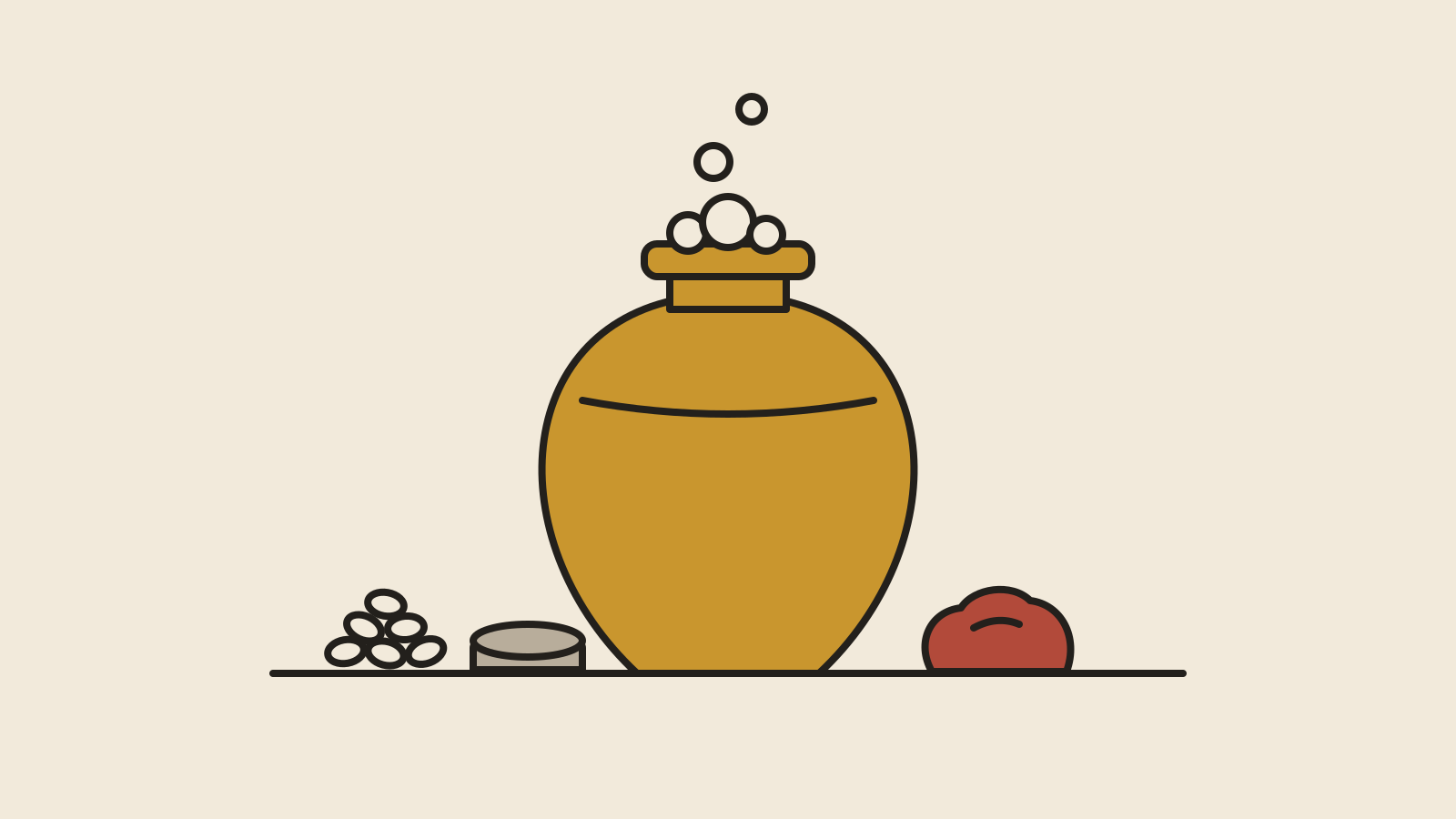
They explained the mind with an image from the brewer's yard. Molasses, grain and yeast do not intoxicate on their own. Leave them to ferment together and the brew does. In the same way, they said, consciousness appears when earth, water, fire and air combine in a living body, and it vanishes when the body breaks up. Apart from one sceptic's treatise, whose place in the school is disputed, its own works are lost. It is known mainly from summaries by its opponents, who had every reason to make it look crude.
Diagram
Cārvāka kept the perceptible world and rejected whatever lies beyond it
Read as text
Two columns divided by whether something is within reach of the senses. On the left, what Cārvāka accepted: the four elements of earth, water, fire and air, the living body as the self, and perception together with everyday inference about perceptible things. On the right, what it rejected: souls and rebirth, karma and heaven and the authority of the Vedas.
Core commitments
- Only four elements exist (earth, water, fire and air) and everything, living bodies included, is made of them.
- Consciousness is a product of the body, as the power to intoxicate is a product of fermentation, so it ends at death.
- Perception is the sure pramana, or source of knowledge. Inference is trusted at most about things that could be perceived, never about souls, gods or other worlds.
Pramana
A pramana is a means of knowledge, such as perception, inference or testimony, that classical Indian philosophers held to produce true awareness reliably.
- The Vedas have no special authority, and their rituals and promises of heaven serve the priests who perform them.
- The aim of life is to live this one well, since no other awaits.
Not to be confused with
| Look-alike | The difference | Differs on |
|---|---|---|
| Nyaya | Nyaya accepts inference as a full source of knowledge, so it can reason from the order of the world to a creator and from memory to a lasting self. Cārvākas refused inferences that reach beyond anything perceivable, and with them the self and God. | Differs onClaim |
| Physicalism | Both hold that everything is physical. Physicalists take their list of what exists from physics, including particles and fields no one perceives. Cārvākas took theirs from the senses, and their rule against inferring the unperceived would tell against such entities. | Differs onMethod |
| Epicureanism | Greece's materialists also denied an afterlife and made pleasure the good. Epicurus reached unseen atoms by inference and ranked calm above excitement. Cārvāka grew up separately in India, built on four perceptible elements and a quarrel with Vedic ritual. | Differs onTradition |
- Differs onClaim
Nyaya accepts inference as a full source of knowledge, so it can reason from the order of the world to a creator and from memory to a lasting self. Cārvākas refused inferences that reach beyond anything perceivable, and with them the self and God.
- Differs onMethod
Both hold that everything is physical. Physicalists take their list of what exists from physics, including particles and fields no one perceives. Cārvākas took theirs from the senses, and their rule against inferring the unperceived would tell against such entities.
- Differs onTradition
Greece's materialists also denied an afterlife and made pleasure the good. Epicurus reached unseen atoms by inference and ranked calm above excitement. Cārvāka grew up separately in India, built on four perceptible elements and a quarrel with Vedic ritual.
Origins and development
In a Buddhist discourse from the Buddha's time, Ajita Kesakambalī teaches that a person is four elements and nothing survives death. The school traced itself to a sage named Bṛhaspati. Its book of aphorisms, of disputed date, survives only in fragments quoted by critics. Purandara, in the seventh or eighth century, allowed inference about the perceptible world. Jayarāśi, around 800, left the one complete work to survive, a sceptic's attack on every source of knowledge, perception included. The best-known portrait, in Mādhava's fourteenth-century survey of the schools, places it lowest of all.
Why it matters
Cārvāka shows that thoroughgoing materialism and religious scepticism are as old in India as anywhere. Twentieth-century Indian rationalists and Marxists, Debiprasad Chattopadhyaya prominent among them, took it up as a native tradition of free thought against priestly authority. Its challenge to inference, that nobody can observe every case of smoke to know that smoke always means fire, pushed Nyaya and Buddhist logicians to explain how general rules are known.
Nyaya
The classical Indian school of logic and epistemology, which holds that the world is real and knowable through perception, inference, comparison and testimony.
Critiques and limits
Rival schools replied that the Cārvāka argument against inference is itself an inference, so it defeats itself. Nyaya philosophers argued that memory and recognition need a lasting self, which a changing body cannot supply. The historian Ramkrishna Bhattacharya argued that the familiar picture of crude pleasure-seekers comes from hostile sources and that the Cārvākas accepted everyday inference. Because the school's texts are lost, every reconstruction rests on fragments and reports.
Key figures
- Bṛhaspati (legendary founder)
- Ajita Kesakambalī
- Purandara
- Jayarāśi Bhaṭṭa
Connections
Critiques
Contrasts with
Differs on claim. Nyaya trusts inference to reach a creator and a lasting self, where Cārvākas refused inferences that go beyond anything perceivable.
Differs on method. Physicalists take their list of what exists from physics, unobservables included, where Cārvākas took theirs from what the senses show.
Differs on tradition. Greece's atomists and India's materialists separately denied an afterlife and prized pleasure, from different starting points.
Critiqued by
Jain scriptures argue against the materialists that the soul is not the body and does not perish with it.
Further reading
- Bhattacharya, R. (2011). Studies on the Cārvāka/Lokāyata. Anthem Press. (Original work published 2009)
- Chattopadhyaya, D., & Gangopadhyaya, M. K. (1990). Cārvāka/Lokāyata: An anthology of source materials and some recent studies. Indian Council of Philosophical Research.
- Chattopadhyaya, D. (1959). Lokāyata: A study in ancient Indian materialism. People's Publishing House.
Cite this entry
Scholia. (2026). Cārvāka. In Scholia: Notes in the margin of the human sciences. Retrieved November 28, 2026, from https://scholia.zennia.sg/schools/carvaka