School or branchPhilosophy
Nyaya
The classical Indian school of logic and epistemology, which holds that the world is real and knowable through perception, inference, comparison and testimony.
Overview
Nyaya, a Sanskrit word for method or rule of reasoning, is the school of classical Indian philosophy most concerned with how we know things. Its philosophers ask what counts as a reliable source of knowledge, how a sound argument is built and how a debate should be run. Their answers became the shared working method of Indian philosophy, used even by schools that rejected Nyaya's conclusions.
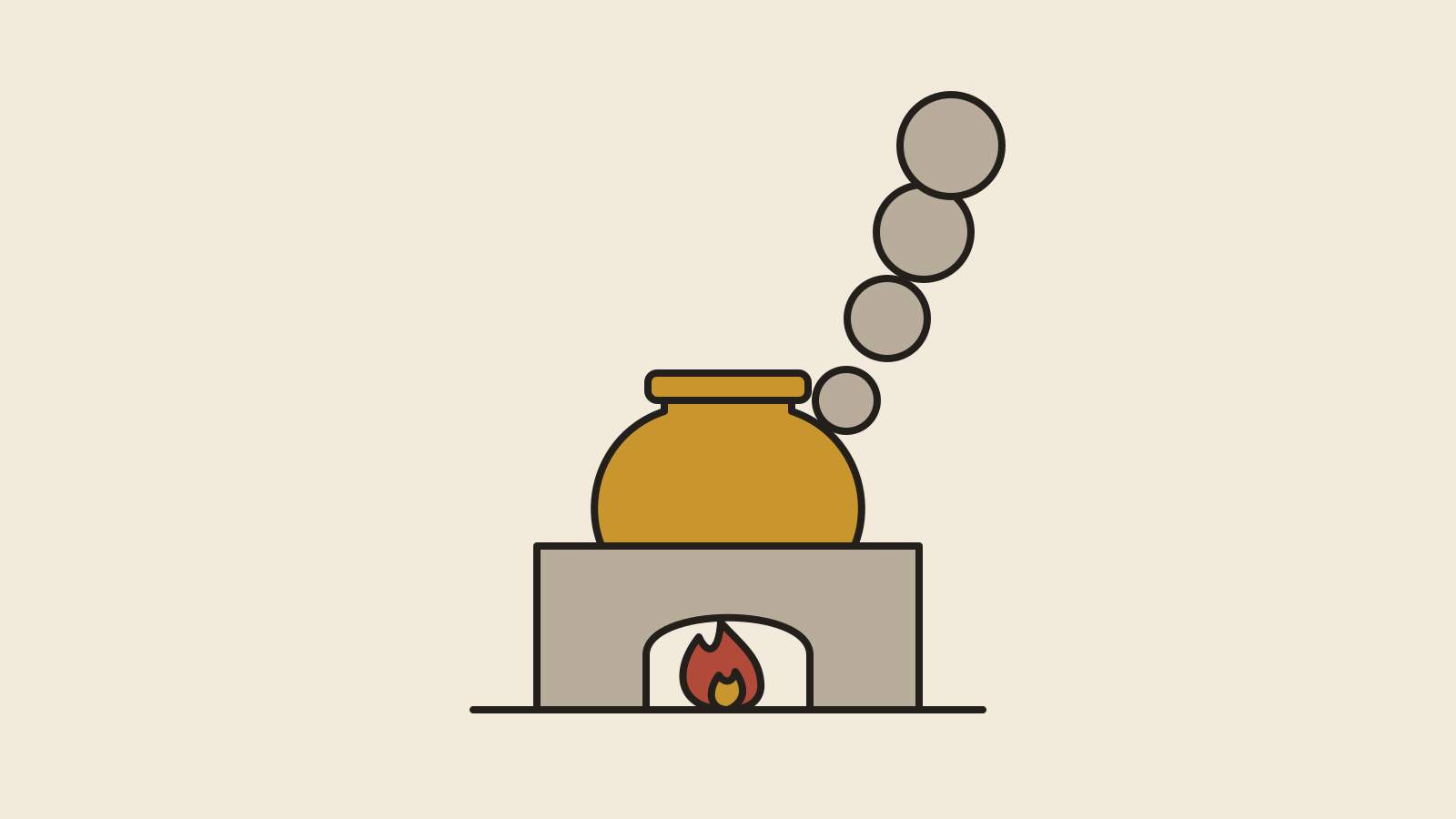
The stock example is smoke on a hill. You cannot see a fire, but you have seen smoke together with fire many times, at a kitchen hearth for instance, and never smoke without it. So you infer fire on the hill. Nyaya spells out each step of that inference and each way it can go wrong.
The school is realist. It holds that the world exists independently of our minds, that we can know it and that each of us is a lasting self. It also developed arguments for a creator God.
Diagram
A Nyaya inference moves in five steps from a claim to its proof
Read as text
Five steps in a row. First the thesis: the hill has fire. Second the reason: because it has smoke. Third the example: wherever there is smoke there is fire, as at a kitchen hearth. Fourth the application: this hill has smoke of that kind. Fifth the conclusion: so the hill has fire.
Core commitments
- Knowledge comes from four sources, each called a pramana: perception, inference, comparison and the testimony of a trustworthy speaker.
Pramana
A pramana is a means of knowledge, such as perception, inference or testimony, that classical Indian philosophers held to produce true awareness reliably.
- A full inference has five steps and must cite an example, which ties the general rule to an observed case.
- The objects of knowledge exist independently of the knower, and a cognition is true when it presents its object as it is.
- A lasting self exists, shown by memory and by our ability to recognise one object through different senses.
- Right knowledge removes the errors that cause suffering, so philosophy serves liberation.
Not to be confused with
| Look-alike | The difference | Differs on |
|---|---|---|
| Logic | Nyaya is often translated as "Indian logic", but it is a whole philosophy, with a theory of knowledge, a metaphysics and a path to liberation. Its inference also differs from formal deduction: it must cite an observed example and aims at knowledge of facts, where formal logic studies valid form alone. | Differs onScope |
| Empiricism | Both ground knowledge in perception. Nyaya adds testimony as a source in its own right, and it accepts things most empiricists doubted: real universals, a lasting self and a God known by inference. | Differs onClaim |
| Vaisheshika | The sister school that catalogued what exists: substances, qualities, motions, universals and atoms. Nyaya specialised in knowledge and argument. The two had merged by about the eleventh century. | Differs onScope |
- Differs onScope
Nyaya is often translated as "Indian logic", but it is a whole philosophy, with a theory of knowledge, a metaphysics and a path to liberation. Its inference also differs from formal deduction: it must cite an observed example and aims at knowledge of facts, where formal logic studies valid form alone.
- Differs onClaim
Both ground knowledge in perception. Nyaya adds testimony as a source in its own right, and it accepts things most empiricists doubted: real universals, a lasting self and a God known by inference.
- Differs onScope
Vaisheshika
The sister school that catalogued what exists: substances, qualities, motions, universals and atoms. Nyaya specialised in knowledge and argument. The two had merged by about the eleventh century.
Origins and development
The founding text is the Nyaya-sutra, attributed to Akshapada Gautama (no relation to the Buddha) and compiled in stages, reaching its present form by about the second century CE. Vatsyayana wrote the first surviving commentary around 450. For centuries Nyaya philosophers sharpened their views in debate with Buddhists such as Dignaga and Dharmakirti, with Uddyotakara and later Udayana replying. Around 1325 Gangesha's Tattvacintamani launched Navya-Nyaya, the "new Nyaya", whose precise technical language spread to grammar, law and poetics.
Why it matters
Nyaya shows that rigorous theories of inference, fallacy and evidence grew up outside Greece, on their own terms. Its treatment of testimony as a basic source of knowledge anticipated a question now central in epistemology: how much of what we know rests on trusting others. Its categories of debate still shape traditional Sanskrit scholarship, and Bimal Krishna Matilal brought its arguments about perception into modern philosophical discussion.
Epistemology
The branch of philosophy that asks what knowledge is, where it comes from and how much of it we can have.
Critiques and limits
Nagarjuna asked what establishes the knowledge sources themselves. If further sources do, a regress begins. If nothing does, the rule that everything needs a source has an exception. The Buddhist logician Dharmakirti argued that Nyaya's universals and enduring substances are fictions laid over momentary particulars. The Carvaka materialists denied that inference yields knowledge at all, since nobody can observe that smoke always accompanies fire. In the twelfth century the Advaita philosopher Shriharsha argued that none of Nyaya's definitions survives scrutiny.
Nagarjuna
The Indian Buddhist philosopher who argued that nothing has a fixed nature of its own, and founded the Madhyamaka school on that claim.
Key figures
- Akshapada Gautama
- Vatsyayana
- Uddyotakara
- Jayanta Bhatta
- Udayana
- Gangesha
Connections
Critiques
Argues that memory and recognising one object by sight and touch both require a lasting self.
Replies that a school denying intrinsic natures cannot trust the arguments it uses to deny them.
Vyākaraṇa (the Sanskrit grammatical tradition)Cognitive science & linguistics
Nyaya philosophers rejected the grammarian Bhartrhari's claim that a sentence's meaning is one indivisible whole, holding that hearers assemble it from words.
Contrasts with
Differs on scope. Nyaya is a whole philosophy of knowledge, reality and liberation, of which a theory of inference is one part.
Differs on claim. Both start from perception, but Nyaya adds testimony as a basic source and accepts universals, a self and God.
Parallels
Nyaya logicians catalogued hetvabhasa, reasons that look sound and are not, with no debt to the Greek lists.
Nyaya realists defended universals against Buddhist critics in a debate that ran independently of the Greek and Latin one.
Contains
Nyaya built its whole system on four pramanas and defended them against Buddhist and sceptical attack.
Critiqued by
His Dispeller of Disputes denies that Nyaya's knowledge sources can be established without a regress or a circle.
Shriharsha's twelfth-century Advaita critique argued that none of Nyaya's definitions of knowledge and its sources survives scrutiny.
Denies that Nyaya's knowledge sources and the objects they reveal can be established independently of each other.
Cross with
Two distant entries to read beside this one, each with the question the pairing opens.
Reliability (measurement)Psychology
Nyaya asks what makes a source of knowledge trustworthy, psychometrics what makes a measure consistent: is a consistent instrument thereby a source of knowledge? Set them side by side
Statistical significancePsychology
Nyaya counts inference as a source of knowledge: how would it judge the step from a statistically significant result to a real effect? Set them side by side
Further reading
- Dasti, M., & Phillips, S. (2017). The Nyāya-sūtra: Selections with early commentaries. Hackett.
- Ganeri, J. (2001). Philosophy in classical India: The proper work of reason. Routledge.
- Matilal, B. K. (1986). Perception: An essay on classical Indian theories of knowledge. Clarendon Press.
Cite this entry
Scholia. (2026). Nyaya. In Scholia: Notes in the margin of the human sciences. Retrieved November 28, 2026, from https://scholia.zennia.sg/schools/nyaya