School or branchPolitical theory & scienceAlso in Philosophy
Conservatism
The political tradition that trusts inherited institutions over abstract plans and accepts change only when it is gradual.
Overview
Conservatism is the political tradition that gives inherited institutions the benefit of the doubt. Its supporters hold that customs, laws and loyalties which have lasted carry knowledge no planner could assemble, and that society is too complicated to rebuild from a theory. Change is accepted, even welcomed, when it comes gradually and grows out of what is already there.
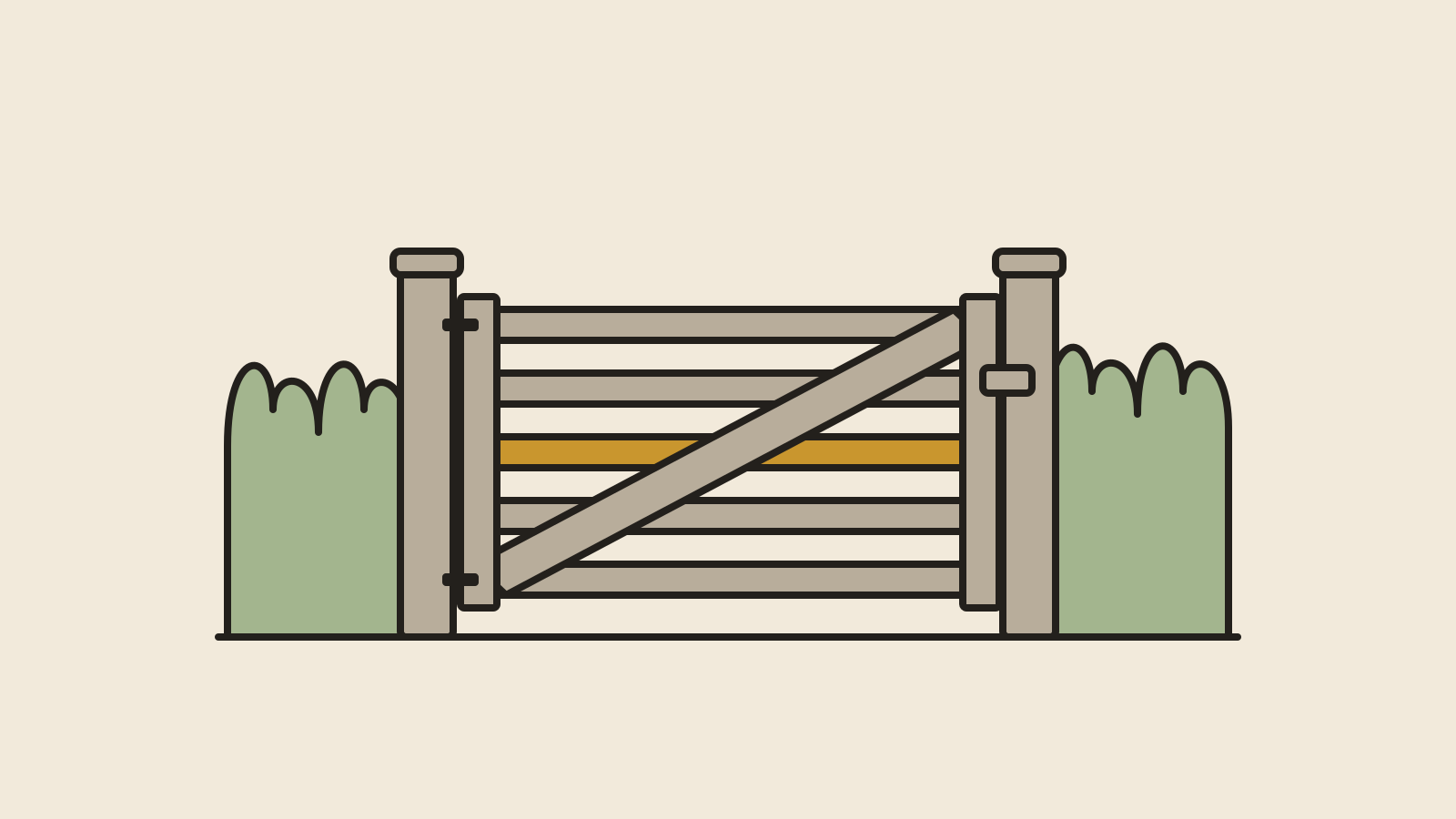
G. K. Chesterton told the rule as a story about a gate across a road. A hasty reformer who sees no use for it wants it gone. A wiser one replies that nobody may remove it until they know why it was put up. Conservatives took that answer as their own. The same instinct appears when a village resists merging its small school into a larger, cheaper one: the school is also where neighbours meet, and that function appears in no budget.
Conservatives disagree about much else, markets and religion included. What they share is a temperament turned into an argument.
Diagram
Conservatism began as a reply to revolution and was named a generation later
Read as text
A timeline from 1790 to the present. In 1790 Edmund Burke publishes Reflections on the Revolution in France. In 1797 Joseph de Maistre publishes Considerations on France, a harsher Continental reply to the revolution. In 1818 Chateaubriand's journal Le Conservateur gives the tradition its name. In 1834 Robert Peel's Tamworth Manifesto sets out the programme of Britain's Conservative Party. In 1953 Russell Kirk's The Conservative Mind traces a tradition from Burke for American readers. In 1962 Michael Oakeshott's Rationalism in Politics restates conservatism as a disposition. In 1979 Margaret Thatcher takes office, joining conservatism to free-market economics. The tradition is active today.
Core commitments
- Tradition is a test: practices that have survived generations of use deserve a presumption in their favour.
- Human reason and human goodness are limited, so power should be checked and grand schemes distrusted.
- Society is an organic whole of families, churches, localities and associations, which stand between the individual and the state.
- Reform should be piecemeal and reversible, repairing institutions without replacing them.
- Authority, property and settled law are conditions of liberty.
Not to be confused with
| Look-alike | The difference | Differs on |
|---|---|---|
| Liberalism (political) | Liberals begin from the rights and choices of individuals and judge institutions by them. Conservatives begin from institutions and hold that individuals are formed by them. The two often agree on constitutional government. | Differs onClaim |
| Libertarianism (political) | Libertarians want the state kept to a minimum on principle and are indifferent to tradition. Conservatives will use the state to uphold order, family and nation. | Differs onClaim |
| Authoritarianism | Authoritarianism is a descriptive label for regimes that concentrate power and restrict opposition. Conservatism is an outlook on how to govern, and its main line defends constitutional limits and independent institutions. | Differs onDescriptive or normative |
| Reaction | Reactionaries want to restore an order already lost, by rupture if need be. Conservatives work with the present and accept changes once they have settled. | Differs onClaim |
- Differs onClaim
Liberals begin from the rights and choices of individuals and judge institutions by them. Conservatives begin from institutions and hold that individuals are formed by them. The two often agree on constitutional government.
- Differs onClaim
Libertarians want the state kept to a minimum on principle and are indifferent to tradition. Conservatives will use the state to uphold order, family and nation.
- Differs onDescriptive or normative
Authoritarianism is a descriptive label for regimes that concentrate power and restrict opposition. Conservatism is an outlook on how to govern, and its main line defends constitutional limits and independent institutions.
- Differs onClaim
Reaction
Reactionaries want to restore an order already lost, by rupture if need be. Conservatives work with the present and accept changes once they have settled.
Origins and development
The tradition took shape in response to the French Revolution. Edmund Burke's Reflections (1790) supplied its arguments, and Joseph de Maistre gave a harsher version on the Continent, built on throne and altar. The name came later: Chateaubriand's journal Le Conservateur appeared in 1818, and Britain's Tories became the Conservative Party in the 1830s. Benjamin Disraeli tied it to social reform. Michael Oakeshott restated it as a disposition, in a 1956 lecture published in 1962. From the 1970s parties of the right joined it, uneasily, to free-market economics.
Why it matters
Parties calling themselves conservative govern or lead the opposition in much of the world, and the outlook reaches well beyond them. Arguments for keeping an unwritten constitution, a local dialect, a historic street or a slow legal procedure are conservative arguments, whoever makes them. Knowing the tradition also helps a reader see the strains inside today's right, where free-marketeers, religious traditionalists and nationalists share a label and differ on what should be conserved.
Critiques and limits
Friedrich Hayek argued in his 1960 essay "Why I Am Not a Conservative" that the outlook can slow change yet cannot say where to go, so its opponents drag it along. Samuel Huntington held in 1957 that conservatism has no ideal of its own and defends whatever institutions exist. Mary Wollstonecraft, answering Burke in 1790, charged that the traditions he defended were mostly those of the propertied. Corey Robin argues that its real constant is the defence of hierarchy against movements from below.
Friedrich Hayek
An Austrian-born economist and philosopher who argued that market prices carry knowledge no planner could gather, and defended liberty under general rules.
Mary Wollstonecraft
An English writer who argued in 1792 that women are rational beings owed the same education and civil standing as men.
Key figures
- Edmund Burke1729–1797
- Joseph de Maistre
- Benjamin Disraeli
- Michael Oakeshott
- Russell Kirk
- Roger Scruton

Connections
Originated by
Burke's 1790 attack on the French Revolution supplied the arguments that later writers organised into a doctrine.
Influenced by
David HumePhilosophy
Hume's doubts about abstract reason and his respect for custom as the guide of life gave conservatives a philosophical footing.
Critiques
Conservatives deny that political obligation rests on individual consent, since people are born into duties they never chose.
Conservatives object that central planning and levelling destroy the inherited institutions and local knowledge that order depends on.
Contrasts with
Differs on claim. Liberals judge institutions by the rights and choices of individuals, where conservatives hold that institutions form the individuals.
Differs on claim. Libertarians want a minimal state on principle, where conservatives will use the state to uphold order, family and nation.
Differs on descriptive or normative. Authoritarianism is a descriptive label for unaccountable regimes, where conservatism is an outlook that mostly defends constitutional limits.
Parallels
Institutions (economics)Economics
North's finding that transplanted formal rules fail without matching customs restates, in economics, Burke's warning against redesigning inherited institutions.
Functionalism (sociology)Sociology
Both hold that long-standing institutions serve purposes no one designed, so removing them risks harms that reformers cannot foresee.
Contains
His Reflections supplied the arguments from which nineteenth-century writers built conservatism, a word he never used.
Cross with
Two distant entries to read beside this one, each with the question the pairing opens.
Prospect theoryEconomics
People feel a loss more than an equal gain. How could one tell a conservative's reasoned caution about reform from plain loss aversion? Set them side by side
DaoismPhilosophy
Daoists tell rulers to stop forcing things and conservatives distrust abstract plans. Does following nature give the same advice as following tradition? Set them side by side
Further reading
- Burke, E. (1987). Reflections on the revolution in France. Hackett. (Original work published 1790)
- Fawcett, E. (2020). Conservatism: The fight for a tradition. Princeton University Press. https://doi.org/10.1515/9780691207773
- Oakeshott, M. (1962). Rationalism in politics and other essays. Methuen.
Cite this entry
Scholia. (2026). Conservatism. In Scholia: Notes in the margin of the human sciences. Retrieved November 28, 2026, from https://scholia.zennia.sg/schools/conservatism
This topic is contested. The entry sets out the main positions rather than settling them.