School or branchPhilosophy
Daoism
The Chinese tradition holding that people and states go best when they stop forcing things and follow the natural course, the Dao.
Overview
Daoism is the tradition that grew from two ancient Chinese books, the Daodejing attributed to Laozi and the Zhuangzi, named after Zhuangzi. Both hold that there is a natural course of things, the Dao, which nobody designed and no rule fully states. Trouble starts when people override it with ambition, cleverness and fixed moral codes. The remedy is wu wei: act without forcing, want less and let things take their own shape.
Laozi
The legendary author of the Daodejing, the short classic that advises yielding, simplicity and governing without interference.
Zhuangzi
The Daoist writer whose stories and paradoxes question every fixed viewpoint and praise a free, skilful and unforced way of living.
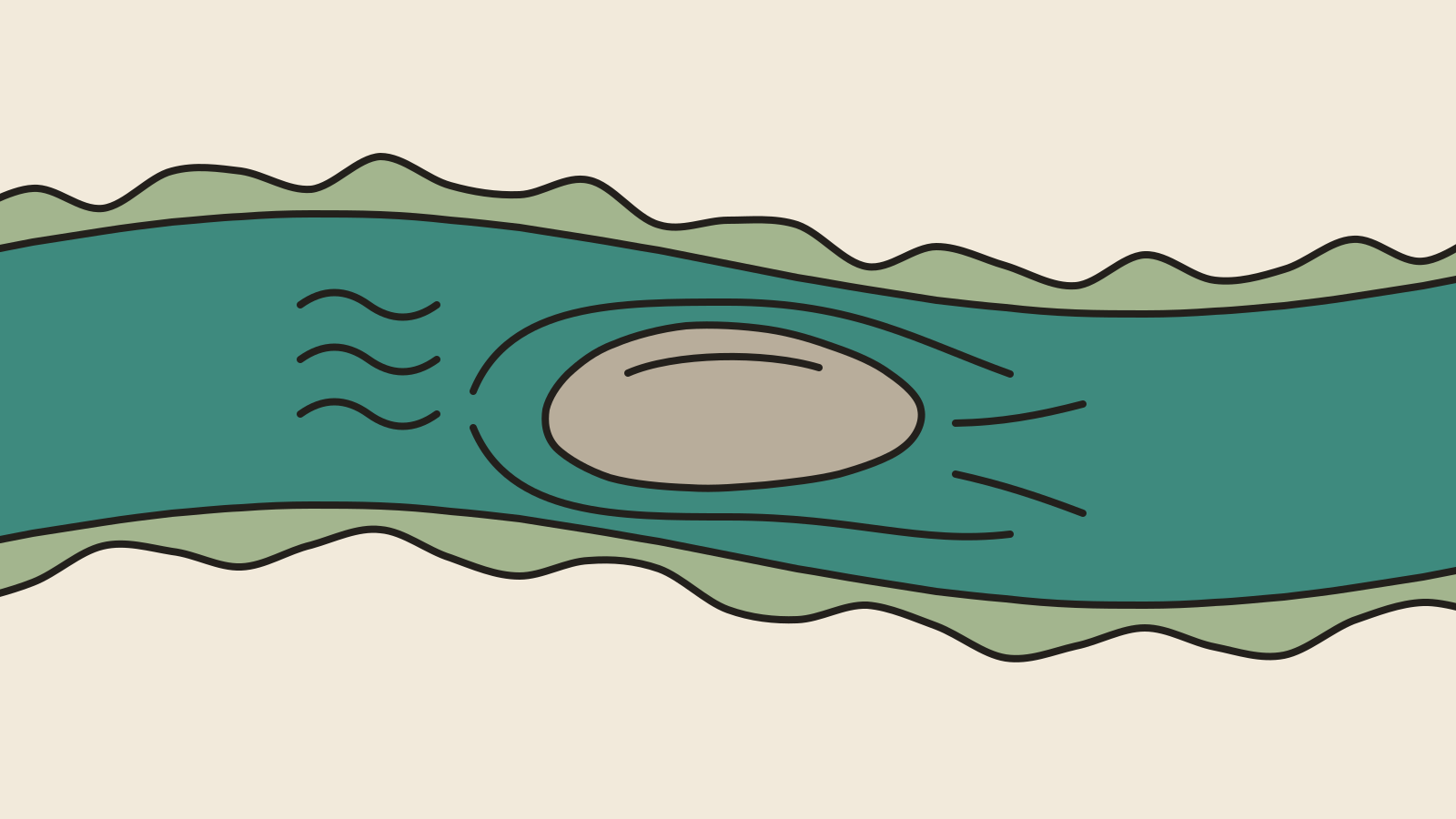
A swimmer caught in a current shows the idea. Fighting straight against the water exhausts her. Going with it at an angle brings her to shore. Daoists see the same pattern in craft, in health and in government, where the best ruler interferes least.
The word covers more than a philosophy. From the second century CE it also names an organised religion with priests, scriptures, gods and practices aimed at long life. Scholars dispute how sharply the two can be separated.
Diagram
Daoism was named as a school long after its classics were written
Read as text
A timeline with five events. Around 300 BCE the Laozi and Zhuangzi texts take shape. By about 110 BCE the historian Sima Tan has coined the name daojia, the school of the Way. In 142 CE the Celestial Masters movement is founded, the start of organised religious Daoism. Around 245 CE Wang Bi writes his commentary on the Laozi. In 1445 the Daoist canon is printed. The tradition is active today.
Core commitments
- The Dao is the source and pattern of everything, and it cannot be captured in words or doctrines.
- Naturalness (ziran, "so of itself") is the standard: things go well when they unfold from their own tendencies.
- Wu wei, unforced action, achieves more than striving and control.
- Distinctions such as good and bad or useful and useless are made by people and should be held loosely.
- Softness, simplicity and few desires protect a person and a state better than strength and wealth.
Not to be confused with
| Look-alike | The difference | Differs on |
|---|---|---|
| Confucianism | Confucians trust study, ritual and moral effort to make people good. Daoists hold that such effort is itself the problem and that goodness comes when the forcing stops. Many Chinese officials were Confucian in office and Daoist in retirement. | Differs onClaim |
| Stoicism | Both advise living in accord with nature and accepting what cannot be changed. The Stoic's nature is a rational order grasped by reason, and virtue means disciplined judgement. The Daoist's nature lies beyond reasoning, and the ideal is spontaneous skill. | Differs onClaim |
| Zen Buddhism | Zen (Chan) took much of its style from Daoism: paradox, distrust of words, praise of the ordinary. It remains Buddhist in doctrine, aiming at awakening from suffering through insight into emptiness. | Differs onTradition |
- Differs onClaim
Confucians trust study, ritual and moral effort to make people good. Daoists hold that such effort is itself the problem and that goodness comes when the forcing stops. Many Chinese officials were Confucian in office and Daoist in retirement.
- Differs onClaim
Both advise living in accord with nature and accepting what cannot be changed. The Stoic's nature is a rational order grasped by reason, and virtue means disciplined judgement. The Daoist's nature lies beyond reasoning, and the ideal is spontaneous skill.
- Differs onTradition
Zen Buddhism
Zen (Chan) took much of its style from Daoism: paradox, distrust of words, praise of the ordinary. It remains Buddhist in doctrine, aiming at awakening from suffering through insight into emptiness.
Origins and development
The core texts took shape in the fourth and third centuries BCE, with no school behind them. The label daojia, the school of the Way, comes from the historian Sima Tan, who died in 110 BCE. Wang Bi and Guo Xiang, writing in the 240s and around 300 CE, produced the commentaries that fixed how the classics were read. Religious Daoism is usually dated from 142 CE, when Zhang Daoling founded the Celestial Masters movement in Sichuan. A canon of well over a thousand texts was printed in 1445.
Why it matters
Chinese medicine, martial arts such as taijiquan, landscape painting and garden design all draw on Daoist ideas of balance and natural flow. Its temples are active across China, Taiwan and Southeast Asia. Elsewhere the Daodejing is read as a guide to leadership and to living lightly on the earth. Economists who favour free markets have claimed Laozi as an early voice for spontaneous order.
Spontaneous order
Many useful social arrangements, such as language, money and markets, arise from people's actions without anyone having designed them.
Critiques and limits
Xunzi charged that Zhuangzi saw nature and missed the human, since societies need standards that somebody must set. Zhu Xi and other Neo-Confucians called withdrawal from family and office selfish. Han Feizi borrowed the non-acting ruler for an authoritarian theory of control, which suggests the politics can be turned to almost any use. Russell Kirkland and Nathan Sivin object to the modern habit of prizing a pure philosophical Daoism and dismissing the religion as its corruption.
Neo-Confucianism
The Song and Ming dynasty renewal of Confucianism that grounded its ethics in a metaphysics of principle and made self-cultivation a strict discipline.
Han Feizi
A Chinese prince who argued that states are kept in order by clear laws, sure rewards and sure punishments, with no need for virtue.
Key figures


Connections
Originated by
Critiques
Daoists regard Confucian moral effort and ritual as the forcing that disturbs a natural order.
Contrasts with
Differs on claim. Confucians trust study, ritual and moral effort, which Daoists regard as the forcing that causes disorder.
Differs on claim. Both follow nature, but the Stoic's is a rational order grasped by reason and the Daoist's lies beyond reasoning.
Parallels
Spontaneous orderEconomics
Hayek's markets and the well-governed state of the Daodejing both show order arising where no one imposes a design.
Contains
The Daodejing credited to him is the founding text of the tradition.
His book is the second founding text of the tradition and the source of its sceptical, playful strand.
Daoists made the way a nameless source and pattern of all things, and the school takes its name from the word.
The Daodejing and the Zhuangzi make unforced action the mark of a person or ruler who follows the way.
Influenced
Legalism (Chinese)Political theory & science
Han Feizi borrowed the Daoist ideal of the still, non-acting ruler and turned it into a method for watching ministers.
Zhou Dunyi's diagram of the Supreme Ultimate, the school's cosmological starting point, is usually traced to Daoist circles.
Critiqued by
Zhu Xi charged Daoists, like Buddhists, with abandoning family and public duty in pursuit of private calm.
Cross with
Two distant entries to read beside this one, each with the question the pairing opens.
SatyagrahaPolitical theory & science
Satyagraha resists injustice by open refusal without violence, Daoists counsel against forcing things: when does yielding count as a way of acting? Set them side by side
Learned helplessnessPsychology
Daoists praise not striving: what separates that from the helplessness of animals and people who stop trying after bad events they could not control? Set them side by side
Further reading
- Chuang Tzu. (1968). The complete works of Chuang Tzu. Columbia University Press. (Original work published -300)
- Graham, A. C. (1989). Disputers of the Tao: Philosophical argument in ancient China. Open Court.
- Kirkland, R. (2004). Taoism: The enduring tradition. Routledge. https://doi.org/10.4324/9780203646717
- Lao Tzu. (1963). Tao te ching. Penguin Books. (Original work published -300)
Cite this entry
Scholia. (2026). Daoism. In Scholia: Notes in the margin of the human sciences. Retrieved November 28, 2026, from https://scholia.zennia.sg/schools/daoism