School or branchEconomicsAlso in Sociology, Political theory & science
Dependency theory
A school arguing that the poverty of poor countries is produced by their subordinate place in a world economy built around the rich ones.
Overview
Dependency theory is a body of work, most of it Latin American, that explains underdevelopment by a country's position in the world economy. Its writers rejected the view that poor countries are late starters on a road the rich have already travelled. They argued that the rich centre and the poor periphery grew out of one history. The wealth of one and the poverty of the other are connected.
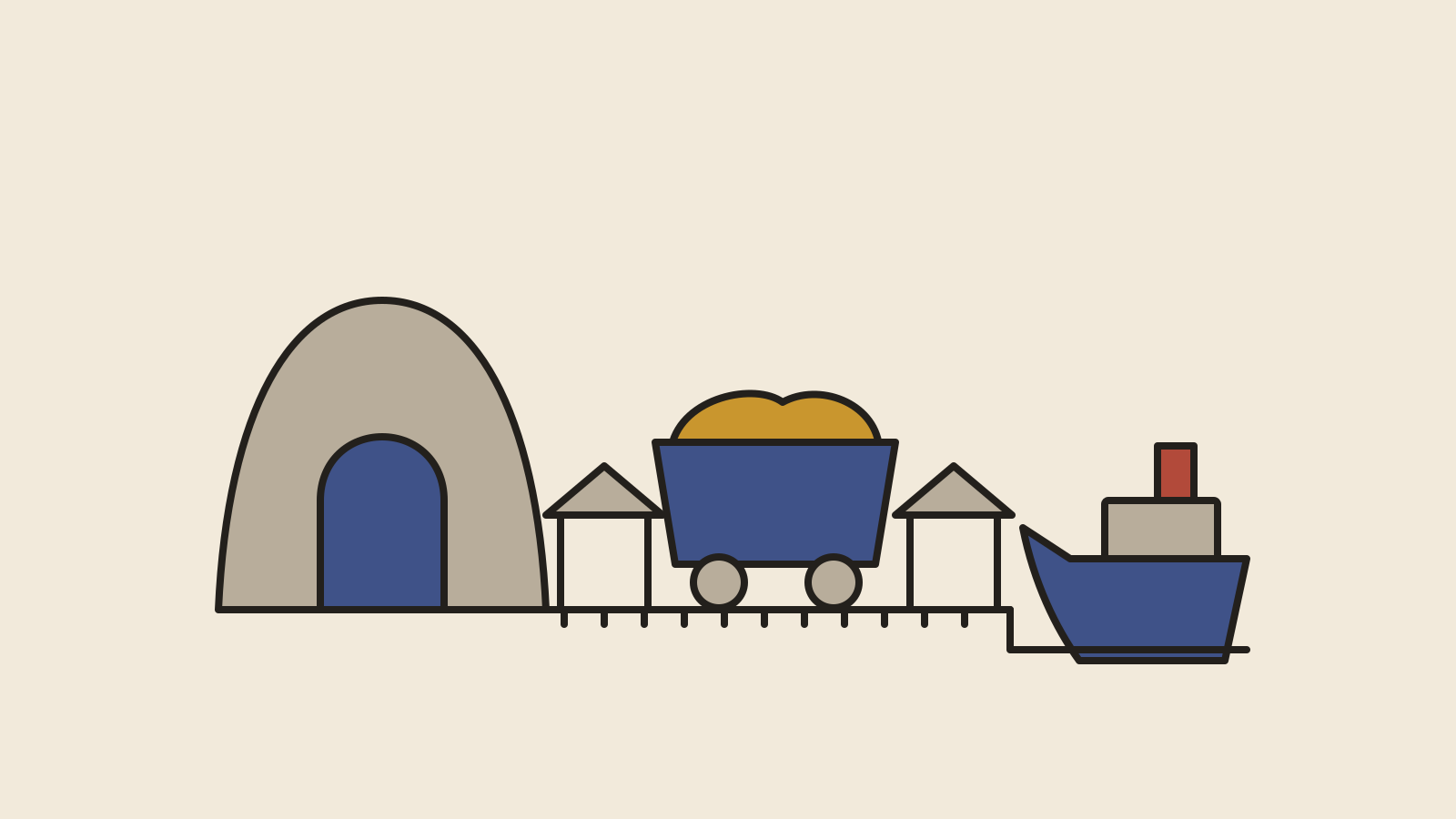
Take a country that lives by exporting copper. Foreign firms own the mines, the machinery is imported and the profits flow abroad. The railway runs from the mine to the port and nowhere else. When the copper price falls, the government's budget falls with it. The economy grows in good years, yet the decisions that shape it are taken elsewhere. Dependency writers called this a conditioned economy: one that can expand only as a reflection of expansion somewhere else.
Diagram
Centre and periphery play unequal parts in one world economy
Read as text
Two columns set side by side on one dimension, the role each plays in the world economy. The centre exports manufactured goods, owns the capital and the technology, and is where the main economic decisions are taken. The periphery exports raw materials, imports its capital and technology, and sees profits and interest leave for the centre. Dependency theory holds that the two roles were formed together and that each keeps the other in place.
Core commitments
- Development and underdevelopment are two outcomes of one historical process, the spread of capitalism outward from Europe.
- The thing to study is the relation between centre and periphery, since no national economy can be understood alone.
- Dependence works through trade in raw materials, foreign ownership, borrowed technology and debt.
- Local elites who profit from the arrangement help to keep it going, so dependence has an internal face.
- Remedies differ: some members wanted state-led industry and regional markets, others a break with capitalism.
Not to be confused with
| Look-alike | The difference | Differs on |
|---|---|---|
| Structuralism (economics) | Structuralists around Raúl Prebisch thought industrial policy could close the gap with the centre inside a capitalist economy. Dependency writers watched that policy stall in the 1960s, doubted it and looked harder at foreign ownership and class. | Differs onClaim |
| World-systems theory | Dependency theory studies the tie between a dependent country and its dominant partners. World-systems theory studies the whole world economy over five centuries and adds a middle tier, the semi-periphery. | Differs onUnit of analysis |
| Modernisation theory | Modernisation theory holds that links with rich countries pull poor ones along the same path. Dependency theory holds that those links created underdevelopment. | Differs onClaim |
| Drain theory | Drain theory describes wealth removed from a colony by its rulers through taxes and remittances. Dependency theory describes formally independent countries held back through markets, ownership and debt. | Differs onMechanism |
- Differs onClaim
Structuralists around Raúl Prebisch thought industrial policy could close the gap with the centre inside a capitalist economy. Dependency writers watched that policy stall in the 1960s, doubted it and looked harder at foreign ownership and class.
- Differs onUnit of analysis
Dependency theory studies the tie between a dependent country and its dominant partners. World-systems theory studies the whole world economy over five centuries and adds a middle tier, the semi-periphery.
- Differs onClaim
Modernisation theory holds that links with rich countries pull poor ones along the same path. Dependency theory holds that those links created underdevelopment.
- Differs onMechanism
Drain theory describes wealth removed from a colony by its rulers through taxes and remittances. Dependency theory describes formally independent countries held back through markets, ownership and debt.
Origins and development
The school grew out of the work of Raúl Prebisch at the United Nations Economic Commission for Latin America in Santiago. From 1949 he described the world as centre and periphery. In the 1960s younger writers hardened the argument. Andre Gunder Frank's 1966 essay The Development of Underdevelopment gave the radical version. Fernando Henrique Cardoso and Enzo Faletto (1969) offered a more open one, in which a dependent economy could still industrialise in partnership with foreign capital. Theotonio dos Santos, Ruy Mauro Marini and Celso Furtado added their own accounts. Samir Amin and Walter Rodney carried the approach to Africa.
Raúl Prebisch
An Argentine economist who argued that exporters of raw materials lose ground in world trade, and who built United Nations bodies to change that.
Fernando Henrique Cardoso
A Brazilian sociologist who argued that dependent economies can still industrialise, and who later governed Brazil as its president.
Why it matters
Dependency ideas fed the demand of poorer states at the United Nations in 1974 for a New International Economic Order. They shaped a generation of thinking in Latin America and Africa. They return whenever a poor country's debts, commodity prices or reliance on foreign technology are in the news, and in arguments over who gains from the lithium and cobalt mined in the global South.
Critiques and limits
Sanjaya Lall (1975) argued that no definition of dependence separated poor economies from rich ones such as Canada, which also rely on foreign capital. The Marxist Bill Warren (1980) held that foreign investment was industrialising the periphery, as Marx had expected. The fast export-led growth of South Korea, Taiwan and Singapore was widely read as evidence against Frank's version. Gabriel Palma (1978) and Cardoso himself replied that dependency was a method for studying particular cases and was never meant as a general law.
Key figures
- Andre Gunder Frank
- Fernando Henrique Cardosoborn 1931
- Enzo Faletto
- Theotonio dos Santos
- Ruy Mauro Marini
- Celso Furtado1920–2004
- Samir Amin1931–2018
- Walter Rodney



Connections
Extends
It kept the structuralists' centre and periphery but added foreign ownership, class and doubts about reform within capitalism.
Influenced by
His division of the world economy into an industrial centre and a raw-material periphery was the school's starting map.
MarxismPolitical theory & science
Its radical wing drew on Marxist accounts of imperialism and of economic surplus transferred from poor countries to rich ones.
The claim that raw-material prices fall against manufactures over time gave the school one mechanism of loss through trade.
Critiques
Modernisation theorySociology
It denies that poor countries are at an earlier stage, holding that underdevelopment was created alongside development elsewhere.
Contrasts with
Differs on claim. Structuralists thought industrial policy could close the gap within capitalism, which dependency writers came to doubt.
World-systems theorySociology
Differs on unit of analysis. Dependency theory studies a dependent country's ties to dominant ones, world-systems theory the whole world economy at once.
Modernisation theorySociology
Differs on claim. One says links with rich countries pull poor ones forward, the other that those links created underdevelopment.
Differs on mechanism. The drain is wealth removed from a colony by its rulers, dependence works on independent states through markets, ownership and debt.
PostcolonialismPolitical theory & science
Differs on mechanism. Dependency theory traces lasting inequality to trade and capital, where postcolonialism traces it to language, representation and identity.
Differs on scope. The hypothesis is one testable claim about prices, while dependency theory is a whole account of why poor countries stay poor.
Parallels
Pan-AfricanismPolitical theory & science
Nkrumah's account of neo-colonialism reached the dependency writers' conclusion that formal independence leaves economic control abroad.
Contains
Aníbal QuijanoSociology
In the 1960s he worked within it, on why Latin American capitalism leaves a marginal mass it never employs.
His claim that underdevelopment formed together with development was a starting point for the dependency writers.
Fernando Henrique CardosoSociology
With Faletto he wrote the school's most cited book and led its reformist wing against the stagnation thesis.
He carried the dependency argument from Latin America to Africa and the Arab world and gave it a Marxist model.
Extended by
World-systems theorySociology
It takes over centre and periphery, adds a semi-periphery and traces the whole system back to the sixteenth century.
Influenced
Immanuel WallersteinSociology
He took its division of the world into exploiting centres and exploited peripheries and added a middle zone.
Decolonial theorySociology
Several founders began as dependency theorists and kept its view that Latin America's position was made from outside.
Globalisation and developmentSociology
The sociology of development took its central dispute from dependency writers: whether ties to rich countries cure poverty or cause it.
Liberation psychologyPsychology
It carries into psychology the complaint that Latin America imports its models from richer countries whose conditions it doesn't share.
Philosophy of liberationPhilosophy
Its founders took from dependency theory the claim that the periphery's poverty is produced by its ties to the centre.
Southern theorySociology
Connell borrows the Latin American economists' picture of centre and periphery and applies it to the making of knowledge.
Coloniality of powerSociology
Quijano worked among the dependency theorists in Santiago and kept their view of Latin America's externally made position.
Cross with
Two distant entries to read beside this one, each with the question the pairing opens.
Attribution theoryPsychology
Is blaming a poor country's poverty on its own failings, and not on its situation in world trade, the attribution error at national scale? Set them side by side
Cultural materialismAnthropology
Would a theory that explains customs by the practical problems of subsistence trace a poor country's institutions to its place in world trade? Set them side by side
Further reading
- Cardoso, F. H., & Faletto, E. (1979). Dependency and development in Latin America. University of California Press. https://doi.org/10.1525/9780520342118 (Original work published 1969)
- Frank, A. G. (1966). The development of underdevelopment. Monthly Review, 18(4), 17–31. https://doi.org/10.14452/MR-018-04-1966-08_3
- Palma, G. (1978). Dependency: A formal theory of underdevelopment or a methodology for the analysis of concrete situations of underdevelopment?. World Development, 6(7–8), 881–924. https://doi.org/10.1016/0305-750X(78)90051-7
Cite this entry
Scholia. (2026). Dependency theory. In Scholia: Notes in the margin of the human sciences. Retrieved November 28, 2026, from https://scholia.zennia.sg/schools/dependency-theory
This topic is contested. The entry sets out the main positions rather than settling them.