School or branchSociologyAlso in Economics, Political theory & science
World-systems theory
A school that treats the capitalist world economy as one system and sorts countries into core, semi-periphery and periphery by their role in it.
Overview
World-systems theory argues that the proper unit for studying social change is the whole world economy, and that a single country studied alone will mislead. Since about the sixteenth century, it says, one capitalist system has grown outward from Europe to cover the globe. It has a single division of labour and many states. Countries hold different places within it, and those places explain much of their wealth, politics and prospects.
A smartphone shows the pattern. It is designed and branded in California, where most of the profit lands. Its chips come from Taiwan and South Korea. It is assembled in China or Vietnam on thin margins. The cobalt in its battery is dug in the Democratic Republic of Congo, often by hand. World-systems writers call the first zone the core, the last the periphery and those between the semi-periphery. They ask how one chain holds all three together.
Diagram
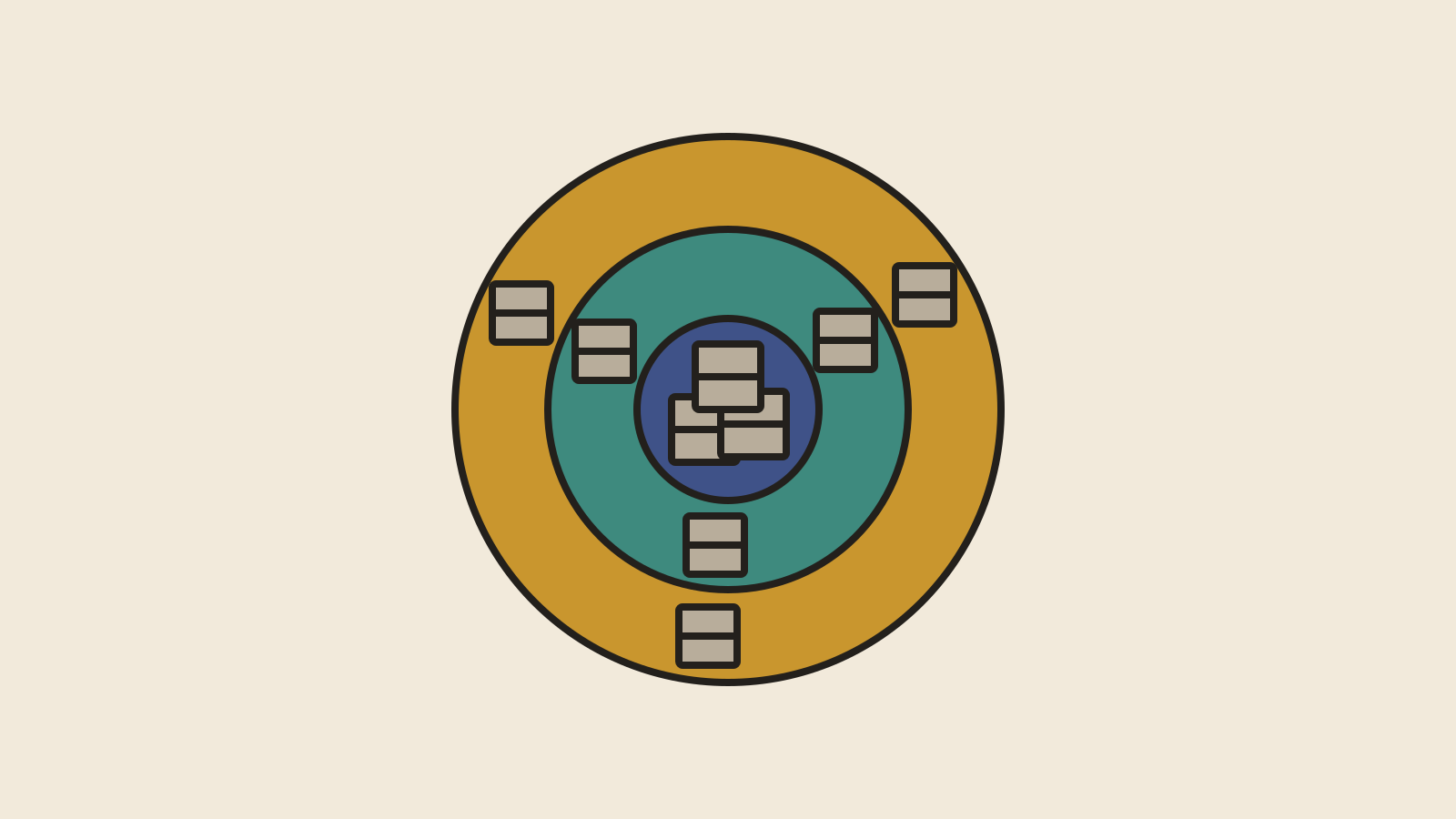
One world economy has three zones, and surplus flows towards the core
Read as text
Three concentric circles. The innermost is the core, where high-profit and capital-heavy production is concentrated. Around it lies the semi-periphery, a middle zone that is exploited by the core and in turn exploits the zone outside it. The outermost ring is the periphery, which supplies raw materials and low-wage labour. Surplus flows inward, from the periphery through the semi-periphery to the core. Countries can move between zones over time, but the three zones remain.
Core commitments
- The world-system, one division of labour spanning many states and cultures, is the unit of analysis.
- Core zones hold high-profit, capital-heavy production, peripheral zones hold low-wage work and raw materials, and surplus flows from the second to the first.
- A semi-periphery sits between them, exploited by the core and exploiting the periphery, and it steadies the system politically.
- Positions can change, so countries rise and fall while the three-tier structure persists.
- The system moves in long cycles of growth and stagnation, and one leading power after another (Dutch, British, American) has dominated it.
Not to be confused with
| Look-alike | The difference | Differs on |
|---|---|---|
| Dependency theory | Dependency theory examines the tie between a dependent country and the economies that dominate it. World-systems theory takes the whole system as its object, traces it over five hundred years and adds the semi-periphery. | Differs onUnit of analysis |
| Modernisation theory | Modernisation theory treats each society as a separate case climbing the same ladder. World-systems theory says there is one system, and that not every country can be core at once. | Differs onUnit of analysis |
| Globalisation and development | That entry covers the branch of sociology that studies global inequality from every angle. World-systems theory is one school within it, with its own strong thesis. | Differs onScope |
| Globalisation | Talk of globalisation usually refers to the integration of markets since the 1970s. World-systems writers say the world economy has been global in reach for centuries and that recent changes are one more phase. | Differs onEra |
- Differs onUnit of analysis
Dependency theory examines the tie between a dependent country and the economies that dominate it. World-systems theory takes the whole system as its object, traces it over five hundred years and adds the semi-periphery.
- Differs onUnit of analysis
Modernisation theory treats each society as a separate case climbing the same ladder. World-systems theory says there is one system, and that not every country can be core at once.
- Differs onScope
That entry covers the branch of sociology that studies global inequality from every angle. World-systems theory is one school within it, with its own strong thesis.
- Differs onEra
Globalisation
Talk of globalisation usually refers to the integration of markets since the 1970s. World-systems writers say the world economy has been global in reach for centuries and that recent changes are one more phase.
Origins and development
Immanuel Wallerstein, an American sociologist who had studied newly independent African states, published the first volume of The Modern World-System in 1974. He drew on dependency theory, on Karl Marx and on the French historian Fernand Braudel's long view of economic history. In 1976 he founded the Fernand Braudel Center at Binghamton University, the school's base for decades. Giovanni Arrighi, Samir Amin, Andre Gunder Frank and Christopher Chase-Dunn extended the approach. Wallerstein preferred the name world-systems analysis, because he saw it as a way of working and never as a finished theory.
Immanuel Wallerstein
An American sociologist who argued that social change must be studied in one capitalist world-system, divided into core, semi-periphery and periphery.
Karl Marx
The German thinker who argued that the way a society produces its living shapes its classes, its conflicts and its ideas.
Why it matters
The vocabulary of core and periphery has passed into journalism and policy, often without its source. The approach offers a way to read global supply chains, the rise of China and arguments over whether American leadership is ending. Its notion of the commodity chain, introduced by Terence Hopkins and Wallerstein, became a research field of its own.
Critiques and limits
Robert Brenner (1977) argued that Wallerstein explains capitalism by trade and so neglects what Brenner saw as its real origin, changing class relations in the English countryside. Theda Skocpol (1977) objected that the theory reduces states and politics to the needs of the world market, and explains events by their usefulness to the system. Others note that the semi-periphery is defined loosely enough to absorb any awkward case. Defenders answer that comparing countries one by one cannot show the relations between them.
Key figures
- Immanuel Wallerstein1930–2019
- Terence Hopkins
- Giovanni Arrighi
- Samir Amin1931–2018
- Andre Gunder Frank
- Christopher Chase-Dunn
- Janet Abu-Lughod


Connections
Originated by
The first volume of his Modern World-System in 1974 founded the approach and set its vocabulary.
Extends
Dependency theoryEconomics
It takes over centre and periphery, adds a semi-periphery and traces the whole system back to the sixteenth century.
Influenced by
Its picture of capitalism as endless accumulation that must keep expanding comes from Marx, moved from the nation to the world.
Wallerstein's mini-systems, world-empires and world-economies rework Polanyi's reciprocity, redistribution and market exchange.
Critiques
It rejects the national society as the unit of study and denies that every country can reach the top together.
Contrasts with
Dependency theoryEconomics
Differs on unit of analysis. Dependency theory studies a dependent country's ties to dominant ones, world-systems theory the whole world economy at once.
Differs on scope. The branch is the whole field of debate on global inequality, and world-systems theory is one school inside it.
Differs on unit of analysis. Wallerstein maps the world economy, and Connell applies a similar centre and periphery map to the production of ideas.
Differs on unit of analysis. Modernisation theory follows separate national societies, world-systems theory a single world economy with unequal positions.
Differs on mechanism. Wallerstein explains world hierarchy by the division of labour, and Quijano adds race as what assigns peoples their places.
Contains
He founded the approach with the first volume of The Modern World-System and led it for forty-five years.
Samir AminEconomics
With Wallerstein, Frank and Arrighi he analysed capitalism as one world system divided into centre and periphery.
Influenced
He adopted its global frame during his years at Binghamton and added race as the system's organising principle.
The school adopts Wallerstein's single world economy dating from the sixteenth century and adds race and knowledge to it.
Applications
Division of labourEconomics
Wallerstein defines a world-system by its single division of labour across many states, with core and periphery as its specialised zones.
Prebisch–Singer hypothesisEconomics
World-systems analysts reuse the centre and periphery vocabulary and treat worsening terms of trade as one channel of unequal exchange.
Cross with
Two distant entries to read beside this one, each with the question the pairing opens.
Balance of powerPolitical theory & science
Balance-of-power theory expects states to combine against the strongest: what keeps peripheral states from combining against the core in the same way? Set them side by side
AutopoiesisCognitive science & linguistics
An autopoietic system keeps producing its own parts and boundary: does the world-system reproduce core and periphery that way, and where is its boundary? Set them side by side
Further reading
- Skocpol, T. (1977). Wallerstein's world capitalist system: A theoretical and historical critique. American Journal of Sociology, 82(5), 1075–1090. https://doi.org/10.1086/226431
- Wallerstein, I. (1974). The modern world-system I: Capitalist agriculture and the origins of the European world-economy in the sixteenth century. Academic Press.
- Wallerstein, I. (2004). World-systems analysis: An introduction. Duke University Press. https://doi.org/10.1215/9780822399018
Cite this entry
Scholia. (2026). World-systems theory. In Scholia: Notes in the margin of the human sciences. Retrieved November 28, 2026, from https://scholia.zennia.sg/schools/world-systems-theory
This topic is contested. The entry sets out the main positions rather than settling them.