School or branchPhilosophyAlso in Psychology
Sāṃkhya
The Indian dualist school that splits reality into many witnessing consciousnesses and one active nature, placing the mind itself on the side of matter.
Overview
Sāṃkhya, "enumeration", is one of the oldest systems of Indian philosophy. It divides reality into two: puruṣa (pure consciousness) and prakṛti (the material nature from which everything else unfolds). Its surprise is where it puts the mind. Thinking, feeling, deciding and the sense of "I" all belong to matter. Consciousness only watches.
Picture yourself anxious before an exam. The racing thoughts, the knot in your stomach and the inner voice predicting failure are, for Sāṃkhya, movements of matter in its subtler forms. What is aware of all of them is something else, a witness that takes no part. Suffering comes from confusing the two. Liberation is the clear knowledge that they are distinct. Matter, on this view, is woven from three strands called guṇas: clarity (sattva), activity (rajas) and inertia (tamas).
Diagram
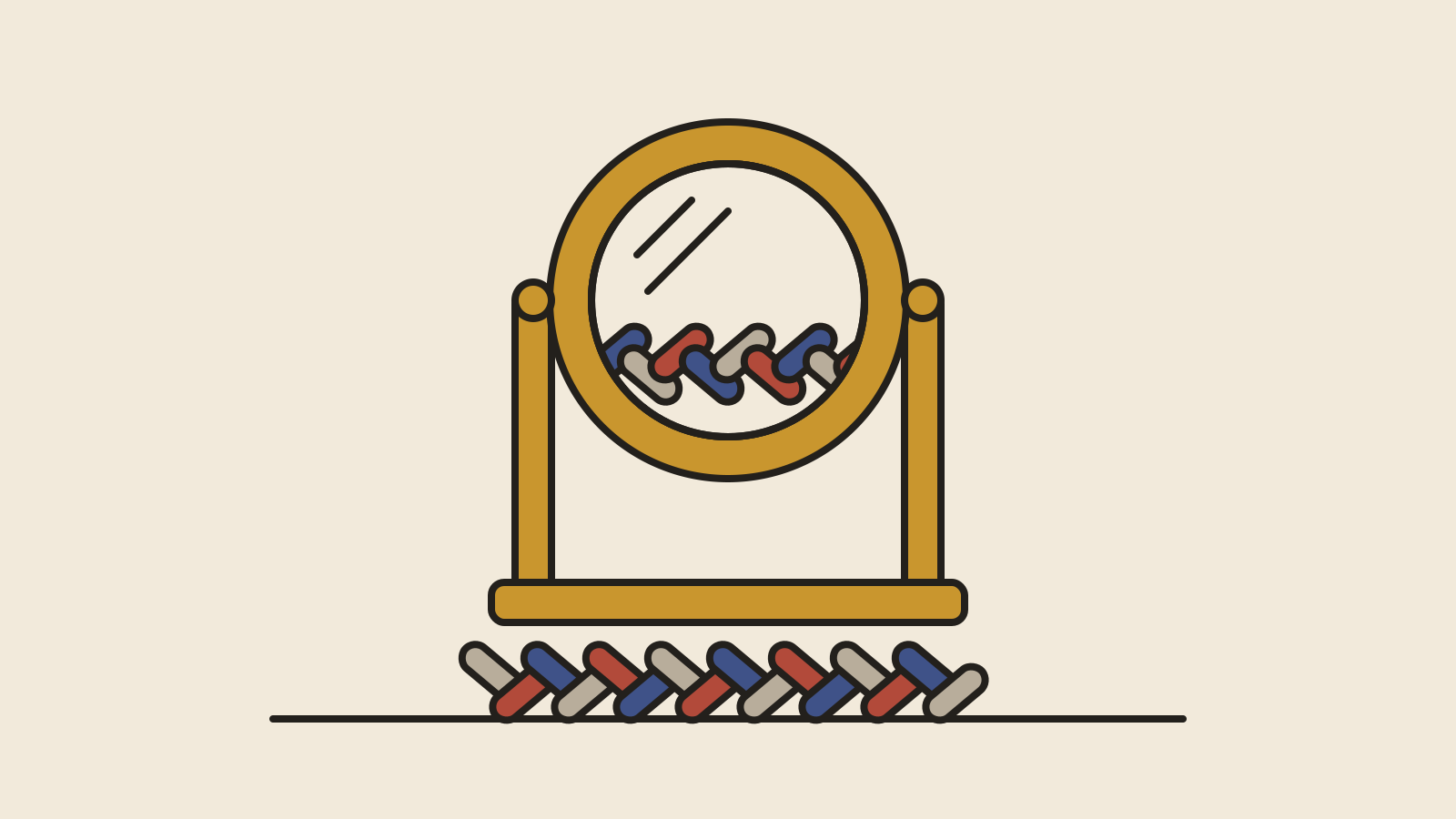
Sāṃkhya divides reality into watching consciousness and acting matter, with mind in matter
Read as text
Two columns, one for each of Sāṃkhya's two eternal realities. On the left, puruṣa: pure consciousness, many separate selves, one for each being, which never act and only witness. On the right, prakṛti: one primal nature, made of three strands called guṇas, which unfolds into everything else, including the intellect, the sense of self and the mind.
Core commitments
- Puruṣa and prakṛti are both real and eternal, and neither can be reduced to the other.
- There are many puruṣas, one for each living being, and each is a passive witness that does nothing.
- Prakṛti unfolds into intellect, the sense of self, the mind, the senses and the elements, as the balance of its three guṇas shifts.
- An effect already exists in its cause before it appears, as curd is latent in milk, a doctrine called satkāryavāda.
- Liberation is isolation (kaivalya): once consciousness is known to be distinct from matter, matter no longer binds it.
Not to be confused with
| Look-alike | The difference | Differs on |
|---|---|---|
| Mind–body dualism | Descartes split a thinking mind from an extended body. Sāṃkhya draws the line elsewhere: thought, emotion and ego fall on the side of matter, and only bare awareness stands apart. | Differs onClaim |
| Advaita Vedanta | Advaita holds that there is one consciousness and that the material world is appearance. Sāṃkhya holds that conscious selves are many and that matter is fully real. | Differs onClaim |
| Jainism | Both count many souls and a real material world, with no creator. The Jain soul acts and is weighed down by karmic matter. The Sāṃkhya puruṣa never acts and is never truly bound. | Differs onClaim |
| Yoga | The Yoga school of Patañjali takes over Sāṃkhya's account of reality almost whole and adds a special self, the Lord (Īśvara), and a method of meditation. Sāṃkhya supplies the theory, Yoga the practice. | Differs onScope |
- Differs onClaim
Descartes split a thinking mind from an extended body. Sāṃkhya draws the line elsewhere: thought, emotion and ego fall on the side of matter, and only bare awareness stands apart.
- Differs onClaim
Advaita holds that there is one consciousness and that the material world is appearance. Sāṃkhya holds that conscious selves are many and that matter is fully real.
- Differs onClaim
Both count many souls and a real material world, with no creator. The Jain soul acts and is weighed down by karmic matter. The Sāṃkhya puruṣa never acts and is never truly bound.
- Differs onScope
Yoga
The Yoga school of Patañjali takes over Sāṃkhya's account of reality almost whole and adds a special self, the Lord (Īśvara), and a method of meditation. Sāṃkhya supplies the theory, Yoga the practice.
Origins and development
Tradition names the sage Kapila as founder. Sāṃkhya ideas, such as the guṇas and the analysis of a person into layers, appear in the later Upanishads, the Mahābhārata and the Bhagavad Gītā. The classical system is set out in Īśvarakṛṣṇa's Sāṃkhyakārikā, about seventy verses from around the fourth or fifth century CE. Commentaries followed, among them the Yuktidīpikā and Vācaspati Miśra's Tattvakaumudī. As a separate school it faded after the first millennium. Vijñānabhikṣu revived it in the sixteenth century in a form reconciled with Vedanta.
Why it matters
Sāṃkhya supplied vocabulary that later Indian thought takes for granted. Yoga philosophy rests on its picture of reality. The three guṇas organise the Bhagavad Gītā's account of character, Ayurvedic medicine and modern questionnaires in Indian psychology that score people on sattva, rajas and tamas. Philosophers of mind note that its split, with thinking as a natural process and awareness as something else, anticipates the hard problem of consciousness.
Indian psychology
A modern school that builds psychology on classical Indian accounts of mind and consciousness, and on practices such as yoga and meditation.
Hard problem of consciousness
The puzzle of why brain activity is accompanied by felt experience at all, when it seems the same activity could go on with nothing felt.
Critiques and limits
Nyaya philosophers rejected satkāryavāda: if the pot already exists in the clay, the potter makes nothing new. Adi Shankara argued that unconscious matter could not unfold in orderly service of souls without a conscious guide. A standing puzzle is how a puruṣa that never acts or changes can be bound or freed at all. The Sāṃkhyakārikā answers that only prakṛti is bound and released, which critics read as making liberation nobody's achievement.
Nyaya
The classical Indian school of logic and epistemology, which holds that the world is real and knowable through perception, inference, comparison and testimony.
Adi Shankara
The Indian philosopher who argued that the self and ultimate reality are one, and gave Advaita Vedanta its classic form.
Key figures
- Kapila (legendary founder)
- Āsuri
- Pañcaśikha
- Īśvarakṛṣṇa
- Gauḍapāda
- Vācaspati Miśra
- Vijñānabhikṣu
Connections
Critiques
Defends the view that effects already exist in their causes against Nyaya's claim that each effect is a new thing.
Contrasts with
Differs on claim. Both count many souls and real matter with no creator, but the Jain soul acts and is weighed down by karmic matter.
Differs on claim. Descartes puts thought on the mind's side, where Sāṃkhya puts thought, feeling and ego in matter and leaves only bare awareness apart.
Differs on claim. Advaita has one consciousness and an apparent world, where Sāṃkhya has many conscious selves and a fully real nature.
Differs on claim. Sāṃkhya's puruṣa is witnessing consciousness like ātman, but puruṣas are many and there is no brahman for them to join.
Influenced
Indian psychologyPsychology
Indian psychology questionnaires that score people on sattva, rajas and tamas take the three guṇas from Sāṃkhya.
Critiqued by
Shankara argued that unconscious matter could not unfold in orderly service of souls without a conscious guide.
Further reading
- King, R. (1999). Indian philosophy: An introduction to Hindu and Buddhist thought. Edinburgh University Press.
- Larson, G. J. (1979). Classical Sāṃkhya: An interpretation of its history and meaning (2nd rev. ed.). Motilal Banarsidass. (Original work published 1969)
- Larson, G. J., & Bhattacharya, R. S. (1987). Sāṃkhya: A dualist tradition in Indian philosophy. Princeton University Press.
Cite this entry
Scholia. (2026). Sāṃkhya. In Scholia: Notes in the margin of the human sciences. Retrieved November 28, 2026, from https://scholia.zennia.sg/schools/samkhya