VersusPhilosophy
Deontology vs consequentialism
Deontology judges an act by duties and rights that hold whatever the results. Consequentialism judges it by results alone.
- School or branchDeontologyThe family of moral theories that judge an act by duties and rights, which hold whatever good might come of breaking them.Philosophy
- IdeaConsequentialismThe view that an act is right or wrong solely because of its results, so the best choice is whichever produces the most good.Philosophy
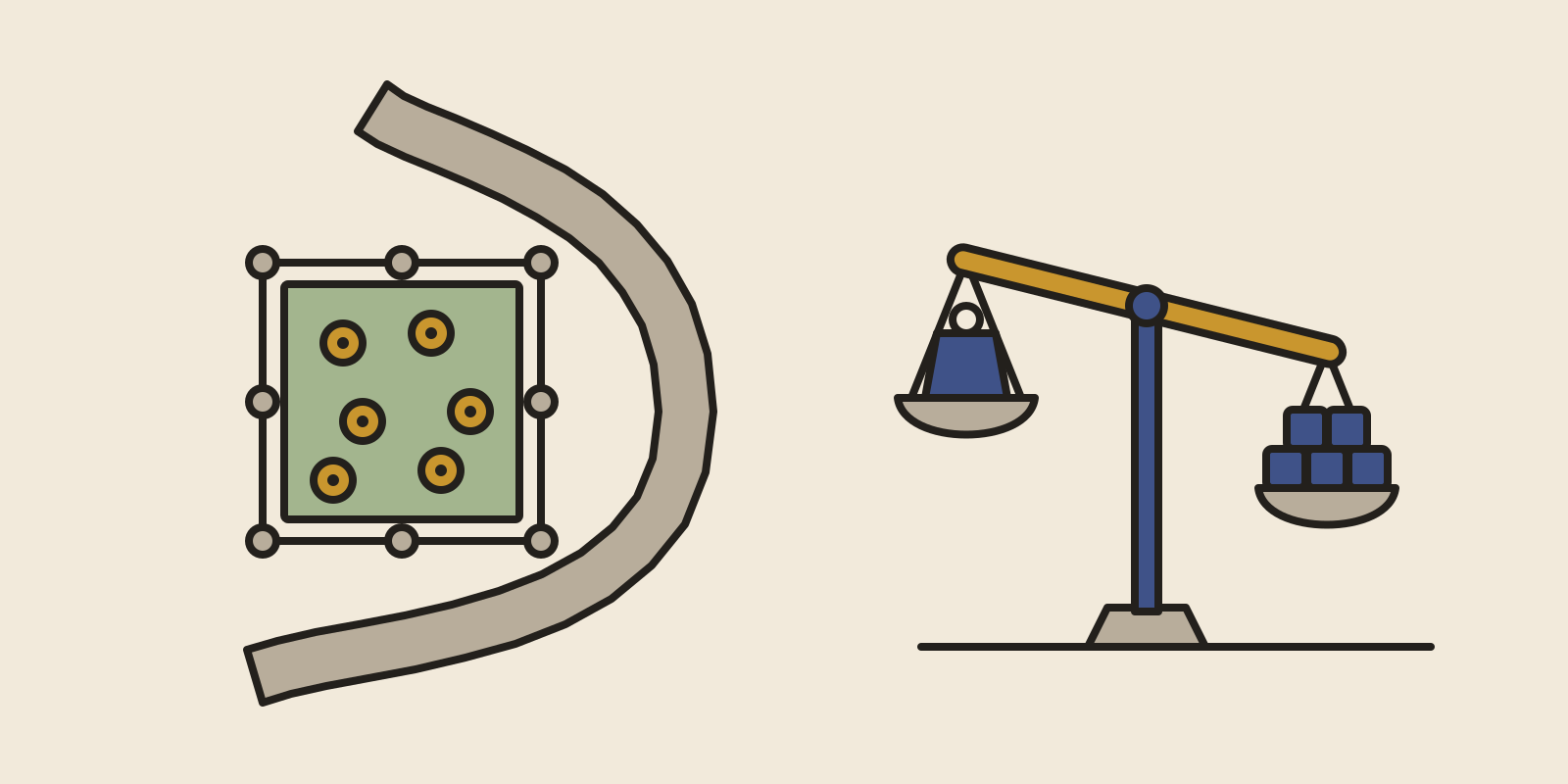
Comparison
| DeontologyPhilosophy | ConsequentialismPhilosophy | |
|---|---|---|
| What makes an act right | It conforms to duties and respects rights | It produces the best available outcome |
| Whether a good result can justify any act | No. Some acts are wrong in themselves | In principle yes. No kind of act is ruled out before its results are known |
| Point of view | The agent's own: your promise binds you as it binds nobody else | Impartial: your gain counts for no more than a stranger's |
| Intention | What a person aims at is judged differently from what they merely foresee | Motives matter only through their effects |
| Classic sources | Kant's Groundwork (1785) and W. D. Ross's list of duties (1930) | The utilitarianism of Bentham and Mill. The name dates from 1958 |
| Standard objection | If breaking a rule is so bad, why not break it once to stop five others breaking it? | It makes any act permissible in principle, even the killing of an innocent |
What makes an act right
- Deontology
- It conforms to duties and respects rights
- Consequentialism
- It produces the best available outcome
Whether a good result can justify any act
- Deontology
- No. Some acts are wrong in themselves
- Consequentialism
- In principle yes. No kind of act is ruled out before its results are known
Point of view
- Deontology
- The agent's own: your promise binds you as it binds nobody else
- Consequentialism
- Impartial: your gain counts for no more than a stranger's
Intention
- Deontology
- What a person aims at is judged differently from what they merely foresee
- Consequentialism
- Motives matter only through their effects
Classic sources
- Deontology
- Kant's Groundwork (1785) and W. D. Ross's list of duties (1930)
- Consequentialism
- The utilitarianism of Bentham and Mill. The name dates from 1958
Standard objection
- Deontology
- If breaking a rule is so bad, why not break it once to stop five others breaking it?
- Consequentialism
- It makes any act permissible in principle, even the killing of an innocent
Diagram
Both ask what makes an act right and give different tests
Read as text
Two overlapping circles. The left circle, deontology, holds duties and rights, some acts ruled out and the agent's own promises. The right circle, consequentialism, holds results alone, the best outcome required and everyone counted equally. The shared centre holds the question both answer, what makes acts right.
Why people confuse them
The usual summary, rules against results, fits badly. Rule consequentialists follow rules too, selecting those whose general adoption would have the best consequences. Many deontologists allow a duty to give way, as Ross did when he held that a weightier duty can outweigh a lighter one. In most ordinary cases the two families also agree that people should keep their promises, tell the truth and help where they can.
The names add to the muddle. The utilitarian Jeremy Bentham coined "deontology", while "consequentialism" comes from Elizabeth Anscombe, who meant it as a criticism of the view.
Elizabeth Anscombe
The philosopher whose 1958 attack on modern ethics revived the study of virtue, and whose book Intention founded the philosophy of action.
When the difference matters
A friend tells you in confidence that she will leave her job next month. A week later your manager, about to build a project around her, asks whether she will stay.
A consequentialist compares the available outcomes. Speaking up saves the firm wasted work, and silence protects your friend and her trust in you. Whichever option leaves things best is the right one, and your promise counts only through its effects.
Consequentialism
The view that an act is right or wrong solely because of its results, so the best choice is whichever produces the most good.
A deontologist starts from the fact that you gave your word to one person and may not deceive another. Two duties pull against each other, and the task is to judge which weighs more. Adding up benefits will not settle that.
Deontology
The family of moral theories that judge an act by duties and rights, which hold whatever good might come of breaking them.
The two may reach the same verdict here, but they separate as the stakes rise, as when a surgeon could save five patients with the organs of one.
Where they overlap
Both are theories of what makes an act right, which sets them apart from virtue ethics and its question of what a good person would do. Deontologists do care about outcomes and deny only that outcomes are all that counts. Public life draws on both traditions. Health agencies rank treatments by the years of healthy life they buy, while consent rules and the ban on torture hold whatever the sums say.
Virtue ethics
The approach to ethics that starts from character, asking what kind of person to be before asking which acts are right.
Further reading
- Alexander, L., & Moore, M. (2024). Deontological ethics. Stanford Encyclopedia of Philosophy. https://plato.stanford.edu/entries/ethics-deontological/
- Anscombe, G. E. M. (1958). Modern moral philosophy. Philosophy, 33(124), 1–19. https://doi.org/10.1017/S0031819100037943
- Kant, I. (1998). Groundwork of the metaphysics of morals. Cambridge University Press. (Original work published 1785)
- Scheffler, S. (1982). The rejection of consequentialism: A philosophical investigation of the considerations underlying rival moral conceptions. Clarendon Press. https://doi.org/10.1093/0198235119.001.0001
Cite this entry
Scholia. (2026). Deontology vs consequentialism. In Scholia: Notes in the margin of the human sciences. Retrieved November 28, 2026, from https://scholia.zennia.sg/versus/deontology-vs-consequentialism