IdeaPhilosophyAlso in Economics
Consequentialism
The view that an act is right or wrong solely because of its results, so the best choice is whichever produces the most good.
The idea
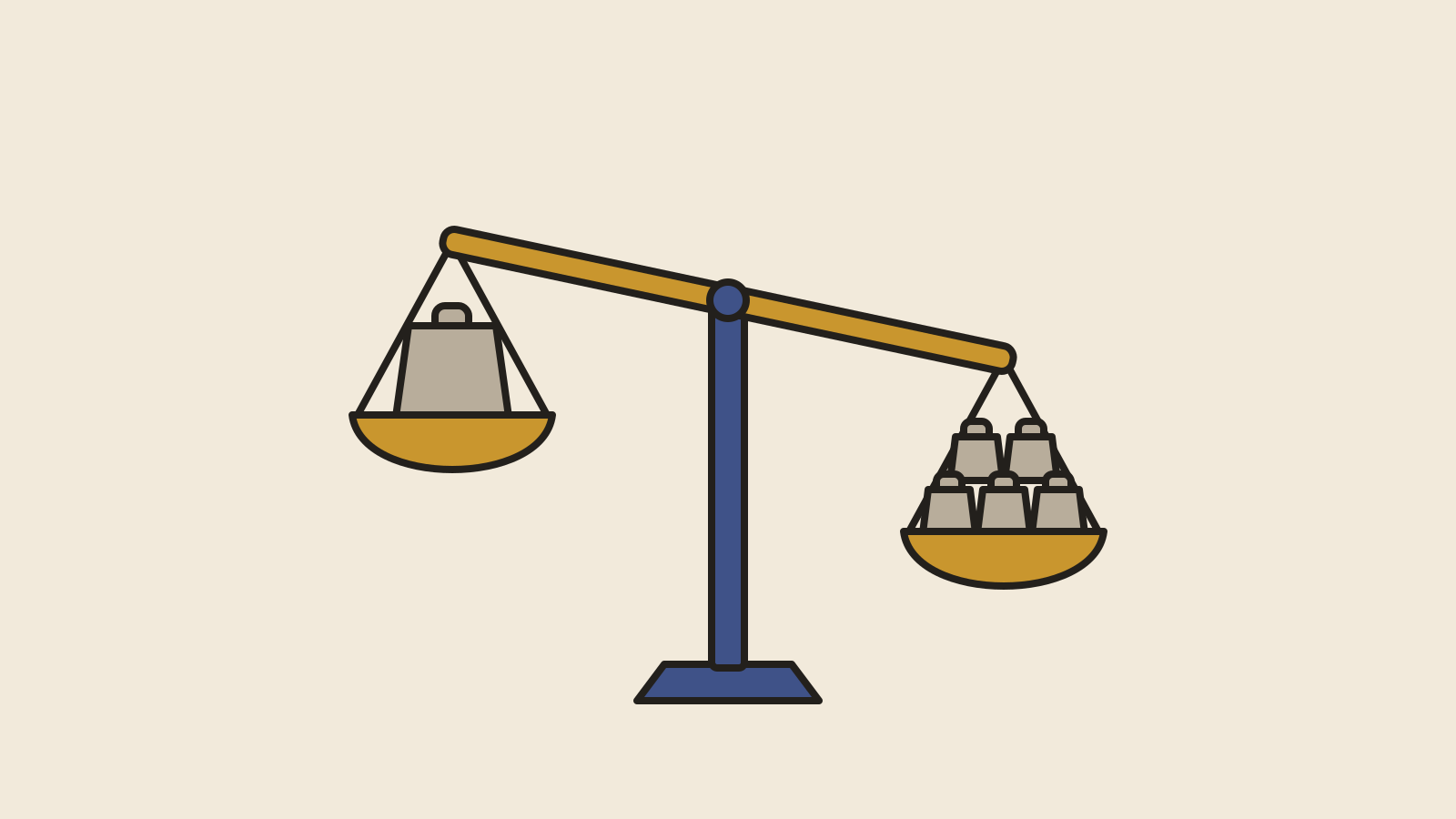
Consequentialism says that what makes an act right is what it brings about. Nothing else counts in the end. Motives, promises and rules matter only through their effects. To decide what to do, compare the outcomes of each option open to you and choose the one that leaves the world best.
Think of a nurse sorting patients after a bus crash. She has one hour and more injured people than she can treat. Staying with the first person who asked for help feels loyal, but it will cost two others their lives. A consequentialist says she should go where her hour saves the most, and that the loyal choice would be the wrong one.
The view is a family of theories. Its members agree that outcomes settle rightness and disagree about which outcomes are good. Utilitarianism, the best-known member, counts happiness or wellbeing. Others count knowledge, friendship or fairness as well.
Utilitarianism
The moral theory that the right act is the one producing the greatest total well-being, with everyone's interests counted equally.
Diagram
Every consequentialist theory answers two questions in its own way
Read as text
A tree with consequentialism at the root and two branches. The first branch asks what is good, with three answers. These are pleasure or wellbeing, satisfied preferences and a list of several goods. The second branch asks what is judged by its outcomes, with two answers: each act, or rules for acts.
Key features
- Rightness depends on outcomes alone, so no kind of act is ruled out in advance of knowing its results.
- Every theory in the family adds an account of the good, such as pleasure, satisfied preferences or a list of several goods.
- Outcomes are judged impartially, so your own gain or your family's counts for no more than a stranger's.
- Most versions tell you to maximise, which makes doing less good than you could a moral failure.
- Act versions judge each choice directly, while rule versions judge acts by rules whose general adoption would have the best results.
Not to be confused with
| Look-alike | The difference | Differs on |
|---|---|---|
| Utilitarianism | Utilitarianism is one kind of consequentialism, the kind that takes wellbeing as the only good and adds up everyone's. A consequentialist can count other goods, or give extra weight to the worst off. | Differs onScope |
| Deontology | Deontologists judge an act by the kind of act it is, measured against duties and rights that hold even when breaking them would do more good. Consequentialists judge only by results. | Differs onStandard of judgement |
| Mohism | Mohism is an early Chinese version, founded in the fifth century BCE, that judged practices by their benefit to all. Consequentialism is the general thesis, named in 1958. | Differs onScope |
| Cost-benefit analysis | A technique for comparing a policy's gains and losses in money terms. It borrows the consequentialist outlook, but it is a tool for officials and makes no claim about what morality is. | Differs onMethod |
- Differs onScope
Utilitarianism is one kind of consequentialism, the kind that takes wellbeing as the only good and adds up everyone's. A consequentialist can count other goods, or give extra weight to the worst off.
- Differs onStandard of judgement
Deontologists judge an act by the kind of act it is, measured against duties and rights that hold even when breaking them would do more good. Consequentialists judge only by results.
- Differs onScope
Mohism is an early Chinese version, founded in the fifth century BCE, that judged practices by their benefit to all. Consequentialism is the general thesis, named in 1958.
- Differs onMethod
Cost-benefit analysis
A technique for comparing a policy's gains and losses in money terms. It borrows the consequentialist outlook, but it is a tool for officials and makes no claim about what morality is.
Origins and development
The thought is old. Mozi argued in fifth-century BCE China that practices should be judged by their benefit to all, and Jeremy Bentham and John Stuart Mill built utilitarianism on it. The name is recent. Elizabeth Anscombe coined "consequentialism" in 1958 as a term of criticism, aimed at English moralists from Henry Sidgwick onward who held people as responsible for the foreseen results of their acts as for the intended ones. Philosophers soon widened it into the neutral label used today. Brad Hooker, Peter Railton and Michael Slote later developed rule-based, indirect and non-maximising versions.
John Stuart Mill
The Victorian philosopher who gave utilitarianism its classic form and made the leading liberal case for free speech, individual liberty and women's equality.
Elizabeth Anscombe
The philosopher whose 1958 attack on modern ethics revived the study of virtue, and whose book Intention founded the philosophy of action.
Why it matters
Public decisions are routinely argued in consequentialist terms. Many health agencies rank treatments by the years of healthy life they buy for each dollar. Economists weigh a new rail line by its total benefits against its total costs. The effective altruism movement asks donors to give where money does the most good. The arguments over lockdowns during the Covid-19 pandemic were in large part arguments about which outcomes to count and how to weigh them.
Critiques and limits
Bernard Williams argued that the view attacks personal integrity. It treats a person's deepest commitments as one more input, to be overridden whenever the sums come out against them. John Rawls objected that adding gains and losses across people ignores the separateness of persons, so that one person's suffering can be bought with another's pleasure. Anscombe held that it makes any act permissible in principle, even the judicial killing of an innocent. Consequentialism is a conceptual position in ethics, defended and rejected by argument, and no experiment settles it.
John Rawls
American philosopher who argued that just rules are those free and equal people would choose without knowing their own place in society.
Connections
Belongs to
One of the three main families of normative theory, alongside duty-based and virtue-based ethics.
Originated by
Anscombe coined the name in 1958 as a criticism, and it later became the neutral label for the whole family.
Influenced by
Mill's Utilitarianism gave the family its most widely read statement a century before it had a name.
Contrasts with
Differs on standard of judgement. Deontology judges acts by duties and rights that hold whatever the results, where consequentialism judges by results alone.
Differs on scope. Consequentialism is the general thesis that outcomes make acts right, and Mohism is one early version of it.
Differs on scope. Consequentialism is the wider family of outcome-based theories, and utilitarianism is the member that counts only summed well-being.
Differs on standard of judgement. Consequentialists judge by outcomes, where Kant asks whether the maxim of an act could be willed as a universal law.
Differs on descriptive or normative. Teleology explains things by their ends, where consequentialism, called teleological ethics, judges acts by the ends they produce.
Applied in
Public and welfare economicsEconomics
Welfare economics ranks policies by their effects on wellbeing, the consequentialist test turned into a working method.
Critiqued by
She coined the word in 1958 for theories that judge acts by expected results and erase the line between intended and foreseen harm.
The footbridge and transplant cases are standard counterexamples to the view that outcomes alone make acts right.
Cross with
Two distant entries to read beside this one, each with the question the pairing opens.
Invisible handEconomics
Smith's traders serve others without intending to: if results are all that matter, does a consequentialist have any reason to care about motives? Set them side by side
Operant conditioningPsychology
Operant conditioning shapes acts by the consequences that followed them: are the consequences people learn from the ones that matter morally? Set them side by side
Further reading
- Anscombe, G. E. M. (1958). Modern moral philosophy. Philosophy, 33(124), 1–19. https://doi.org/10.1017/S0031819100037943
- Parfit, D. (1984). Reasons and persons. Clarendon Press.
- Scheffler, S. (1982). The rejection of consequentialism: A philosophical investigation of the considerations underlying rival moral conceptions. Clarendon Press. https://doi.org/10.1093/0198235119.001.0001
- Smart, J. J. C., & Williams, B. (1973). Utilitarianism: For and against. Cambridge University Press. https://doi.org/10.1017/cbo9780511840852
Cite this entry
Scholia. (2026). Consequentialism. In Scholia: Notes in the margin of the human sciences. Retrieved November 28, 2026, from https://scholia.zennia.sg/ideas/consequentialism