VersusPsychology
Localisation of function vs phrenology
Both give parts of the brain separate jobs. Phrenology read them from skull shape and anecdote, while localisation rests on damage, stimulation and scans.
- IdeaLocalisation of functionDifferent parts of the brain do different jobs, so damage to one area can knock out one ability and leave the rest intact.Psychology
- IdeaPhrenologyA refuted nineteenth-century doctrine that character can be read from the bumps of the skull, because each mental faculty has its own brain organ.Psychology
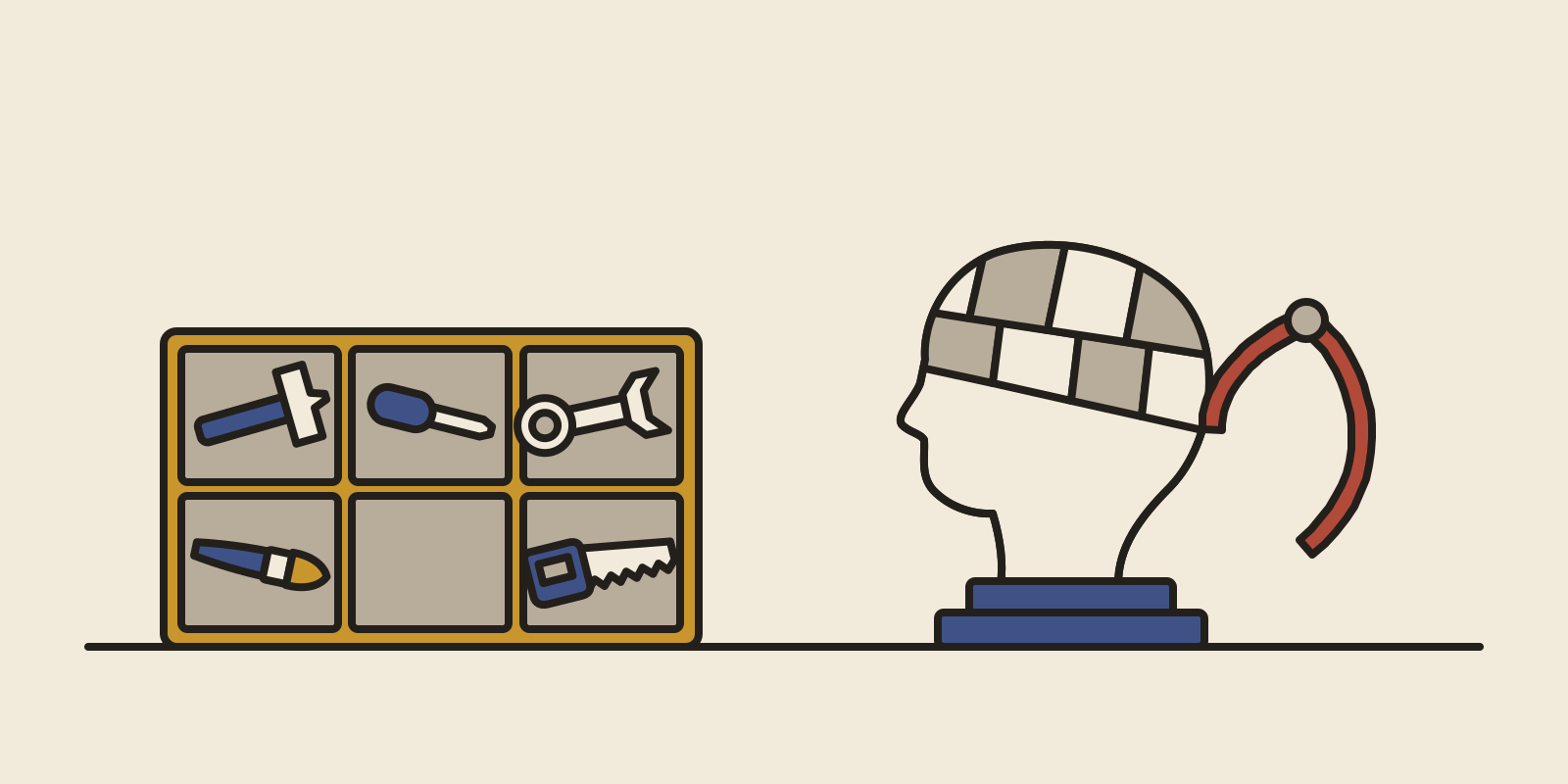
Comparison
| Localisation of functionPsychology | PhrenologyPsychology | |
|---|---|---|
| Dates from | Paul Broca's 1861 report on a patient who could say only "tan" | Franz Joseph Gall's Vienna lectures, begun in 1796 |
| Evidence | The effects of brain damage, electrical stimulation during surgery and scans of working brains | The feel of the skull, and striking cases of gifted people, criminals and asylum patients |
| What gets a place | Seeing, hearing, movement and speech | Traits of character such as cautiousness or love of children |
| Role of the skull | None | Its outer surface is taken to mirror the brain beneath |
| Who used it | Neurologists and surgeons, to find damage and avoid causing more | Paying customers, employers and parents choosing a child's trade |
| Standing today | Supported for sensing, movement and language, less secure for complex thought | Refuted |
Dates from
- Localisation of function
- Paul Broca's 1861 report on a patient who could say only "tan"
- Phrenology
- Franz Joseph Gall's Vienna lectures, begun in 1796
Evidence
- Localisation of function
- The effects of brain damage, electrical stimulation during surgery and scans of working brains
- Phrenology
- The feel of the skull, and striking cases of gifted people, criminals and asylum patients
What gets a place
- Localisation of function
- Seeing, hearing, movement and speech
- Phrenology
- Traits of character such as cautiousness or love of children
Role of the skull
- Localisation of function
- None
- Phrenology
- Its outer surface is taken to mirror the brain beneath
Who used it
- Localisation of function
- Neurologists and surgeons, to find damage and avoid causing more
- Phrenology
- Paying customers, employers and parents choosing a child's trade
Standing today
- Localisation of function
- Supported for sensing, movement and language, less secure for complex thought
- Phrenology
- Refuted
Diagram
Phrenology and localisation share a premise and differ in their evidence
Read as text
Two overlapping circles. The left circle, localisation of function, holds evidence from damage, stimulation and scans, functions such as sensing, movement and speech and the status supported. The right circle, phrenology, holds evidence from skull shape and anecdote, traits of character and the status refuted. The shared centre holds the premise that functions have separate seats in the brain.
Why people confuse them
The good idea grew out of the bad one. Gall argued that mental faculties have separate seats on the surface of the brain, and that premise survived when his skull reading collapsed. A map of the brain's language and motor areas can look, at a glance, like the patchwork head in a phrenologist's window.
Critics lean on the likeness too. William Uttal called brain imaging "the new phrenology" in 2001, arguing that it repeats Gall's assumption that mental life divides into separable faculties. Headlines about the brain's "centre" for love or shopping make the charge easy to believe.
When the difference matters
After a stroke a woman understands everything said to her and can manage only a few halting words. Before any scan, the neurologist says the damage is probably in the lower left frontal lobe, and the scan agrees. That is localisation of function at work, and dismissing it as skull-reading would discard knowledge that guides surgery every day.
Localisation of function
Different parts of the brain do different jobs, so damage to one area can knock out one ability and leave the rest intact.
The opposite mistake is as costly. Suppose a firm offers to rate job applicants from head measurements, or from a scan said to show a large "leadership area". This is phrenology's reasoning, with a broad trait of character given a single spot and size taken as the measure of strength. A 2018 study of more than 5,700 people found that scalp shape predicted none of the traits tested.
Phrenology
A refuted nineteenth-century doctrine that character can be read from the bumps of the skull, because each mental faculty has its own brain organ.
A new claim can be sorted by asking what the evidence was and how modest a function is being placed.
Where they overlap
Both hold that the mind is the work of the brain, a view Gall defended when it was still disputed, and both deny that the brain acts as one undivided mass. They also share an opponent. Pierre Flourens, and Karl Lashley a century later, found in animals that the amount of cortex removed mattered more than where it was. Flourens aimed that finding at Gall, and it remains the standard caution for localisation's bolder claims.
Further reading
- Broca, P. (1861). Remarques sur le siège de la faculté du langage articulé, suivies d'une observation d'aphémie (perte de la parole). Bulletin de la Société Anatomique de Paris, 6, 330–357.
- Finger, S. (1994). Origins of neuroscience: A history of explorations into brain function. Oxford University Press. https://doi.org/10.1093/oso/9780195065039.001.0001
- Gall, F. J. (1835). On the functions of the brain and of each of its parts (W. Lewis, Trans., Vols. 1–6). Marsh, Capen & Lyon. (Original work published 1822)
- Uttal, W. R. (2001). The new phrenology: The limits of localizing cognitive processes in the brain. MIT Press.
Cite this entry
Scholia. (2026). Localisation of function vs phrenology. In Scholia: Notes in the margin of the human sciences. Retrieved November 28, 2026, from https://scholia.zennia.sg/versus/localisation-of-function-vs-phrenology