VersusPsychology
Stereotype vs prototype theory
A prototype is the most typical case of any category. A stereotype is a shared belief about a kind of person, applied to individuals.
- TermStereotypeA widely shared, simplified belief about what the members of a social group are like, applied to individuals whatever their own traits.Psychology
- IdeaPrototype theoryPeople sort the world by resemblance to a category's best examples, so some members are more typical than others and boundaries are fuzzy.Cognitive science & linguistics
Comparison
| StereotypePsychology | Prototype theoryCognitive science & linguistics | |
|---|---|---|
| What it is | A term for a shared, simplified belief about a social group | A theory of how the mind organises categories round their best examples |
| Covers | Kinds of people | Any category at all: birds, furniture, colours, diseases |
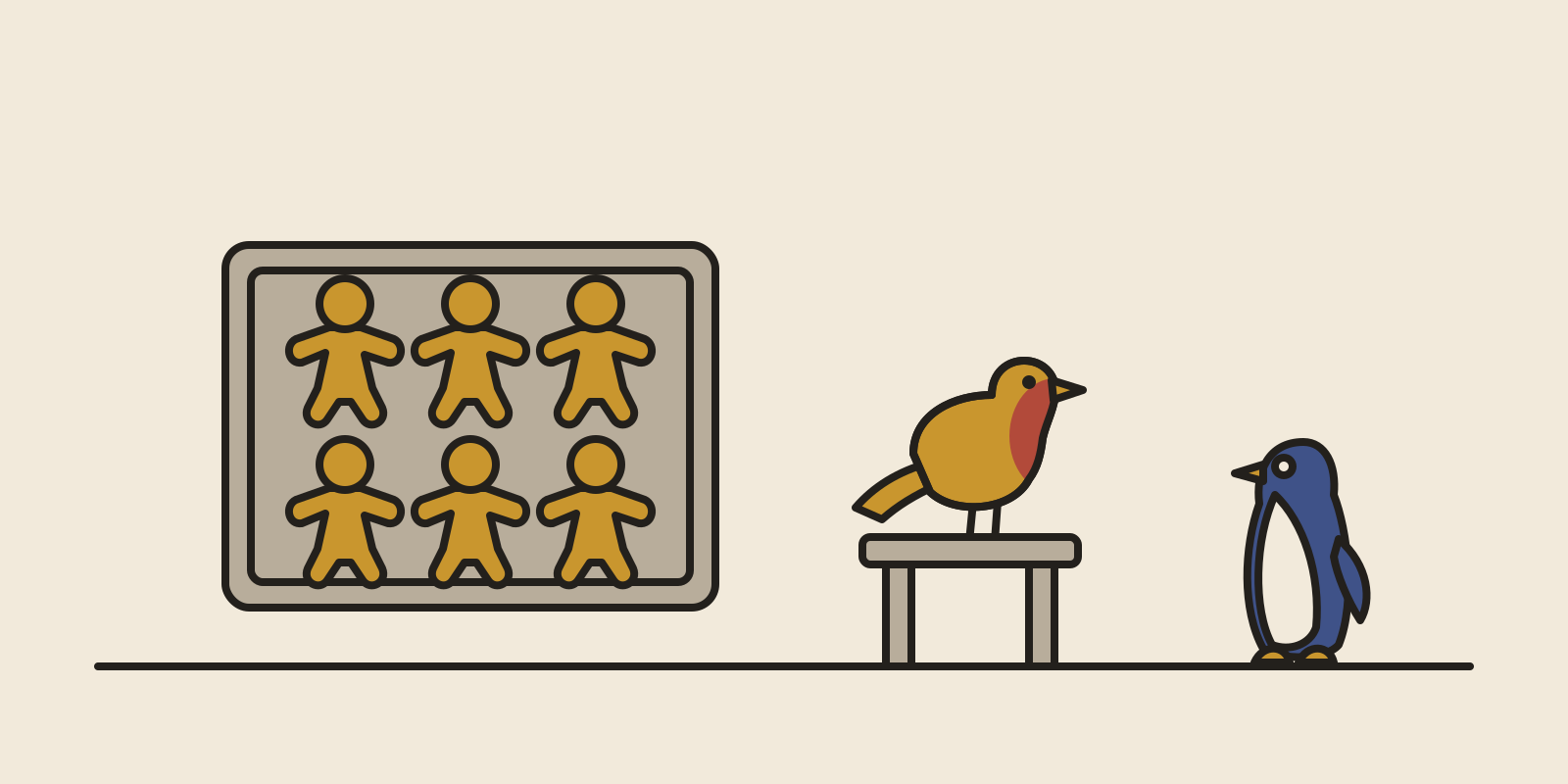
| Example | The elderly are forgetful | A robin is a more typical bird than a penguin |
| Where it comes from | Learned from family, jokes and films more than from experience | Forms in ordinary minds from the features members tend to share |
| Judgement | Often carries one, and is applied to a person whatever that person is like | Carries none. Typical means only close to the centre of the category |
| Source | Walter Lippmann, Public Opinion (1922) | Eleanor Rosch's experiments, 1973 to 1978 |
What it is
- Stereotype
- A term for a shared, simplified belief about a social group
- Prototype theory
- A theory of how the mind organises categories round their best examples
Covers
- Stereotype
- Kinds of people
- Prototype theory
- Any category at all: birds, furniture, colours, diseases
Example
- Stereotype
- The elderly are forgetful
- Prototype theory
- A robin is a more typical bird than a penguin
Where it comes from
- Stereotype
- Learned from family, jokes and films more than from experience
- Prototype theory
- Forms in ordinary minds from the features members tend to share
Judgement
- Stereotype
- Often carries one, and is applied to a person whatever that person is like
- Prototype theory
- Carries none. Typical means only close to the centre of the category
Source
- Stereotype
- Walter Lippmann, Public Opinion (1922)
- Prototype theory
- Eleanor Rosch's experiments, 1973 to 1978
Diagram
A stereotype concerns kinds of people and a prototype any category
Read as text
Two overlapping circles. The left circle, stereotype, holds beliefs about social groups that are shared across a society and often carry a judgement. The right circle, prototype, holds any category at all, graded typicality and no judgement. The shared centre holds a quick picture of a category.
Why people confuse them
Both are quick pictures that stand in for a whole category. Ask for a bird and a robin comes to mind, and ask for a professor and an absent-minded man in tweed may arrive just as fast. From the inside the two feel alike.
The words are close cousins as well. Both end in "type", from the Greek for an impression or model: a stereotype was first a printing plate, and a prototype is a first model from which copies are made. Some psychologists add to the overlap by describing a stereotype as the prototype of a social group.
When the difference matters
Two patients with heart attacks are sent home from one emergency ward.
The first is a man whose only symptoms were nausea and a sore jaw, seen by a doctor who was looking for the textbook picture of crushing chest pain. This is the effect that prototype theory describes, in which typical cases are recognised quickly and unusual ones are missed. The doctor held no view about what sort of person the patient was.
Prototype theory
People sort the world by resemblance to a category's best examples, so some members are more typical than others and boundaries are fuzzy.
The second is a woman who did have chest pain, which the doctor took less seriously because of a belief about women. That is a stereotype, a belief about a group applied to the person in front of you.
Stereotype
A widely shared, simplified belief about what the members of a social group are like, applied to individuals whatever their own traits.
The first error calls for training on the many ways a heart attack can present, the second for checking a belief about people against the patient herself.
Where they overlap
Both save effort, since sorting by resemblance is quicker than examining every case, and both bend attention so that cases which fit are noticed first and remembered best. And in both, a picture that holds on average says little about a single member. A penguin is still a bird, and plenty of people in their eighties forget nothing. Both are also largely learned, so each varies from one society to another.
Further reading
- Hilton, J. L., & von Hippel, W. (1996). Stereotypes. Annual Review of Psychology, 47, 237–271. https://doi.org/10.1146/annurev.psych.47.1.237
- Lippmann, W. (1922). Public opinion. Harcourt, Brace and Company.
- Murphy, G. L. (2002). The big book of concepts. MIT Press. https://doi.org/10.7551/mitpress/1602.001.0001
- Rosch, E. (1975). Cognitive representations of semantic categories. Journal of Experimental Psychology: General, 104(3), 192–233. https://doi.org/10.1037/0096-3445.104.3.192
Cite this entry
Scholia. (2026). Stereotype vs prototype theory. In Scholia: Notes in the margin of the human sciences. Retrieved November 28, 2026, from https://scholia.zennia.sg/versus/stereotype-vs-prototype-theory