VersusAnthropology
Structuralism (anthropology) vs structuralism (linguistics)
Linguistic structuralism is the source and deals with language only. Lévi-Strauss carried its method over to kinship, myth and cooking.
- School or branchStructuralism (anthropology)The school that reads myths, kinship rules and customs as expressions of unconscious patterns of thought, built from contrasts as language is.Anthropology
- School or branchStructuralism (linguistics)The approach that treats a language as a system in which each sound and word is defined by its relations to the others.Cognitive science & linguistics
Comparison
| Structuralism (anthropology)Anthropology | Structuralism (linguistics)Cognitive science & linguistics | |
|---|---|---|
| Founding work | Claude Lévi-Strauss, The Elementary Structures of Kinship (1949) | Ferdinand de Saussure's Course in General Linguistics (1916), named structuralism by Roman Jakobson in 1929 |
| Material | Kinship rules, myths, cooking and classification | The sounds, words and grammatical forms of a language |
| Where the structure lies | In unconscious patterns of the human mind, often paired opposites | In the system a community of speakers shares |
| A typical contrast | Raw and cooked, nature and culture | Two sounds that tell one word from another |
| How an analysis is tested | By comparing all the versions of a myth or custom | By swapping one unit for another and seeing what changes |
| Later life | Its binary oppositions passed into literary and film criticism | Displaced by generative grammar after 1957, though its tools are still taught first |
Founding work
- Structuralism (anthropology)
- Claude Lévi-Strauss, The Elementary Structures of Kinship (1949)
- Structuralism (linguistics)
- Ferdinand de Saussure's Course in General Linguistics (1916), named structuralism by Roman Jakobson in 1929
Material
- Structuralism (anthropology)
- Kinship rules, myths, cooking and classification
- Structuralism (linguistics)
- The sounds, words and grammatical forms of a language
Where the structure lies
- Structuralism (anthropology)
- In unconscious patterns of the human mind, often paired opposites
- Structuralism (linguistics)
- In the system a community of speakers shares
A typical contrast
- Structuralism (anthropology)
- Raw and cooked, nature and culture
- Structuralism (linguistics)
- Two sounds that tell one word from another
How an analysis is tested
- Structuralism (anthropology)
- By comparing all the versions of a myth or custom
- Structuralism (linguistics)
- By swapping one unit for another and seeing what changes
Later life
- Structuralism (anthropology)
- Its binary oppositions passed into literary and film criticism
- Structuralism (linguistics)
- Displaced by generative grammar after 1957, though its tools are still taught first
Diagram
The structural method passed from linguistics to anthropology through Jakobson
Read as text
A timeline from 1916 to 1971. In 1916 Saussure's Course in General Linguistics is published. In 1929 Jakobson gives the approach the name structuralism. In 1942 Jakobson teaches structural phonology to Lévi-Strauss in New York. In 1949 Lévi-Strauss publishes The Elementary Structures of Kinship. In 1957 generative grammar begins to displace structural linguistics. In 1962 Lévi-Strauss publishes The Savage Mind. One bar shows linguistic structuralism leading its field from 1916 to 1957. A second shows Lévi-Strauss's main works from 1949 to 1971.
Why people confuse them
The anthropology took its name and its method from the linguistics, and one man links them. Jakobson, who had named the linguists' approach, taught structural phonology to Lévi-Strauss in New York in 1942, when both were wartime exiles. In 1960s France the method spread to literary criticism, psychoanalysis and Marxism, so that "structuralism" came to mean a whole intellectual movement. Readers who meet it there often take Lévi-Strauss for the origin, although he was the borrower, some thirty years after Saussure's Course.
When the difference matters
Take a claim of each kind. A linguist says that "p" and "b" are separate units of English. The check is quick: swap one for the other in "pat" and any speaker will tell you the word has changed. This is the method of linguistic structuralism, and anyone who knows the language can confirm its results.
Structuralism (linguistics)
The approach that treats a language as a system in which each sound and word is defined by its relations to the others.
A critic says that serving roast meat and not boiled at a wedding banquet marks the guests as honoured outsiders. This is a reading in the style of structural anthropology, and no diner can settle it the way a speaker settles "pat" and "bat". Edmund Leach, who admired the approach, complained that many such analyses could not be checked against evidence.
Structuralism (anthropology)
The school that reads myths, kinship rules and customs as expressions of unconscious patterns of thought, built from contrasts as language is.
The borrowing changed more than the subject. When someone decodes a meal or a football match, ask which kind of claim it is.
Where they overlap
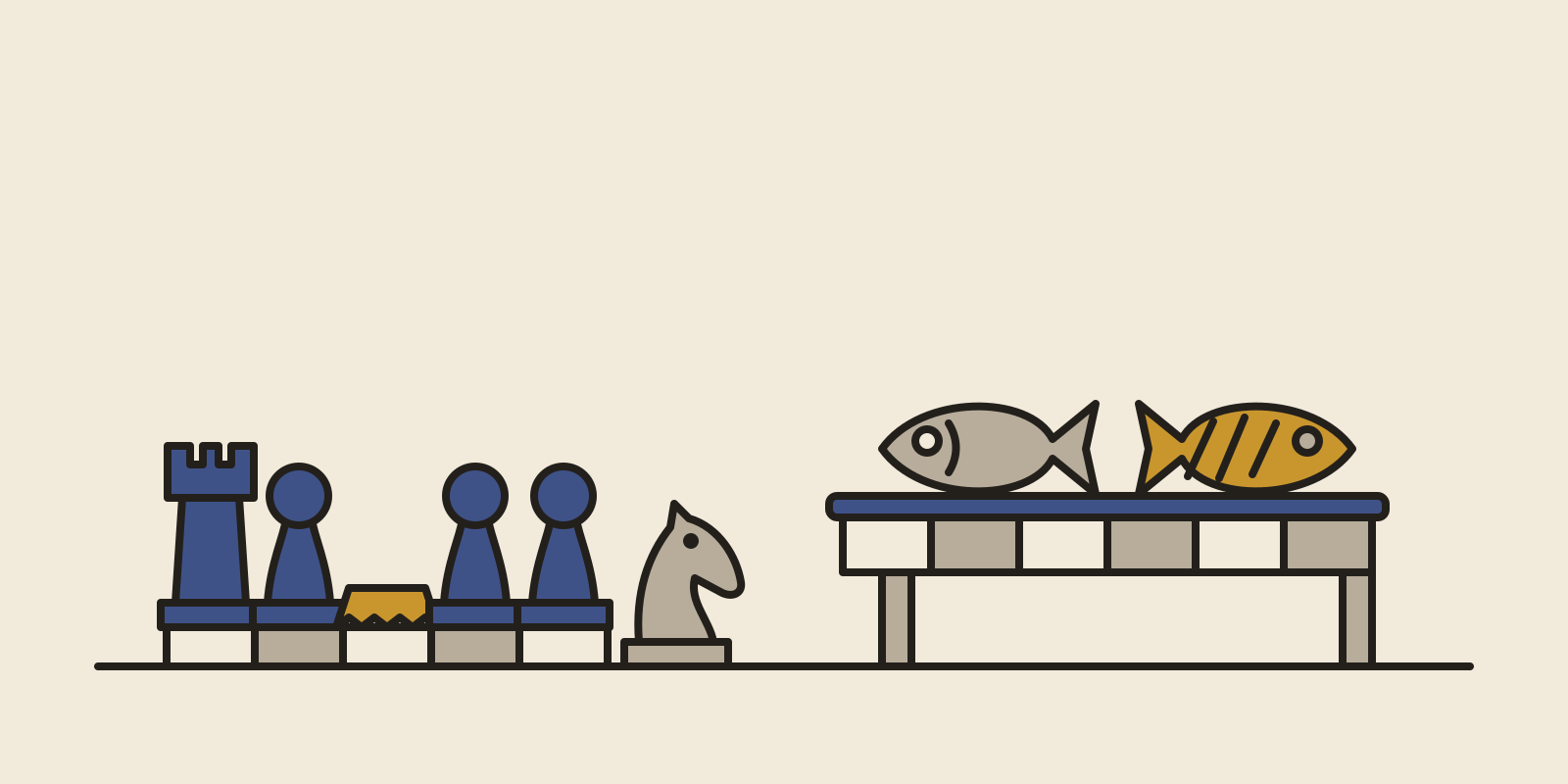
Both hold that an element means nothing alone and gets its value from its contrasts with others. Saussure's picture was chess. A bottle cap can serve as a lost knight so long as both players treat it as one. Both say people follow the system without being able to state it, as speakers follow the grammar of their language. Jacques Derrida criticised each of them, and both have since been absorbed into their disciplines, leaving their vocabulary and working tools behind.
Further reading
- Leach, E. (1970). Lévi-Strauss. Fontana.
- Lévi-Strauss, C. (1963). Structural anthropology. Basic Books. (Original work published 1958)
- Lévi-Strauss, C. (1969). The elementary structures of kinship (Rev. ed.). Beacon Press. (Original work published 1949)
- Saussure, F. de. (1983). Course in general linguistics. Duckworth. (Original work published 1916)
Cite this entry
Scholia. (2026). Structuralism (anthropology) vs structuralism (linguistics). In Scholia: Notes in the margin of the human sciences. Retrieved November 28, 2026, from https://scholia.zennia.sg/versus/structuralism-anthropology-vs-structuralism-linguistics