CrossingCognitive science & linguistics
Prototype theory + universals
Rosch's experiments suggest that minds sort without a shared property, which weakens one motive for universals and leaves the metaphysical question standing.
- IdeaPrototype theoryPeople sort the world by resemblance to a category's best examples, so some members are more typical than others and boundaries are fuzzy.Cognitive science & linguistics
- TermUniversalsA universal is a feature that many different things can share, such as redness or being human, as opposed to a particular thing.Philosophy
What each entry sees
Prototype theory
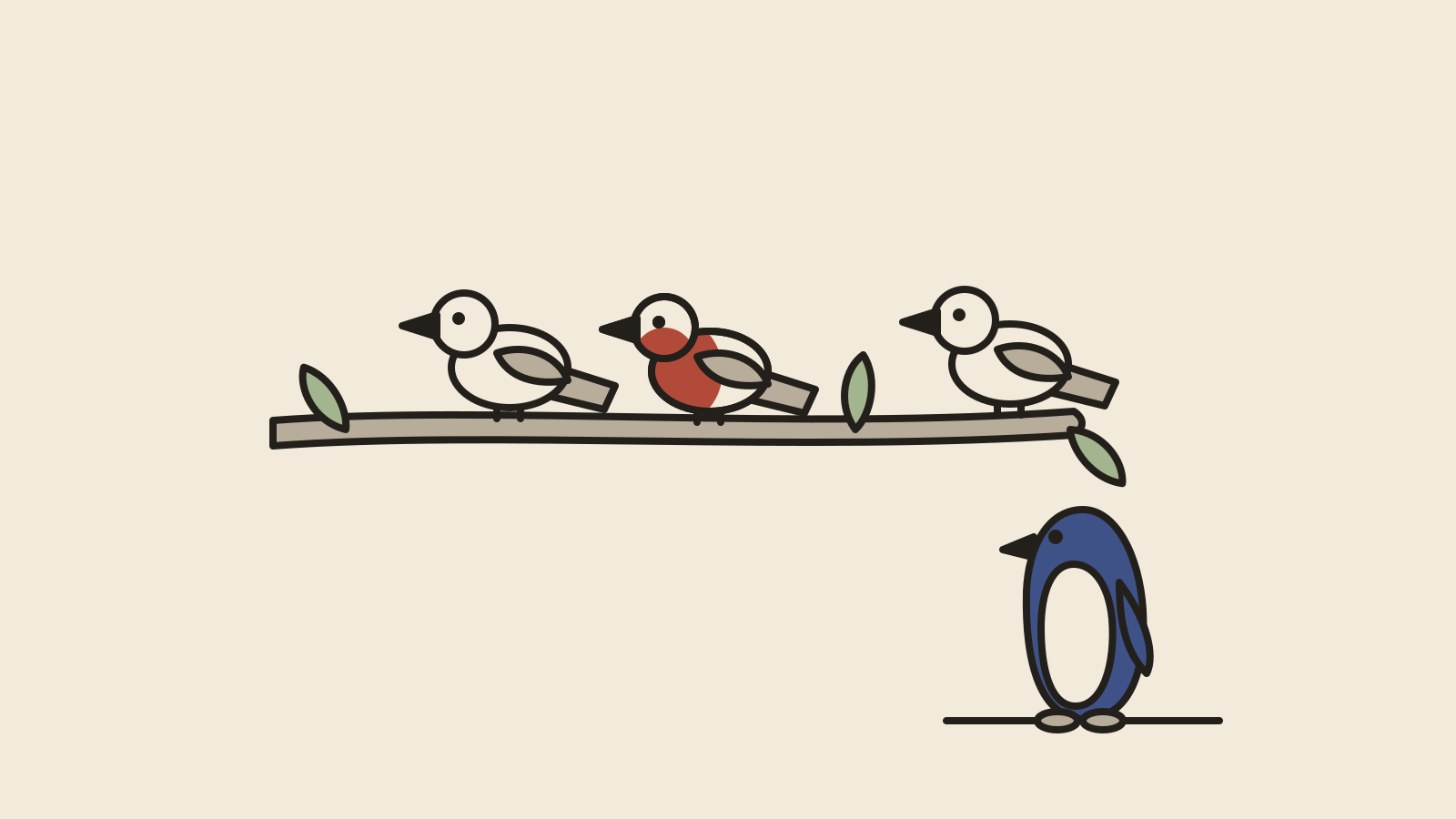
Prototype theory holds that a category in the mind is organised round its most typical members. People sort new things by how closely they resemble that centre, with no definition to consult. Eleanor Rosch's experiments in the 1970s found that people rate a robin as a better bird than a penguin, and agree closely in such ratings. No single feature is required of every member, and the edges of a category are blurred. Rosch herself warned that these effects are findings and do not show how concepts are stored.
Prototype theory
People sort the world by resemblance to a category's best examples, so some members are more typical than others and boundaries are fuzzy.
Universals
A universal is a feature that many things can share, such as redness or being a horse. The problem of universals asks whether shared features exist and what kind of thing they would be. Realists say they exist, nominalists deny them and conceptualists place them in the mind. The standard argument for universals is that they explain how different things can be the same in some respect.
Universals
A universal is a feature that many different things can share, such as redness or being human, as opposed to a particular thing.
Nominalism
The view that only particular things exist, and that general words such as "red" or "justice" name no extra shared entity.
Diagram
Prototype theory + universals
Read as text
Overlap of Prototype theory (Idea, Cognitive science & linguistics) and Universals (Term, Philosophy). Only Prototype theory: Archetype and Aristotle. Only Universals: Metaphysics and Nominalism. Shared: The question it opens.
What the crossing shows
The standard argument starts from sameness: many different things are called birds, so it seems there must be something that all of them have. Rosch's results suggest that everyday sorting needs no such thing. Robins and penguins hang together by overlapping features, none of them required. One motive for believing in universals, the way people group things under a word, loses force.
The old question survives for two reasons. The universals entry separates a concept, which lives in a mind, from a universal, which a realist says would exist if nobody thought of it. Rosch's experiments concern the first. Resemblance, meanwhile, has to be resemblance in some respect, as David Armstrong pressed against theories built on it. A sparrow is like a robin because both fly and sing, and flying looks like one more shared feature. The puzzle returns one level down.
The question it opens
If people sort things by resemblance to best examples, is the search for what all members share a mistake about how concepts work? It could be a mistake about ordinary categories in the mind and still a fair question about nature. Science states its laws about kinds such as electrons, where every member does seem alike. Whether such kinds differ from bird and furniture is open.
Further reading
- Aristotle. (1963). Categories and De interpretatione. Clarendon Press. (Original work published -350)
- Armstrong, D. M. (1989). Universals: An opinionated introduction. Westview Press.
- Rosch, E. H. (1973). Natural categories. Cognitive Psychology, 4(3), 328–350. https://doi.org/10.1016/0010-0285(73)90017-0
- Rosch, E. (1975). Cognitive representations of semantic categories. Journal of Experimental Psychology: General, 104(3), 192–233. https://doi.org/10.1037/0096-3445.104.3.192
Cite this entry
Scholia. (2026). Prototype theory + universals. In Scholia: Notes in the margin of the human sciences. Retrieved November 28, 2026, from https://scholia.zennia.sg/crossings/prototype-theory-plus-universals