IdeaAnthropology
Alliance theory
Lévi-Strauss's claim that marriage is an exchange between groups, and that the ties between in-laws are what bind families into a society.
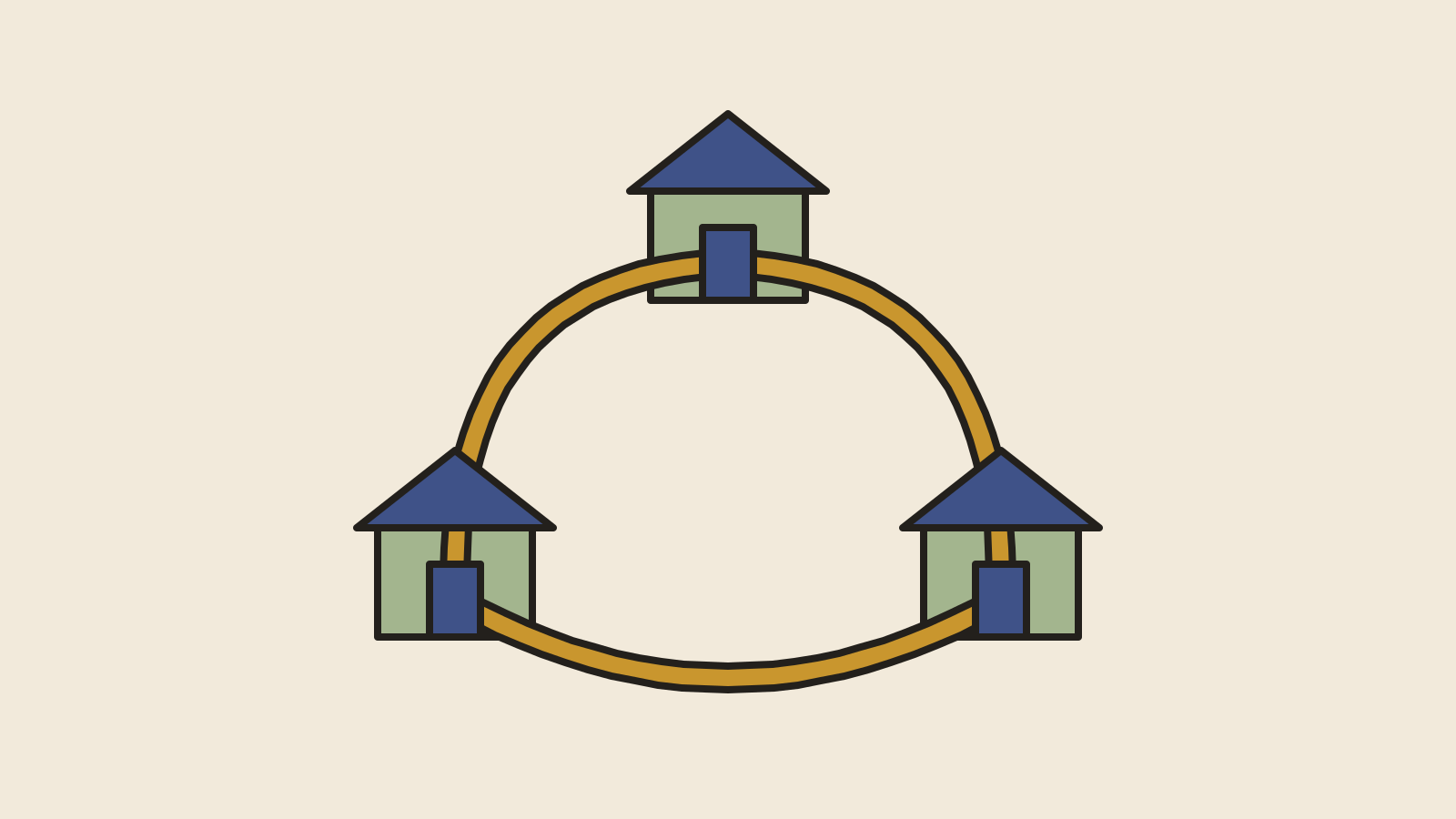
The idea
Alliance theory holds that marriage is, before anything else, an exchange between groups. A family whose men may not marry their own daughters and sisters must give them to others and look to others for wives in return. Repeated over generations, these exchanges tie separate families into a society. On this view the bond that matters most in kinship is the one between in-laws. The link between parent and child comes second.
Traces of the idea survive in any wedding where a father gives away the bride, or where two families bargain over gifts and spend years afterwards visiting, helping and judging one another. Claude Lévi-Strauss argued that this is the original logic of kinship. The rule against incest is its other face. By forbidding a man his own kin it obliges him to offer them to someone else, and so turns a stranger into an ally.
Diagram
In generalised exchange each group gives spouses one way round a circle
Read as text
A cycle of three stages. Group A gives spouses to group B, group B gives to group C and group C gives to group A, which closes the circle. No group receives from the group it gives to, so each depends on the whole chain. At the centre is the result: all three groups are allied. This is generalised exchange. In the other form, restricted exchange, two groups swap spouses directly.
Key features
- Marriage rules are read as systems of exchange between groups, and the theory treats women as the most valued of gifts.
- In restricted exchange two groups swap spouses directly, generation after generation.
- In generalised exchange spouses move one way round a chain, so that A gives to B, B to C and C in time to A.
- Elementary systems tell people which kind of relative to marry, often a cross-cousin (the child of a mother's brother or a father's sister), while complex systems only say whom to avoid.
- The smallest unit of kinship already includes an in-law, the mother's brother who gave the bride.
Not to be confused with
| Look-alike | The difference | Differs on |
|---|---|---|
| Descent theory | Descent theory says societies without states are held together by groups of people who share an ancestor. Alliance theory says they are held together by the marriages between such groups. One looks down the generations, the other sideways between groups. | Differs onClaim |
| Incest taboo | The taboo is a rule found almost everywhere. Alliance theory is one explanation of it, and goes on to classify whole marriage systems by how they exchange. | Differs onScope |
| Exogamy | Exogamy is the rule or habit of marrying outside one's own group. Alliance theory is a claim about why such rules exist and what they build. | Differs onScope |
- Differs onClaim
Descent theory says societies without states are held together by groups of people who share an ancestor. Alliance theory says they are held together by the marriages between such groups. One looks down the generations, the other sideways between groups.
- Differs onScope
The taboo is a rule found almost everywhere. Alliance theory is one explanation of it, and goes on to classify whole marriage systems by how they exchange.
- Differs onScope
Exogamy
Exogamy is the rule or habit of marrying outside one's own group. Alliance theory is a claim about why such rules exist and what they build.
Origins and development
Lévi-Strauss set the theory out in The Elementary Structures of Kinship (1949), drafted during his wartime years in New York. He took the idea of exchange from Marcel Mauss's essay on the gift and the method from structural linguistics. In Britain, Edmund Leach and Rodney Needham took it up in the 1950s and 1960s against the reigning descent theory, and Louis Dumont applied it to south India. The quarrel between the two camps faded in the 1970s as kinship studies turned to other questions.
Gift exchange
Mauss's claim that gifts only look free: giving, accepting and returning are obligations, and the cycle is what ties people and groups together.
Why it matters
The theory moved the centre of family life, as anthropologists saw it, from bloodlines to in-laws. It explains why so many societies care intensely about who marries whom, why payments pass between families at a wedding and why royal houses and business families alike have married strategically. It also gave feminist scholars a precise account of male power to argue with.
Critiques and limits
Gayle Rubin argued in 1975 that a theory in which men exchange women describes a system of male power, and that Lévi-Strauss had recorded women's subordination without examining it. Pierre Bourdieu found that families in Algeria and rural France pursue marriage strategies and bend the supposed rules. Leach showed that the theory's showpiece cases fit the facts loosely. The theory is interpretive. It rests on readings of ethnographic cases, and few anthropologists now hold it as a general law.
Connections
Belongs to
It was the school's first full demonstration, reading marriage rules as one system of exchange.
It is one of the branch's two classic models, and the rival of descent theory.
Originated by
He set the theory out in The Elementary Structures of Kinship in 1949.
Extends
It carries Mauss's duties to give, receive and return from goods to spouses, the gift that makes in-laws.
Influenced by
Structuralism (linguistics)Cognitive science & linguistics
The method of finding a few contrasts beneath many surface forms came from the linguists' analysis of sound systems.
Contrasts with
Differs on claim. Descent theory finds social order in groups that share an ancestor, alliance theory in the marriages that link such groups.
Differs on scope. The taboo is a near-universal rule, and alliance theory is one explanation of it that goes on to classify marriage systems.
Critiqued by
Pierre BourdieuSociology
Bourdieu's studies of Kabyle and Béarn marriages replaced Lévi-Strauss's marriage rules with strategies that families pursue to keep land and standing.
Cross with
Two distant entries to read beside this one, each with the question the pairing opens.
Balance of powerPolitical theory & science
Do groups choose marriage partners as states choose allies, to offset whichever neighbour is growing too strong? Set them side by side
Prisoner's dilemmaEconomics
What stops a group from taking spouses and giving none back, when cheating pays in any single exchange? Set them side by side
Further reading
- Fox, R. (1967). Kinship and marriage: An anthropological perspective. Penguin.
- Lévi-Strauss, C. (1969). The elementary structures of kinship (Rev. ed.). Beacon Press. (Original work published 1949)
- Rubin, G. (1975). The traffic in women: Notes on the "political economy" of sex. In R. R. Reiter (Ed.), Toward an anthropology of women (pp. 157–210). Monthly Review Press.
Cite this entry
Scholia. (2026). Alliance theory. In Scholia: Notes in the margin of the human sciences. Retrieved November 28, 2026, from https://scholia.zennia.sg/ideas/alliance-theory