IdeaPsychology
Classical conditioning
Learning in which a signal that reliably comes before an event starts to trigger a response in advance of it.
The idea
Some responses need no learning. Food in the mouth brings saliva, a puff of air makes the eye blink, a sudden pain brings fear. Classical conditioning is what happens when a neutral signal reliably comes just before such an event. After enough pairings the signal alone produces a response, usually one that prepares the body for what is coming.
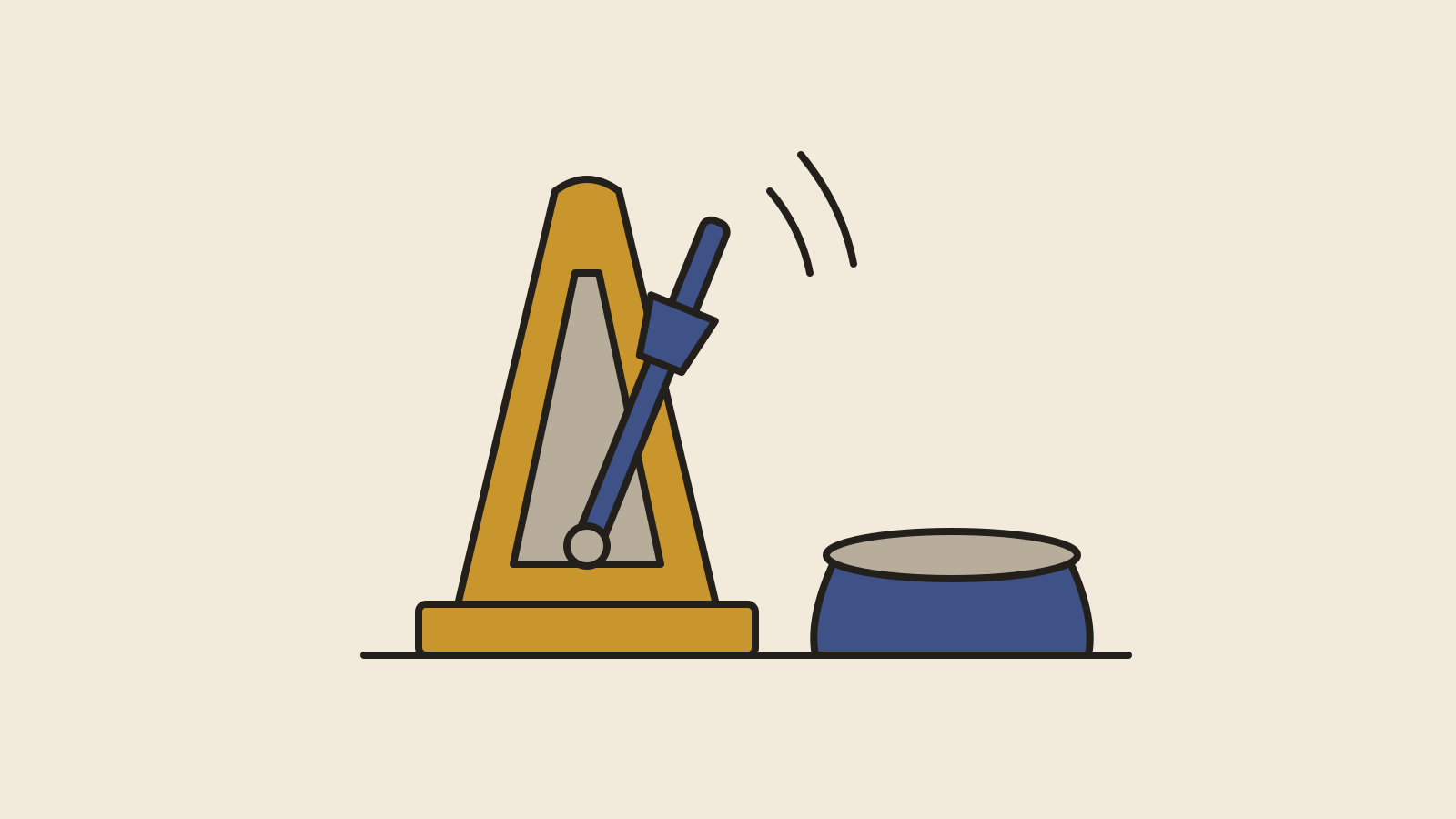
Ivan Pavlov's dogs are the textbook case: a metronome sounded before each feeding soon made them salivate with no food in sight. Everyday cases are easy to find. A cat's mouth waters at the sound of a tin opener, and a child who was once badly stung may tense at any buzzing. The whine of a dentist's drill can raise a patient's pulse in the waiting room.
Ivan Pavlov
Russian physiologist who showed that a reflex can be attached to a new signal, which gave psychology a precise laboratory method for studying learning.
The learner doesn't have to do anything, and nothing is being rewarded. What changes is what a signal means, and the body acts on the new meaning without being asked.
Diagram
A signal that predicts food comes to trigger the response itself
Read as text
Four steps in order. Before training, food in the mouth brings salivation and the sound of a metronome brings none. During training the metronome is sounded just before food, many times over. After training the metronome alone brings salivation. Food is the unconditioned stimulus, the metronome becomes the conditioned stimulus and salivation to the metronome is the conditioned response.
Key features
- Four terms describe it: an unconditioned stimulus (food) and the unconditioned response it brings (salivation), then a conditioned stimulus (the metronome) and the conditioned response it comes to produce.
- The signal must predict the event, and learning is usually fastest when the signal comes just before it.
- Extinction: the response fades if the signal keeps arriving without the event, though it can return after a pause.
- Generalisation spreads the response to similar signals, and discrimination training narrows it again.
- The responses involved are reflexes and emotional reactions, which are set off automatically.
Not to be confused with
| Look-alike | The difference | Differs on |
|---|---|---|
| Operant conditioning | In classical conditioning two events are linked, a signal and what follows it, whatever the learner does. In operant conditioning an action is linked with its consequence, so the outcome depends on the learner's behaviour. | Differs onMechanism |
| Reinforcement | Pavlov used the word for following the signal with food. Its usual modern sense belongs to operant conditioning: a consequence that makes an action more frequent. In classical conditioning no action earns anything. | Differs onMechanism |
| Habituation | Habituation involves one stimulus: a response weakens when the same harmless event keeps recurring, as with a ticking clock. Conditioning needs two events and builds a new response. | Differs onMechanism |
| Associationism | The philosophers' doctrine that all thought is built from ideas linked by experience. Classical conditioning is one measurable kind of association, between a signal and a reflex. | Differs onScope |
- Differs onMechanism
In classical conditioning two events are linked, a signal and what follows it, whatever the learner does. In operant conditioning an action is linked with its consequence, so the outcome depends on the learner's behaviour.
- Differs onMechanism
Pavlov used the word for following the signal with food. Its usual modern sense belongs to operant conditioning: a consequence that makes an action more frequent. In classical conditioning no action earns anything.
- Differs onMechanism
Habituation
Habituation involves one stimulus: a response weakens when the same harmless event keeps recurring, as with a ticking clock. Conditioning needs two events and builds a new response.
- Differs onScope
Associationism
The philosophers' doctrine that all thought is built from ideas linked by experience. Classical conditioning is one measurable kind of association, between a signal and a reflex.
Origins and development
Pavlov met the effect while studying digestion in St Petersburg and described it to an international congress in Madrid in 1903. His word was conditional: the reflex depends on experience. Early translators wrote conditioned, and it stuck. John B. Watson carried the method into American psychology and claimed in 1920 to have conditioned an infant to fear a white rat. In 1972 Robert Rescorla and Allan Wagner published a mathematical model in which learning is driven by surprise, the gap between what was expected and what happened.
John B. Watson
American psychologist who founded behaviourism in 1913, arguing that psychology should study what people do and drop the inner life.
Why it matters
It explains why places, smells and songs can bring back fear, craving or nausea. Exposure therapy treats phobias and post-traumatic stress by presenting the feared signal safely until the response dies down. Drug users can relapse when they return to the rooms where they used, and some chemotherapy patients feel sick on entering the hospital. Advertisers pair products with attractive people and music in the hope that the good feeling transfers.
Critiques and limits
The effect itself is among the best established in psychology, found in species from sea slugs to humans. The textbook account of it has been corrected. Robert Rescorla argued in 1988 that pairing alone is not enough: an animal learns about a signal only if it tells the animal something new. John Garcia and Robert Koelling showed in 1966 that rats readily link a taste with later illness, yet barely link the same taste with shock. Evolution has prepared some associations and not others.
Connections
Belongs to
Behavioural psychology (learning and behaviour analysis)
It is one of the two basic forms of associative learning the branch studies.
Originated by
Pavlov found the effect while studying digestion in dogs and spent three decades mapping its rules.
Influenced by
EmpiricismPhilosophy
It gave the empiricists' association of ideas a measurable form, a link between a signal and a reflex.
Contrasts with
Differs on mechanism. Conditioning accounts say babies learn to love whoever feeds them, where attachment theory says the tie is inborn and seeks protection.
Differs on mechanism. Classical conditioning links a signal with an event, while operant conditioning links an act with its consequence.
Differs on mechanism. Pavlov's reinforcement followed a signal whatever the animal did, while operant reinforcement depends on the learner's act.
Applied in
Exposure treatments for phobias and trauma work by extinguishing conditioned fear.
Conditioned fear and eyeblink responses are standard tools for tracing how the brain stores a memory.
Cross with
Two distant entries to read beside this one, each with the question the pairing opens.
Arbitrariness of the signCognitive science & linguistics
A bell has no natural tie to food and a word none to its meaning: is learning a word a form of conditioning? Set them side by side
Rational expectationsEconomics
Is a conditioned response a forecast of what comes next, and do animals revise it as rational forecasters would? Set them side by side
Further reading
- Garcia, J., & Koelling, R. A. (1966). Relation of cue to consequence in avoidance learning. Psychonomic Science, 4(1), 123–124. https://doi.org/10.3758/BF03342209
- Pavlov, I. P. (1927). Conditioned reflexes: An investigation of the physiological activity of the cerebral cortex. Oxford University Press. (Original work published 1927)
- Rescorla, R. A. (1988). Pavlovian conditioning: It's not what you think it is. American Psychologist, 43(3), 151–160. https://doi.org/10.1037/0003-066X.43.3.151
Cite this entry
Scholia. (2026). Classical conditioning. In Scholia: Notes in the margin of the human sciences. Retrieved November 28, 2026, from https://scholia.zennia.sg/ideas/classical-conditioning