IdeaPhilosophyAlso in Psychology, Cognitive science & linguistics
Trolley problem
A pair of cases in which killing one to save five seems right in one and wrong in the other, and the puzzle of why.
The idea
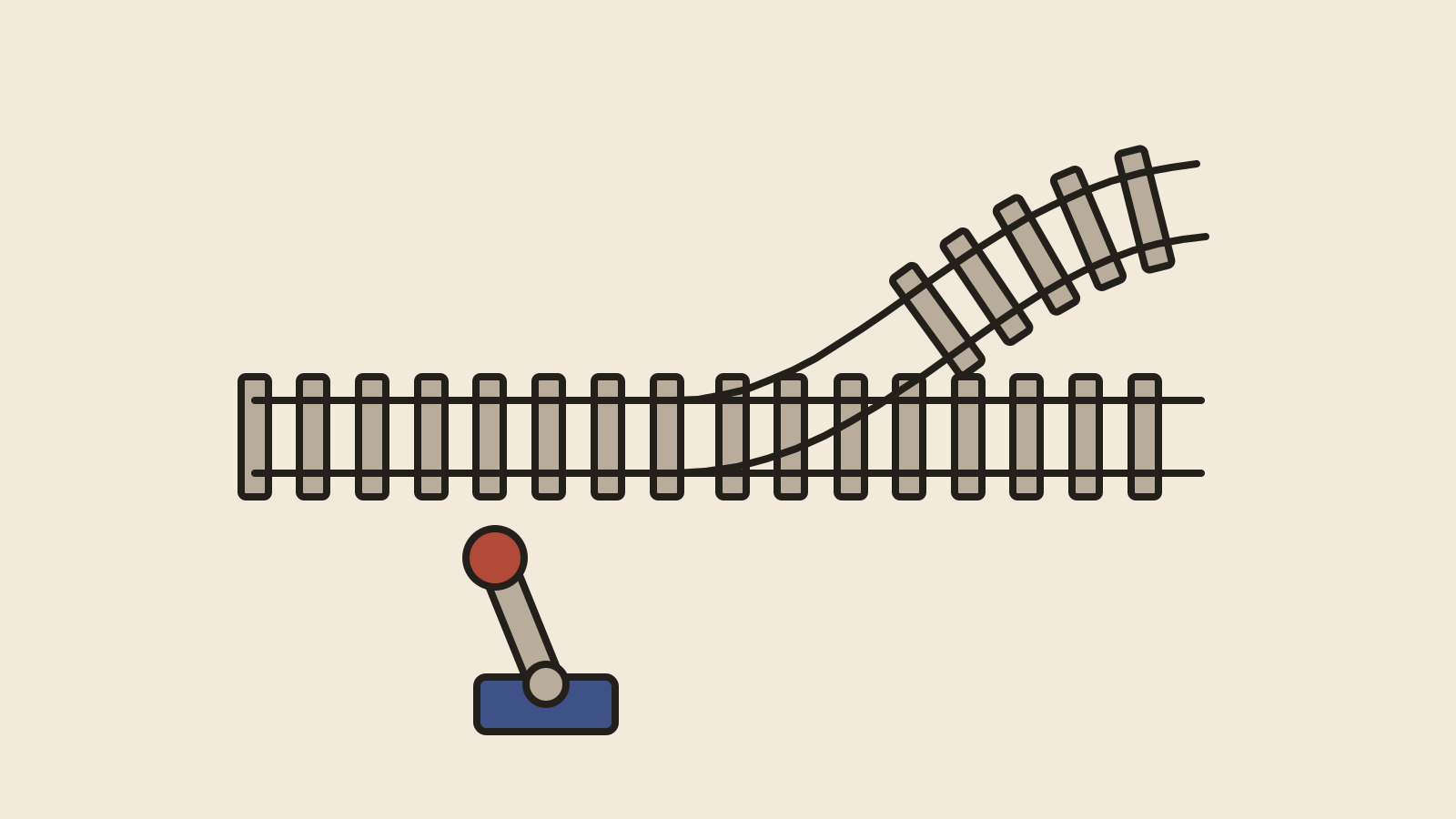
A runaway tram is heading for five people on the track. You are standing by a switch that would send it down a side track, where it will kill one person instead. Most people say you may pull the switch. Now change the case, so that you are on a footbridge above the track and the only way to stop the tram is to push a heavy stranger off the bridge into its path. He dies and the five live. Most people say you may not.
The numbers are the same in both cases, one death against five, so consequentialism in its simplest form treats them alike. The trolley problem is the task of explaining why the verdicts differ, or of showing that one of them is mistaken.
Consequentialism
The view that an act is right or wrong solely because of its results, so the best choice is whichever produces the most good.
Hospitals meet the same structure. A ward may send its one free ventilator to wherever it will save the most patients. It may not take a healthy visitor's organs to save five.
Diagram
The same five-for-one exchange draws opposite verdicts in the two cases
Read as text
Two cases set side by side, divided by how the one person dies. On the left, the switch case: you divert the tram, the death is a side effect, and most people say the act is permitted. On the right, the footbridge case: you push a man, his death is the means of stopping the tram, and most people say the act is wrong. In both, one dies and five are saved.
Key features
- The problem is a pair or series of cases, and no single case poses it.
- The cases hold the outcome fixed and vary how the death comes about, which isolates what besides outcomes might matter.
- Proposed explanations include the difference between killing and letting die, between harm intended as a means and harm foreseen as a side effect, and between redirecting a threat and starting a new one.
- New variants, such as a looped side track or a trapdoor, are built to test each proposed explanation.
Not to be confused with
| Look-alike | The difference | Differs on |
|---|---|---|
| Doctrine of double effect | A principle from Catholic moral theology. It says harm foreseen as a side effect may be permitted where the same harm intended as a means is not. It is one proposed solution to the problem. | Differs onClaim |
| Dual-process theory | A psychological account of how people reach judgements, by fast intuition or slow reasoning. It may explain why the cases feel different. It cannot say which response is correct. | Differs onDescriptive or normative |
| Thought experiment | The general method of testing a claim on an imagined case. The trolley problem is one famous use of it. | Differs onScope |
- Differs onClaim
Doctrine of double effect
A principle from Catholic moral theology. It says harm foreseen as a side effect may be permitted where the same harm intended as a means is not. It is one proposed solution to the problem.
- Differs onDescriptive or normative
A psychological account of how people reach judgements, by fast intuition or slow reasoning. It may explain why the cases feel different. It cannot say which response is correct.
- Differs onScope
The general method of testing a claim on an imagined case. The trolley problem is one famous use of it.
Origins and development
The Oxford philosopher Philippa Foot introduced the runaway tram in a 1967 paper on abortion and the doctrine of double effect. Her driver had to choose between two tracks, and she set him beside a judge who could stop a riot by framing an innocent man. Judith Jarvis Thomson named the "trolley problem" in 1976 and added the footbridge case, then in 1985 the bystander at the switch. Frances Kamm and others multiplied the variants. In 2001 the psychologist Joshua Greene put the cases to volunteers in a brain scanner, and they became a standard tool of moral psychology.
Why it matters
The cases are taught in most introductory ethics courses and are widely known outside them. Engineers and regulators met a version when they asked how a self-driving car should behave if a crash cannot be avoided. Military ethics and medical triage turn on the same distinctions between harming and failing to help. Psychologists use the cases to study how emotion and reasoning feed moral judgement.
Critiques and limits
The legal scholar Barbara Fried argued that such thin, artificial cases draw attention away from the everyday problem of imposing risks when outcomes are uncertain. Thomson herself changed her mind in 2008 and concluded that the bystander may not pull the switch. Greene's claim that the footbridge response is an emotional reflex has been challenged by Guy Kahane and Selim Berker. The problem is a conceptual puzzle with no agreed solution, and the psychological findings built on it remain disputed.
Connections
Belongs to
The cases are the standard test in normative ethics of whether anything besides outcomes makes an act right.
Influenced by
The doctrine of double effect that Foot was examining descends from Aquinas's discussion of killing in self-defence.
Critiques
The footbridge and transplant cases are standard counterexamples to the view that outcomes alone make acts right.
Contrasts with
Dual-process theoryPsychology
Differs on descriptive or normative. Dual-process theory explains how people come to judge the cases, and cannot say which judgement is correct.
Differs on scope. A thought experiment is the general method of testing claims on imagined cases, of which the trolley cases are one use.
Applied in
Social psychologyPsychology
Psychologists present the cases to volunteers to study how emotion and reasoning shape moral judgement.
Cross with
Two distant entries to read beside this one, each with the question the pairing opens.
Prospect theoryEconomics
People weigh losses more than equal gains from a reference point: how much of the gap between the two trolley cases is framing? Set them side by side
Opportunity costEconomics
On an opportunity-cost view, refusing to kill the one costs five lives: what in the second trolley case resists that accounting? Set them side by side
Further reading
- Foot, P. (1967). The problem of abortion and the doctrine of the double effect. Oxford Review, 5, 5–15.
- Greene, J. D., Sommerville, R. B., Nystrom, L. E., Darley, J. M., & Cohen, J. D. (2001). An fMRI investigation of emotional engagement in moral judgment. Science, 293(5537), 2105–2108. https://doi.org/10.1126/science.1062872
- Thomson, J. J. (1976). Killing, letting die, and the trolley problem. The Monist, 59(2), 204–217. https://doi.org/10.5840/monist197659224
- Thomson, J. J. (1985). The trolley problem. The Yale Law Journal, 94(6), 1395–1415. https://doi.org/10.2307/796133
Cite this entry
Scholia. (2026). Trolley problem. In Scholia: Notes in the margin of the human sciences. Retrieved November 28, 2026, from https://scholia.zennia.sg/ideas/trolley-problem