IdeaSociologyAlso in Psychology
Doing gender
Gender is something people do in everyday dealings with others, who hold them to account for it, more than something they simply are.
The idea
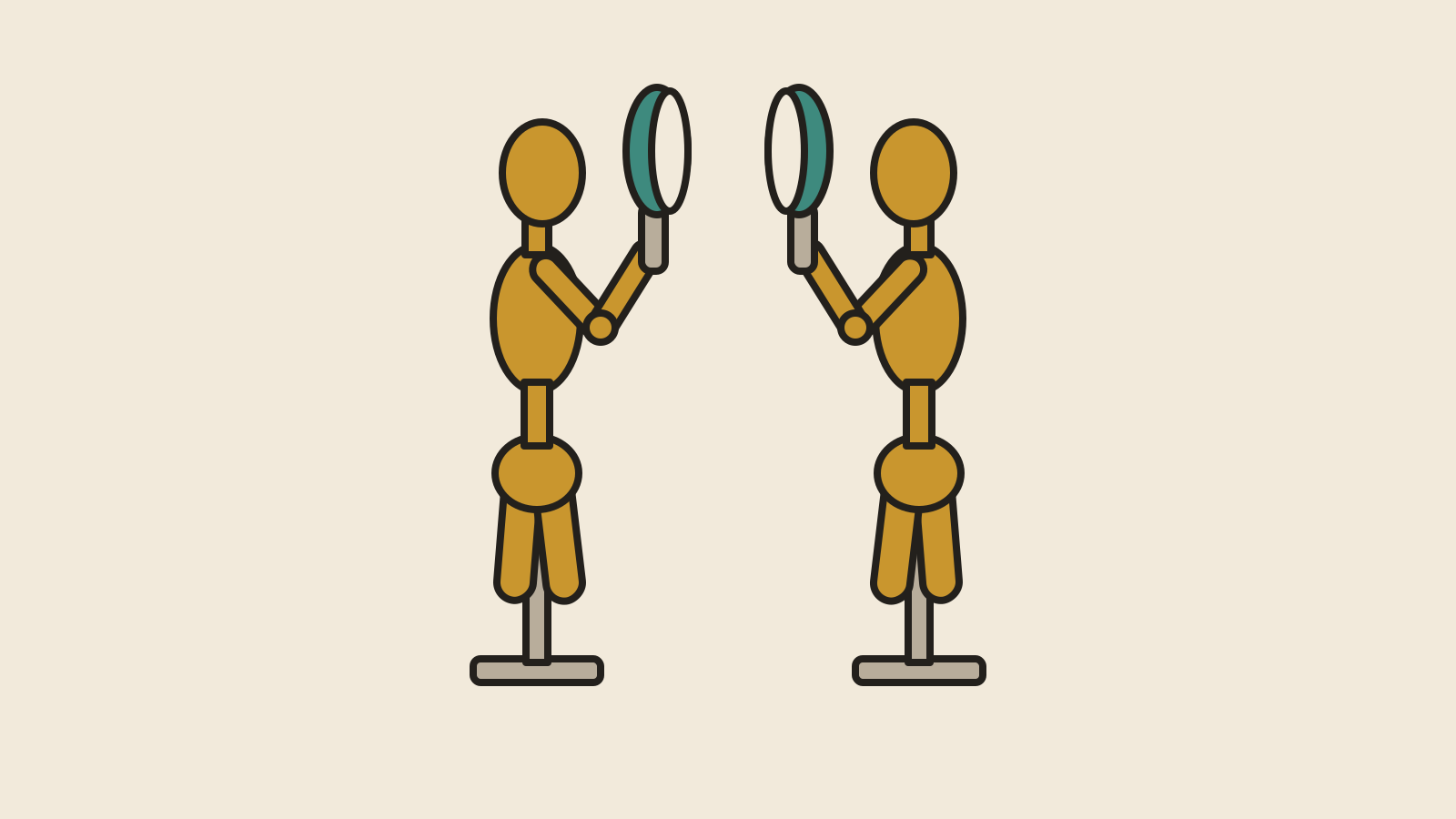
Most people think of gender as something a person has, fixed early by biology or upbringing. Candace West and Don Zimmerman argued in 1987 that it is better seen as something people do. In every encounter we present ourselves as a woman or a man, read others the same way and judge whether conduct fits. Gender is the result of that constant and mostly unnoticed work.
Watch two colleagues reach a door together. Who holds it, who walks through first, who says thanks and how: each small move can be read as fitting for a man or for a woman. Each person knows the other may read it so. Nobody has to be told. The chance of being judged is enough to steer behaviour, and the steered behaviour then looks like natural difference.
Diagram
Doing gender makes the differences that seem to justify the categories
Read as text
A loop of four nodes, each strengthening the next. People are placed in a sex category on sight. They are then held accountable to that category by others. They fit their conduct to what is expected. Because conduct fits, differences between women and men look natural. That in turn makes the two categories seem obvious, which strengthens the first step.
Key features
- Three things are kept apart: sex (classed by agreed biological criteria), sex category (the everyday placing of someone as female or male on sight) and gender (conduct managed in light of that placing).
- Accountability drives it. People act knowing that others may judge their conduct as fitting or unfitting for their sex category.
- Gender is done in interaction, so it belongs to situations and relationships more than to individual minds.
- Nobody can opt out, because others will read conduct in gendered terms whatever the person intends.
- Doing it makes differences between women and men appear natural, which supports the arrangements built on them.
Not to be confused with
| Look-alike | The difference | Differs on |
|---|---|---|
| Dramaturgy | Goffman's performers play to an audience and can drop the act backstage. West and Zimmerman say gender has no backstage: a person can be held to account as a woman or a man anywhere. | Differs onClaim |
| Hegemonic masculinity | Doing gender describes face-to-face interaction. Hegemonic masculinity describes a society-wide ranking of ways of being a man. The first says how gender is produced, the second which version is most honoured. | Differs onLevel |
| Gender performativity | Judith Butler's idea, from philosophy, is that repeated acts and speech produce the appearance of an inner gender. West and Zimmerman, from sociology, locate the work in interaction and in the risk of being judged by others. | Differs onMechanism |
| Gender roles | Role theory says people learn a script in childhood and then follow it. West and Zimmerman reply that gender is never finished being learned and has to be achieved again in each encounter. | Differs onClaim |
- Differs onClaim
Goffman's performers play to an audience and can drop the act backstage. West and Zimmerman say gender has no backstage: a person can be held to account as a woman or a man anywhere.
- Differs onLevel
Doing gender describes face-to-face interaction. Hegemonic masculinity describes a society-wide ranking of ways of being a man. The first says how gender is produced, the second which version is most honoured.
- Differs onMechanism
Gender performativity
Judith Butler's idea, from philosophy, is that repeated acts and speech produce the appearance of an inner gender. West and Zimmerman, from sociology, locate the work in interaction and in the risk of being judged by others.
- Differs onClaim
Gender roles
Role theory says people learn a script in childhood and then follow it. West and Zimmerman reply that gender is never finished being learned and has to be achieved again in each encounter.
Origins and development
West and Zimmerman, sociologists trained in ethnomethodology, first presented the argument as a conference paper in 1977. The article was published ten years later in the first volume of Gender & Society. They built on Harold Garfinkel's 1967 study of Agnes, a transgender woman who had to learn consciously what others did unawares, and on Erving Goffman's essays on gender display. In 1995 West and Sarah Fenstermaker extended the argument to race and class as "doing difference". The article became one of the most cited in the sociology of gender.
Ethnomethodology
The study of the everyday methods people use to make social life orderly and to make sense of one another.
Harold Garfinkel
The founder of ethnomethodology, who studied the unnoticed methods people use to make everyday life orderly and showed them by breaking them.
Why it matters
The idea changes where to look for inequality. If gender is produced in meetings, classrooms and kitchens, then pay scales and laws are only part of the story. Researchers have used it to study who interrupts whom, how housework gets divided when wives earn more and how transgender people are treated at work. The phrase "doing gender" is now common outside sociology.
Critiques and limits
Francine Deutsch argued in 2007 that the approach had become a theory of conformity. Studies kept finding gender being done and rarely asked how it might be undone. Barbara Risman added that calling every departure from expectations a new way of doing gender blurs the concept. Patricia Hill Collins objected that "doing difference" shrinks racism and class exploitation to encounters and loses sight of institutions. The idea rests on interpretation and close observation. It is a way of seeing more than a hypothesis one test could settle.
Patricia Hill Collins
The American sociologist who set out Black feminist thought as a body of knowledge and described oppression as a matrix of interlocking systems.
Connections
Belongs to
It treats gender as a practical accomplishment of everyday interaction, the school's core move applied to a new topic.
It moved the branch from sex roles learned in childhood to gender produced in interaction.
Influenced by
His study of Agnes showed that being taken as a woman needs continuous work that most people never notice.
His essays on gender display showed gendered conduct as staged, a picture West and Zimmerman judged too optional.
Contrasts with
Differs on claim. Goffman's performers can rest backstage, where West and Zimmerman say gender is done in every setting with no backstage.
Differs on level. Doing gender describes face-to-face encounters, hegemonic masculinity the society-wide order that ranks ways of being a man.
Applied in
SociolinguisticsCognitive science & linguistics
West and Zimmerman's studies of interruptions in mixed-sex talk made conversation a main site for watching gender done.
Workplace studies use it to show how jobs, meetings and dress codes call for displays of gender.
Cross with
Two distant entries to read beside this one, each with the question the pairing opens.
Turing testCognitive science & linguistics
Turing adapted his test from a party game of guessing which hidden player is a woman: what does passing show about gender as something done? Set them side by side
Existence precedes essencePhilosophy
If people make themselves through choices, how free is the choice of how to do gender when others hold you to account for it? Set them side by side
Further reading
- Deutsch, F. M. (2007). Undoing gender. Gender & Society, 21(1), 106–127. https://doi.org/10.1177/0891243206293577
- West, C., & Zimmerman, D. H. (1987). Doing gender. Gender & Society, 1(2), 125–151. https://doi.org/10.1177/0891243287001002002
- West, C., & Fenstermaker, S. (1995). Doing difference. Gender & Society, 9(1), 8–37. https://doi.org/10.1177/089124395009001002
Cite this entry
Scholia. (2026). Doing gender. In Scholia: Notes in the margin of the human sciences. Retrieved November 28, 2026, from https://scholia.zennia.sg/ideas/doing-gender
This topic is contested. The entry sets out the main positions rather than settling them.