IdeaSociologyAlso in Psychology
Dramaturgy
Everyday social life works like theatre: people perform versions of themselves for audiences and relax the act backstage.
The idea
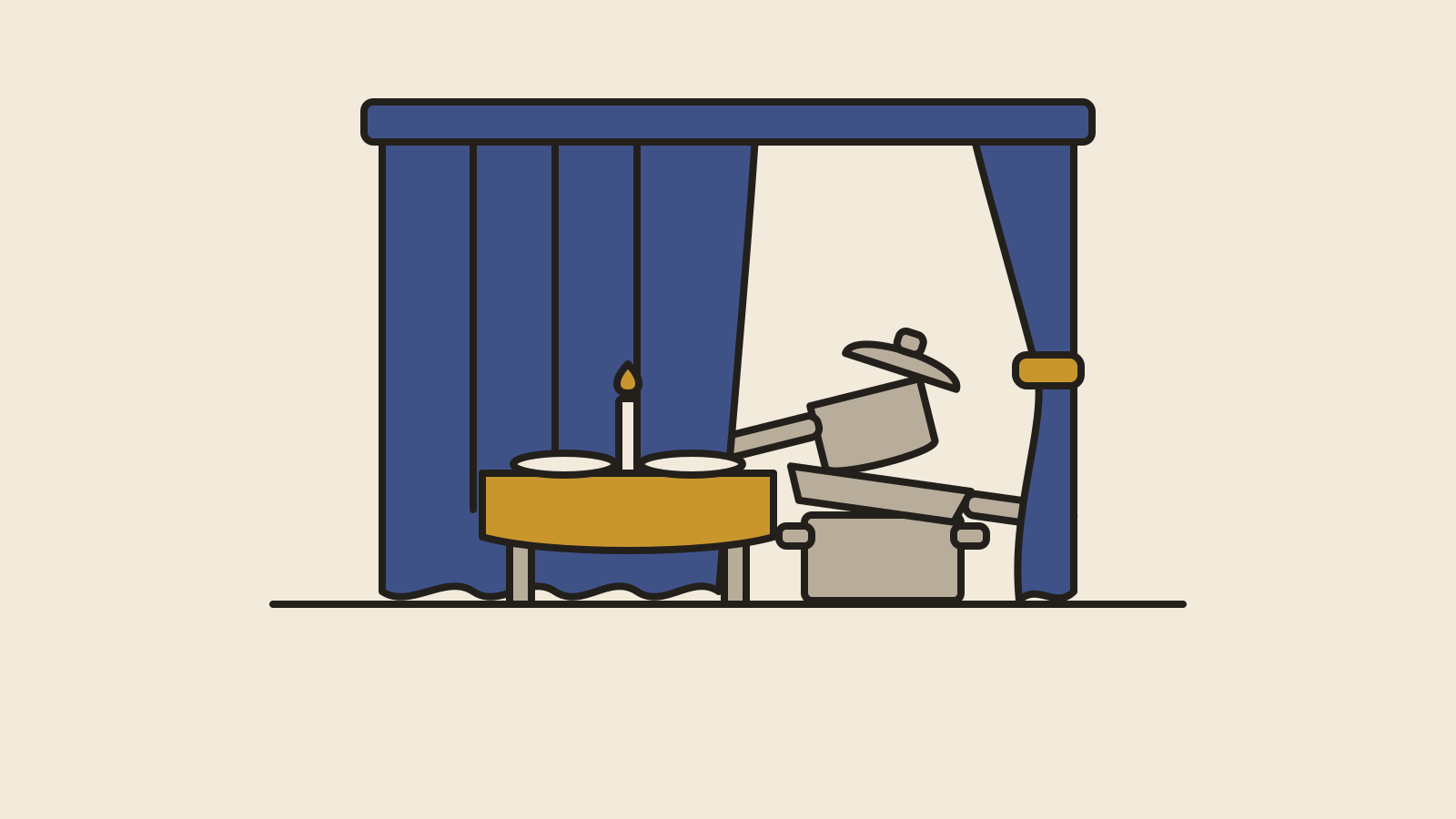
Erving Goffman proposed that everyday social life can be read as theatre. Whenever people are in each other's presence, each gives a performance: a version of themselves fitted to the occasion and the audience. Performances need a stage. In the front region the audience is watching and the performer keeps up the manner the part requires. In the back region the audience is shut out, and the performer can drop the act, rehearse or complain.
A restaurant shows the whole scheme. In the dining room a waiter is calm, attentive and spotless. Through the swing door, in the kitchen, the same waiter may be swearing about table six and eating a chip off a returned plate. Goffman watched just this in a Shetland hotel. Neither waiter is the fake one. Each is the same person doing what a different region allows, and the dining room would stop working if the door stayed open.
Diagram
Every performance has a front region and a hidden back region
Read as text
Two regions set side by side and divided by who can see into them. On the front stage the audience is present and the performer keeps up the manner the part requires. On the back stage the audience is shut out and the performer can drop the act.
Key features
- Performers work in teams: the staff of a shop or the members of a family cooperate to hold up one shared impression.
- A front is the standard equipment of a part, made up of setting, appearance and manner.
- People give some expressions on purpose and give others off unawares, and audiences check the first against the second.
- Audiences usually help. They look away from slips with tact, because a collapsed performance embarrasses everyone present.
- The theatre is a metaphor. Goffman called it scaffolding, to be taken down once it has shown how encounters are built.
Not to be confused with
| Look-alike | The difference | Differs on |
|---|---|---|
| Social role | A role is the part: the conduct expected of a position such as nurse or host. Dramaturgy is a whole account of staging. It adds regions, teams, props and audiences to the part and asks how it is carried off. | Differs onScope |
| Impression management | The effort to control what others conclude about us. It is one piece of dramaturgy, and psychologists now study it separately as self-presentation, often without the theatre. | Differs onScope |
| Looking-glass self | Cooley explains where self-feeling comes from: we absorb the judgements we imagine others make. Dramaturgy describes how people act on those judgements in advance by staging what others will see. | Differs onClaim |
| Doing gender | Goffman's performers can step backstage and rest. Candace West and Don Zimmerman argued that gender has no backstage: people are held to account as women or men in every setting, so it is done all the time. | Differs onClaim |
- Differs onScope
A role is the part: the conduct expected of a position such as nurse or host. Dramaturgy is a whole account of staging. It adds regions, teams, props and audiences to the part and asks how it is carried off.
- Differs onScope
Impression management
The effort to control what others conclude about us. It is one piece of dramaturgy, and psychologists now study it separately as self-presentation, often without the theatre.
- Differs onClaim
Cooley explains where self-feeling comes from: we absorb the judgements we imagine others make. Dramaturgy describes how people act on those judgements in advance by staging what others will see.
- Differs onClaim
Goffman's performers can step backstage and rest. Candace West and Don Zimmerman argued that gender has no backstage: people are held to account as women or men in every setting, so it is done all the time.
Origins and development
Goffman developed the approach during doctoral fieldwork on Unst, in the Shetland Islands, between 1949 and 1951. The Presentation of Self in Everyday Life appeared as a University of Edinburgh monograph in 1956 and in a revised American edition in 1959. He borrowed some of the theatrical vocabulary from the critic Kenneth Burke. Later he tried other metaphors and treated encounters as rituals and as games. In Frame Analysis (1974) he looked again at how far the comparison with the stage holds.
Why it matters
Service work runs on it. Call-centre scripts, cabin crew smiles and the tidy consulting room are all managed fronts, and Arlie Hochschild's study of emotional labour began from Goffman. Research on politeness in language grew from his notion of face, the public self-image each speaker claims. The idea fits online life closely too. A profile is a front and the private group chat is a back region.
Emotional labour
Paid work that requires managing your own feelings to produce a mood in customers, as a requirement of the job.
Critiques and limits
Alvin Gouldner argued in 1970 that dramaturgy describes a world of appearances with power and inequality left out, a sociology suited to the salaried middle class. The philosopher Alasdair MacIntyre objected that Goffman's self shrinks to a peg on which roles are hung, with nobody left to be sincere. Others ask how far a scheme built from mid-century British and American manners travels. The idea is interpretive. It rests on observation and organises what we see, and Goffman never offered it as a testable law.
Connections
Belongs to
It shares the school's focus on meaning made face to face, though Goffman cared more about encounters than about selves.
Originated by
Goffman worked it out from fieldwork in a Shetland hotel and published it in 1956.
Influenced by
Goffman took from Durkheim the idea that the modern person is treated as sacred, which performances and tact protect.
Contrasts with
Differs on claim. Goffman's performers can rest backstage, where West and Zimmerman say gender is done in every setting with no backstage.
Differs on scope. A role is the part expected of a position, and dramaturgy is the whole account of how parts are staged.
Differs on claim. Cooley explains where self-feeling comes from, while Goffman describes how people stage themselves to steer others' judgements.
Differs on mechanism. Goffman's performer manages the outward display, while Hochschild's worker may also change the feeling itself, at an employer's direction.
Applied in
Studies of service jobs use front and back regions to explain scripts, uniforms and the strain of a paid smile.
Social psychologyPsychology
Psychologists study impression management in experiments as self-presentation, usually without the theatrical frame.
SociolinguisticsCognitive science & linguistics
Politeness theory grew from Goffman's notion of face, the public self-image each speaker claims in talk.
Influenced
Her surface and deep acting push Goffman's stage metaphor inward, from managing appearances to managing the feeling itself.
Cross with
Two distant entries to read beside this one, each with the question the pairing opens.
Wu weiPhilosophy
Can an action be unforced in the Daoist sense if, as Goffman holds, it is always performed for an audience? Set them side by side
Personality traitPsychology
If people perform different selves for different audiences, what is left for a personality trait to measure across situations? Set them side by side
Further reading
- Goffman, E. (1959). The presentation of self in everyday life. Anchor Books. (Original work published 1956)
- Gouldner, A. W. (1970). The coming crisis of Western sociology. Basic Books.
- Smith, G. (2006). Erving Goffman. Routledge. https://doi.org/10.4324/9780203002346
Cite this entry
Scholia. (2026). Dramaturgy. In Scholia: Notes in the margin of the human sciences. Retrieved November 28, 2026, from https://scholia.zennia.sg/ideas/dramaturgy