IdeaSociologyAlso in Economics, Political theory & science
Double movement
Each push to extend the market into new parts of life provokes a counter-push to protect people from its effects.
The idea
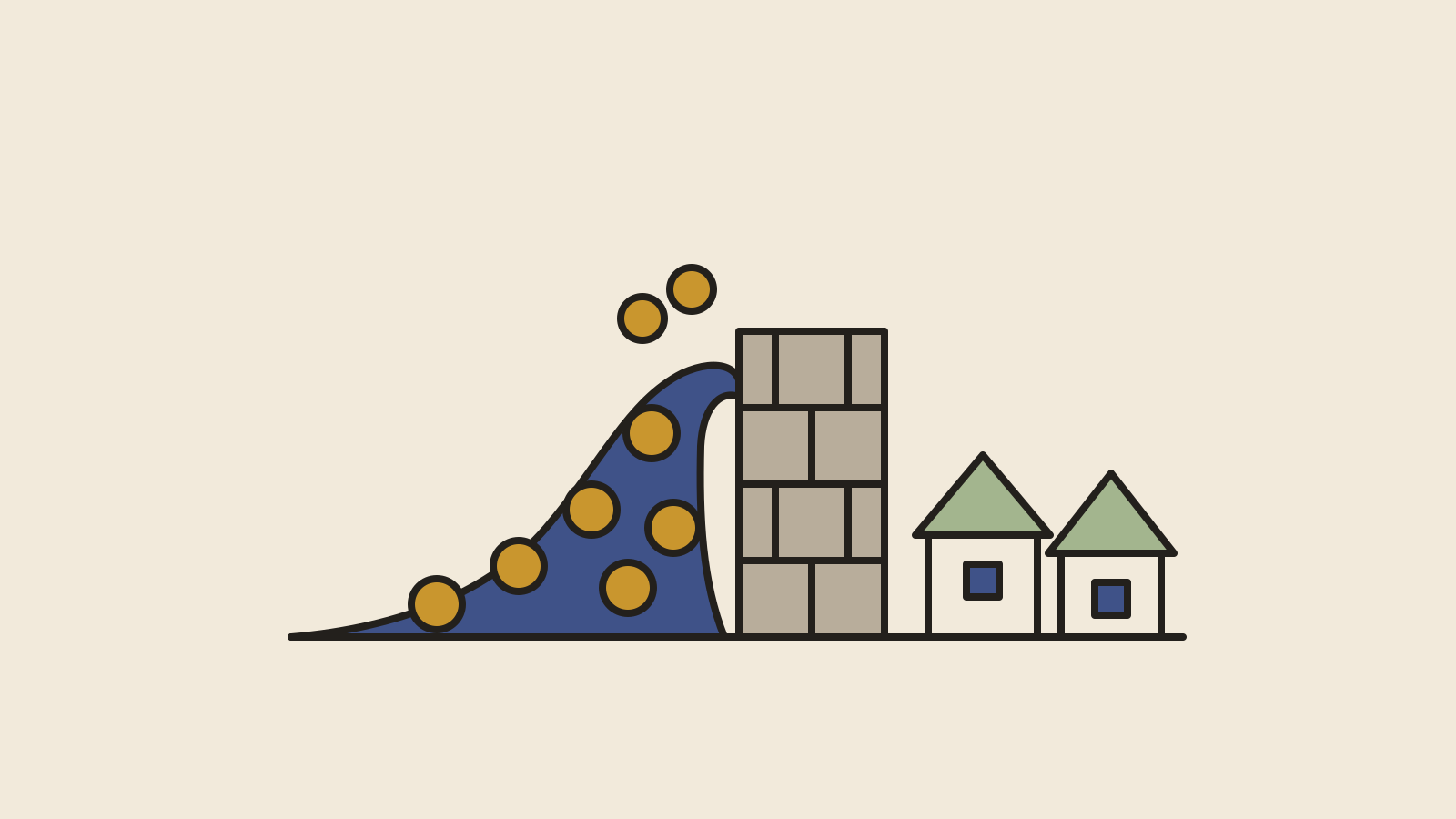
The double movement is Karl Polanyi's claim about how market societies behave. Each push to extend the market into new parts of life provokes a counter-push to protect people from its effects. The two run together, and he read modern history as their tug of war.
Karl Polanyi
Hungarian economic historian who argued that markets were always embedded in society until the nineteenth century tried, at great cost, to set them free.
Polanyi had the nineteenth century in mind. British governments created free markets in labour, land and money. Within decades, there and across Europe, came factory acts, tariffs on grain, trade unions and central banks, as one group after another sought shelter from prices that could wreck a livelihood overnight.
The delivery rider is a current case. Apps turned the job into piecework sold by the minute, with no sick pay and no cover for accidents. Riders protested, courts took up their status and legislatures began writing rules. Singapore, for one, passed a law in 2024 giving platform workers injury insurance and pension contributions.
Diagram
Each extension of the market provokes a movement to limit it
Read as text
A loop of three steps. Extending the market into labour, land and money disrupts livelihoods. Disrupted livelihoods feed a protective countermovement of laws, tariffs and unions. The countermovement in turn limits the market, which is the one link in the loop that pushes the other way.
Key features
- The first movement is deliberate: states build markets by law, as when Britain's Poor Law reform of 1834 pushed the poor to seek wages.
- The second is a reaction with no single plan or author, and it arose in many countries under governments of every colour.
- It answers the treatment of labour, land and money as goods for sale, which Polanyi called fictitious commodities.
- Protection is sought by several classes at once, landowners and businessmen as well as workers.
- The reaction need not be benign: Polanyi counted fascism among its forms, alongside the New Deal and socialism.
Not to be confused with
| Look-alike | The difference | Differs on |
|---|---|---|
| Embeddedness | Embeddedness is the general claim that economies sit inside social relations. The double movement is the historical sequence that Polanyi says follows when a society tries to lift its markets out of them. | Differs onScope |
| Laissez-faire | Laissez-faire is a doctrine about what governments should do. The double movement is a claim about what happens when they try it, and it includes the charge that free markets took constant state action to create. | Differs onDescriptive or normative |
| Spontaneous order | Hayek held that markets grow unplanned and that planning is the imposed design. Polanyi reversed the picture: the free market was built by legislation, and the protective reaction was the part nobody designed. | Differs onClaim |
| Class struggle | Marx's motor of history is one class fighting another over the surplus. Polanyi's countermovement is society at large defending itself against the market, with different classes joining for different reasons. | Differs onMechanism |
- Differs onScope
Embeddedness is the general claim that economies sit inside social relations. The double movement is the historical sequence that Polanyi says follows when a society tries to lift its markets out of them.
- Differs onDescriptive or normative
Laissez-faire is a doctrine about what governments should do. The double movement is a claim about what happens when they try it, and it includes the charge that free markets took constant state action to create.
- Differs onClaim
Hayek held that markets grow unplanned and that planning is the imposed design. Polanyi reversed the picture: the free market was built by legislation, and the protective reaction was the part nobody designed.
- Differs onMechanism
Class struggle
Marx's motor of history is one class fighting another over the surplus. Polanyi's countermovement is society at large defending itself against the market, with different classes joining for different reasons.
Origins and development
Polanyi set out the idea in The Great Transformation (1944), written in wartime America to explain how the liberal order of the nineteenth century had ended in depression, fascism and war. He blamed the strain between market and protection, which the gold standard finally made unbearable. For decades it had few readers outside anthropology. It returned in the 1980s with economic sociology, and again after the crash of 2008. Fred Block and Margaret Somers have used it to analyse what they call market fundamentalism.
Why it matters
The idea offers a way to read political backlash. Tariffs meant to shield factory towns, campaigns against trade deals, rent controls, demands to rein in banks after 2008 and calls to regulate gig work can all be seen as the second movement at work. It also carries a warning that Polanyi drew from the 1930s. When moderate protection fails, people may accept it from authoritarian hands.
Critiques and limits
Nancy Fraser argues that two movements are too few. Protection has often meant protecting hierarchies, such as the male breadwinner's wage, so she adds a third movement for emancipation. Gareth Dale notes that talk of society protecting itself leaves vague who acts and why. Santhi Hejeebu and Deirdre McCloskey argued in 1999 that markets are far older and more widespread than Polanyi allowed, so the nineteenth century was no sharp break. The thesis is an interpretation of history argued from cases, and can't be tested like a law of nature.
Connections
Belongs to
Political economyEconomics
It is a claim about how states make markets and how politics then limits them, the field's oldest subject.
Originated by
Polanyi set out the idea in The Great Transformation (1944) to explain how nineteenth-century liberalism ended in depression and fascism.
Influenced by
Marx's account of labour turned into a commodity lies behind the idea, though Polanyi dropped class struggle as history's motor.
Contrasts with
Differs on scope. Embeddedness is the general claim that economies sit inside society, the double movement the sequence that follows attempts to lift them out.
Laissez-faireEconomics
Differs on descriptive or normative. Laissez-faire prescribes that governments stand back, while the double movement describes what happens when they try.
Spontaneous orderEconomics
Differs on claim. Hayek held that markets grow unplanned and planning is imposed, where Polanyi held that markets were legislated and protection arose unplanned.
Applied in
Scholars of globalisation read the backlash against open trade and finance since 2008 as a new protective countermovement.
Students of protest use it to class movements that defend livelihoods, land or neighbourhoods against market pressure.
Further reading
- Block, F., & Somers, M. R. (2014). The power of market fundamentalism: Karl Polanyi's critique. Harvard University Press.
- Dale, G. (2010). Karl Polanyi: The limits of the market. Polity.
- Fraser, N. (2013). A triple movement? Parsing the politics of crisis after Polanyi. New Left Review, 81, 119–132.
- Polanyi, K. (1944). The great transformation. Farrar & Rinehart.
Cite this entry
Scholia. (2026). Double movement. In Scholia: Notes in the margin of the human sciences. Retrieved November 28, 2026, from https://scholia.zennia.sg/ideas/double-movement