IdeaPhilosophyAlso in Cognitive science & linguistics, Sociology
Emergence
Wholes can have properties that none of their parts has, as a traffic jam has a shape and motion that no single car has.
The idea
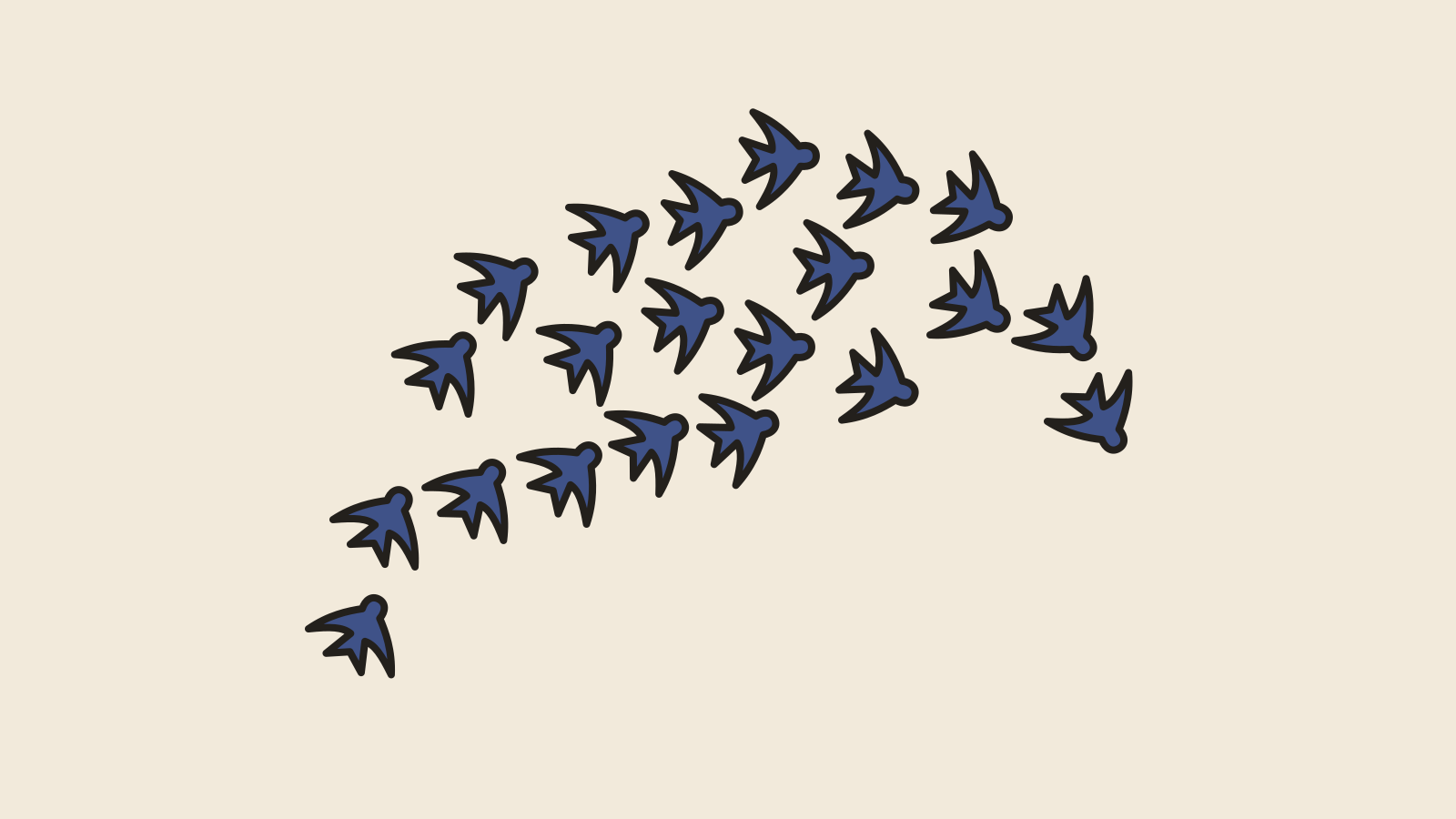
On a busy motorway a jam can form with no accident. One driver brakes a little, the next brakes a little harder, and soon a wave of stopped cars is rolling backwards while every car in it is trying to move forwards. The jam has a speed, a direction and a lifespan. No single car has any of them. That is emergence: a whole with properties its parts lack.
Nobody doubts that some wholes are like this. The argument is over what it means. On the weak view, emergent properties are surprising but could in principle be worked out from the parts, given enough computing power. On the strong view, some properties, consciousness being the main candidate, could not be worked out from the parts even in principle. They are new additions to the world.
Diagram
Weak emergence is derivable from the parts in principle, strong emergence is not
Read as text
Two columns divided by whether the whole can be derived from its parts. On the left, weak emergence: yes, in principle, as with traffic jams and flocks of birds. On the right, strong emergence: no, not even in principle, with consciousness the main candidate on some views. The strong column is emphasised because it is the disputed one.
Key features
- A whole has properties that none of its parts has, as water is wet though no single water molecule is.
- Emergent properties still depend on the parts: change nothing below and nothing above changes.
- Weak emergence is novelty that can in principle be derived from the parts, often only by simulating them step by step.
- Strong emergence is novelty that cannot be derived even in principle, and it may bring new causal powers that act back on the parts.
Not to be confused with
| Look-alike | The difference | Differs on |
|---|---|---|
| Reductionism | Reductionism says higher-level properties can be explained by lower-level ones. Strong emergence denies this for some properties. Weak emergence accepts it in principle, which is why most reductionists can live with it. | Differs onClaim |
| Spontaneous order | Emergence is the broad scientific notion that wholes have properties their parts lack, as in flocks of birds. Spontaneous order is the social case, where the parts are people following rules. | Differs onScope |
| Panpsychism | Emergentists say experience arises when parts that lack it are organised the right way. Panpsychists say experience cannot come from parts with none, so it was in the parts already. | Differs onMechanism |
| Supervenience | Supervenience says only that higher-level properties cannot change without some lower-level change. Emergence adds that the higher properties are genuinely new. | Differs onClaim |
- Differs onClaim
Reductionism says higher-level properties can be explained by lower-level ones. Strong emergence denies this for some properties. Weak emergence accepts it in principle, which is why most reductionists can live with it.
- Differs onScope
Emergence is the broad scientific notion that wholes have properties their parts lack, as in flocks of birds. Spontaneous order is the social case, where the parts are people following rules.
- Differs onMechanism
Emergentists say experience arises when parts that lack it are organised the right way. Panpsychists say experience cannot come from parts with none, so it was in the parts already.
- Differs onClaim
Supervenience says only that higher-level properties cannot change without some lower-level change. Emergence adds that the higher properties are genuinely new.
Origins and development
The philosopher and critic G. H. Lewes coined "emergent" in 1875, building on John Stuart Mill's contrast between causes whose effects add up and causes that combine into something new. The British emergentists, among them Samuel Alexander, C. Lloyd Morgan and C. D. Broad, developed it in the 1920s. Their best example was chemistry, and Brian McLaughlin argued in 1992 that quantum mechanics later explained chemical bonding from below. The idea returned with complexity science, where weak emergence is now a working notion.
John Stuart Mill
The Victorian philosopher who gave utilitarianism its classic form and made the leading liberal case for free speech, individual liberty and women's equality.
Why it matters
Readers meet it in talk of ant colonies, markets, cities and the brain. Claims that large language models show emergent abilities, skills that appear suddenly as the models grow, are a current test case, and some researchers argue the sudden jumps reflect how the skills were measured.
Critiques and limits
Jaegwon Kim pressed the causal exclusion argument. If every physical event has a complete physical cause, a strongly emergent property has nothing left to do. It must either reduce to the physical or make no difference. Defenders reply that physics may not be causally closed in this way. Weak emergence is widely accepted. Strong emergence remains contested, with consciousness its main remaining candidate.
Connections
Belongs to
Whether wholes can have genuinely new properties and powers is a question in metaphysics about how levels of reality relate.
Influenced by
Mill distinguished causes whose effects simply add up from causes that combine to produce something new, the contrast emergence rests on.
Contrasts with
Differs on claim. Reductionism expects wholes to be explained by their parts, and strong emergence denies that this is always possible.
Spontaneous orderEconomics
Differs on scope. Emergence is the general notion that wholes have properties their parts lack, and spontaneous order is the social case.
Differs on mechanism. Emergence says experience arises from parts that lack it, where panpsychism says it was present in the parts already.
Differs on claim. Supervenience says only that higher properties vary with lower ones, and emergence adds that the higher properties are genuinely new.
Parallels
Social factSociology
Durkheim held that society is a reality of its own kind, irreducible to individuals, as chemical compounds have properties their elements lack.
Gestalt psychologyPsychology
Gestalt psychologists argued that a perceived whole, such as a melody, has a character no list of its parts captures.
Further reading
- Broad, C. D. (1925). The mind and its place in nature. Kegan Paul, Trench, Trubner.
- Chalmers, D. J. (2006). Strong and weak emergence. In P. Clayton & P. Davies (Eds.), The re-emergence of emergence: The emergentist hypothesis from science to religion (pp. 244–254). Oxford University Press. https://doi.org/10.1093/acprof:oso/9780199544318.003.0011
- O'Connor, T. (2020). Emergent properties. Stanford Encyclopedia of Philosophy. https://plato.stanford.edu/entries/properties-emergent/
Cite this entry
Scholia. (2026). Emergence. In Scholia: Notes in the margin of the human sciences. Retrieved November 28, 2026, from https://scholia.zennia.sg/ideas/emergence