School or branchPsychologyAlso in Cognitive science & linguistics, Philosophy
Gestalt psychology
A school founded in Germany in 1912 which held that we perceive organised wholes that can't be built up from separate sensations.
Overview
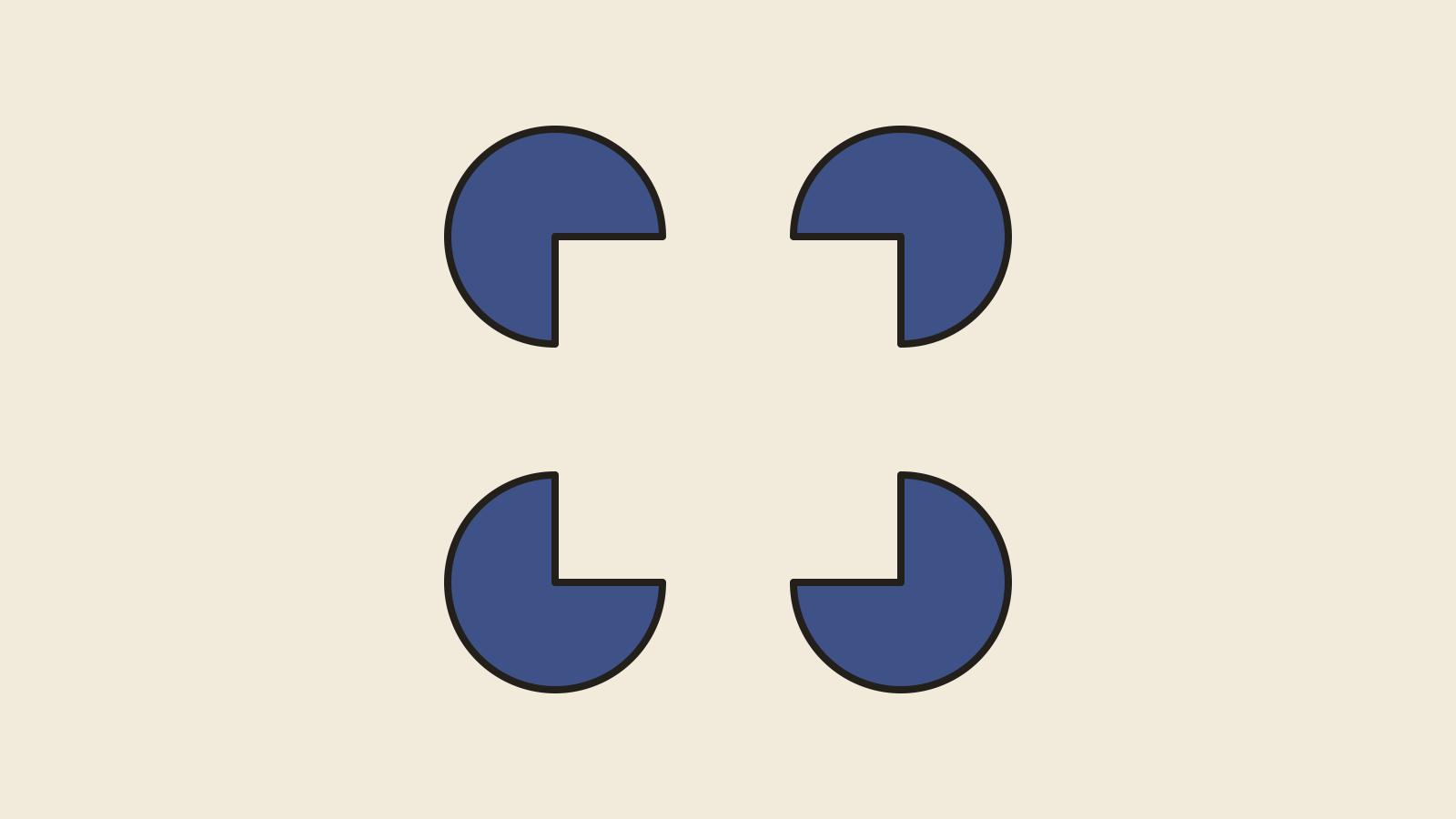
Gestalt psychology holds that experience comes organised. We don't first register thousands of separate sensations and then assemble them. We see objects, hear tunes and grasp situations as wholes, and the whole has properties its parts lack. Gestalt is German for form or configuration.
A melody makes the point. Play a tune in a different key and every note has changed, yet anyone recognises it at once. What they recognise can't be any of the notes. It is the pattern of relations among them. The same holds for the bulbs on a cinema sign that light one after another. Nothing moves, yet we see movement, which is in none of the bulbs.
Max Wertheimer, Wolfgang Köhler and Kurt Koffka built a school on such cases. They carried the claim from perception into problem solving, learning and the working of the brain.
Diagram
Gestalt psychology rose in Germany, was scattered by exile and was absorbed
Read as text
A timeline with six events and one period. In 1890 Ehrenfels describes form qualities. In 1912 Wertheimer publishes his experiments on apparent movement, the founding of the school. In 1917 Köhler publishes his studies of problem solving in apes. In 1923 Wertheimer sets out the laws of grouping. Köhler directs the Berlin institute from 1922 to 1935. In 1933 Wertheimer leaves Germany, and in 1935 Koffka publishes Principles of Gestalt Psychology in the United States. The school has since been absorbed into mainstream psychology.
Core commitments
- The whole is different from the sum of its parts, and the character of a part depends on the whole it belongs to.
- Experience should be described as it appears before it is analysed, since analysis into sensations destroys what needs explaining.
- Perception organises itself by lawful tendencies such as grouping and the separation of figure from background, the Gestalt principles.
Gestalt principles of perception
Rules for how vision automatically groups separate elements into whole figures: by nearness, likeness, shared movement, smooth lines and closed shapes.
- Problem solving often works by insight, a sudden restructuring of how the situation is seen.
- Brain processes share the structure of the experiences they underlie, a doctrine Köhler called isomorphism.
Not to be confused with
| Look-alike | The difference | Differs on |
|---|---|---|
| Structuralism (psychology) | Structuralism starts from elements and builds wholes out of them. The Gestalt school starts from the organised whole and denies that it can be recovered by adding up sensations. | Differs onUnit of analysis |
| Gestalt principles of perception | The principles are the school's best-known findings, a set of rules for how vision groups what it sees. The school was a general psychology with views on thinking, learning and the brain. | Differs onScope |
| Gestalt therapy | A form of psychotherapy developed by Fritz and Laura Perls with Paul Goodman around 1950. It borrowed the word and a little vocabulary. The school was an experimental research programme, and Gestalt psychologists such as Mary Henle denied any real connection. | Differs onMethod |
| Holism | Holism is the general view, found in biology, medicine and philosophy, that wholes can't be fully explained through their parts. Gestalt psychology is one experimental programme that tested a version of it. | Differs onScope |
- Differs onUnit of analysis
Structuralism starts from elements and builds wholes out of them. The Gestalt school starts from the organised whole and denies that it can be recovered by adding up sensations.
- Differs onScope
Gestalt principles of perception
The principles are the school's best-known findings, a set of rules for how vision groups what it sees. The school was a general psychology with views on thinking, learning and the brain.
- Differs onMethod
Gestalt therapy
A form of psychotherapy developed by Fritz and Laura Perls with Paul Goodman around 1950. It borrowed the word and a little vocabulary. The school was an experimental research programme, and Gestalt psychologists such as Mary Henle denied any real connection.
- Differs onScope
Holism
Holism is the general view, found in biology, medicine and philosophy, that wholes can't be fully explained through their parts. Gestalt psychology is one experimental programme that tested a version of it.
Origins and development
In 1890 Christian von Ehrenfels pointed out that a melody has a form quality beyond its notes. The school proper began in Frankfurt in 1912, when Wertheimer published experiments on apparent movement with Köhler and Koffka as his observers. Köhler studied problem solving in chimpanzees on Tenerife during the First World War and directed the Berlin institute from 1922. Koffka moved to the United States in 1927. Wertheimer left Germany in 1933 as the Nazis purged the universities. Köhler protested, resigned and followed in 1935. In America they trained few doctoral students, and their ideas were absorbed piecemeal.
Why it matters
Anyone who lays out a page, a map or a phone screen uses Gestalt findings about what the eye groups together. The school kept perception and thinking on the research agenda through the behaviourist decades and fed into cognitive psychology. Kurt Lewin carried its outlook into social psychology. Thomas Kuhn borrowed the gestalt switch, in which one drawing flips between two readings, to describe scientific revolutions.
Cognitive psychology
The branch of psychology that studies mental processes such as attention, memory, language and reasoning by experiment.
Kurt Lewin
German-American psychologist who helped found experimental social psychology and held that behaviour depends on the person and the situation together.
Critiques and limits
David Marr judged that the school described wholes, sought their laws and failed. Its central law, that perception settles into the simplest form available, was never defined tightly enough to say what counts as simplest. Köhler's theory that perception rests on electrical fields in the cortex failed in the 1950s, when Karl Lashley and Roger Sperry disrupted such fields in animals and found perception intact. The slogan that the whole is greater than the sum of its parts is a misquotation: Koffka wrote that it is something else.
David Marr
A British neuroscientist who argued that seeing must be understood as a computation, explained at three separate levels.
Key figures
- Max Wertheimer
- Wolfgang Köhler
- Kurt Koffka
- Kurt Lewin1890–1947
- Karl Duncker
- Rudolf Arnheim
- Solomon Asch

Connections
Influenced by
PhenomenologyPhilosophy
The founders trained under Carl Stumpf, who taught them to describe experience as it appears before analysing it.
Critiques
Its demonstrations of apparent movement and grouping were aimed at the claim that perception is a sum of sensations.
Köhler's apes solved problems by sudden insight, which he set against learning by blind trial and error.
Contrasts with
Differs on unit of analysis. Structuralism starts from elementary sensations and builds up, where the Gestalt school starts from the organised whole.
Gestalt principles of perception
Differs on scope. The principles are the school's findings on visual grouping, while the school was a general psychology of perception, thought and brain.
Parallels
Structuralism (linguistics)Cognitive science & linguistics
Both put the whole before its parts: a percept is not a sum of sensations, and a sound has value only within its system.
Contains
He carried the Gestalt view that wholes come before parts from perception into motivation and group life.
Gestalt principles of perception
Wertheimer's laws of grouping were the school's main evidence that perception delivers organised wholes.
Influenced
Max Wertheimer and Kurt Goldstein taught him to study the person as a whole.
Dissonance theory shares the Gestalt assumption that the mind presses towards a consistent whole.
Ruth BenedictAnthropology
Gestalt psychology gave her the model of a whole whose character cannot be found by adding up its parts.
Thomas KuhnPhilosophy
He modelled a change of paradigm on the gestalt switch, in which one drawing is suddenly seen as a different figure.
Cognitive linguisticsCognitive science & linguistics
The Gestalt contrast of figure and ground reappears in Talmy's and Langacker's accounts of how sentences frame a scene.
The Gestalt school kept the study of perception and problem solving alive during the behaviourist decades.
Embodied and situated cognitionCognitive science & linguistics
Merleau-Ponty built his account of the lived body on Gestalt findings, and Gibson's affordances developed from Koffka's teaching at Smith College.
Gestalt psychologists supplied the principle that a person is a whole that cannot be rebuilt from parts.
Asch, Lewin and Heider brought from Gestalt psychology the view that people respond to a situation as they perceive it.
Heider worked among the Berlin Gestalt psychologists in the 1920s and treated explaining a person's behaviour as a kind of perception.
Paradigm shiftPhilosophy
Kuhn compared a revolution to a gestalt switch, in which the same lines are suddenly seen as a different figure.
Cross with
Two distant entries to read beside this one, each with the question the pairing opens.
Social factSociology
Durkheim said a society is more than its members and Gestalt psychologists said a percept is more than its sensations: is it one argument? Set them side by side
General equilibrium theoryEconomics
In general equilibrium every price depends on every other: is an economy a whole in the Gestalt sense, irreducible to separate markets? Set them side by side
Further reading
- Ash, M. G. (1995). Gestalt psychology in German culture, 1890–1967: Holism and the quest for objectivity. Cambridge University Press.
- Koffka, K. (1935). Principles of Gestalt psychology. Harcourt, Brace.
- Wagemans, J., Elder, J. H., Kubovy, M., Palmer, S. E., Peterson, M. A., Singh, M., & von der Heydt, R. (2012). A century of Gestalt psychology in visual perception: I. Perceptual grouping and figure–ground organization. Psychological Bulletin, 138(6), 1172–1217. https://doi.org/10.1037/a0029333
- Wertheimer, M. (1912). Experimentelle Studien über das Sehen von Bewegung. Zeitschrift für Psychologie, 61, 161–265.
Cite this entry
Scholia. (2026). Gestalt psychology. In Scholia: Notes in the margin of the human sciences. Retrieved November 28, 2026, from https://scholia.zennia.sg/schools/gestalt-psychology