IdeaCognitive science & linguisticsAlso in Philosophy
Extended mind
The claim that a notebook or phone someone relies on in the right way is literally part of that person's mind.
The idea
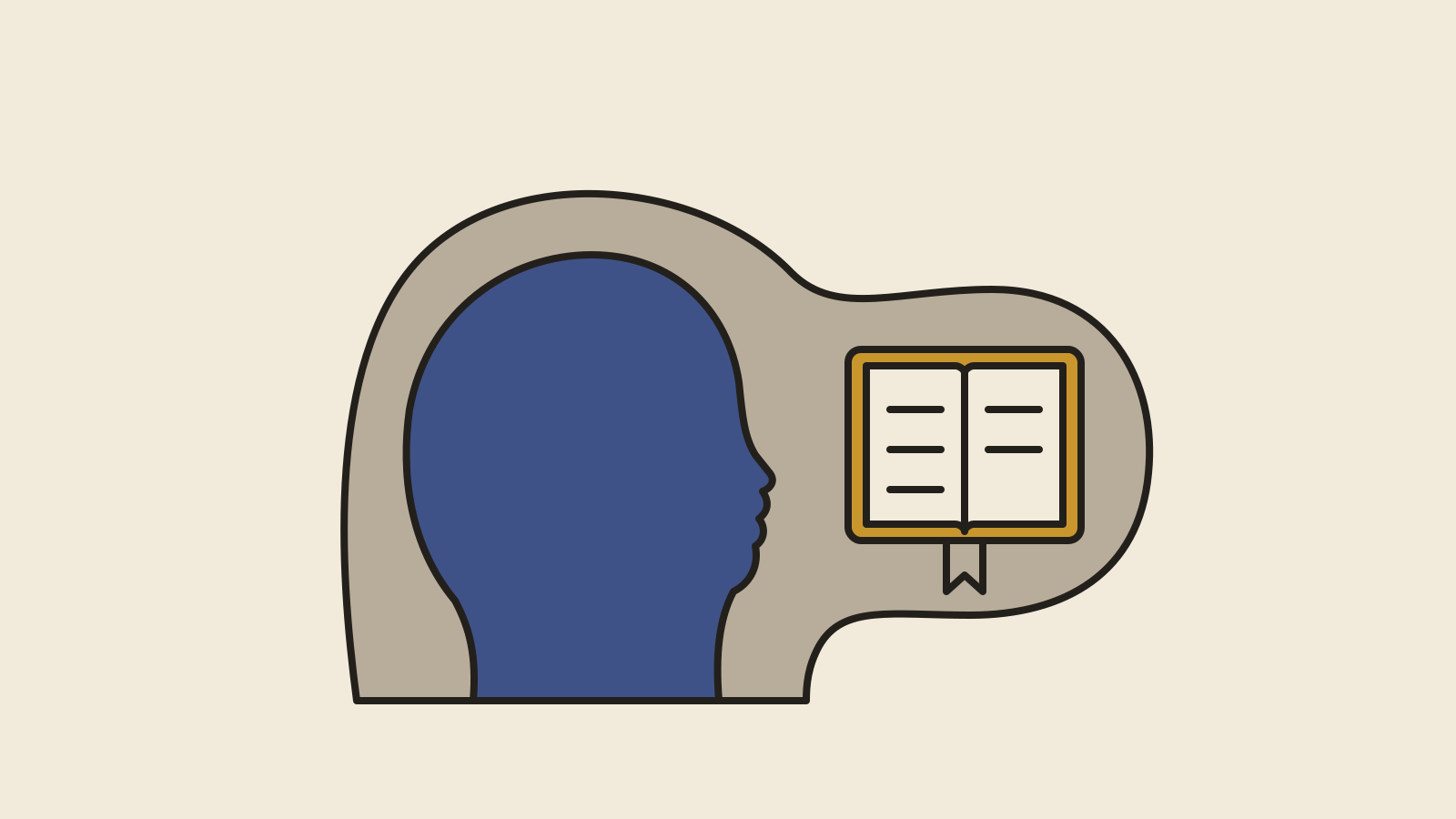
The extended mind thesis says that a mind does not have to stop at the skin. When a person relies on something outside the body in the right way, that thing is part of their mind, as much as any brain cell is.
Most people no longer know their friends' phone numbers. The numbers sit in a phone that is always in a pocket and trusted completely. Andy Clark and David Chalmers, who proposed the thesis in 1998, would say the owner still believes that the number is such-and-such. The belief is stored in the phone. Their own example is Otto, a man with Alzheimer's disease who writes everything in a notebook he carries everywhere. Wanting to visit a museum, he looks up its address and sets off. Inga, whose memory is healthy, simply recalls the address. The authors argue that notebook and memory do the same job, so Otto and Inga both held the belief before they consulted anything.
Diagram
Clark and Chalmers say Inga's memory and Otto's notebook do one job
Read as text
Two cases set side by side on one dimension, where the belief is kept. On the left Inga keeps the museum's address in biological memory and recalls it. On the right Otto, who has Alzheimer's disease, keeps it in a pocket notebook and reads it. Clark and Chalmers argue that both stores do the same job, so both hold the belief.
Key features
- The parity principle: if a process in the world would count as mental were it done in the head, it counts as mental where it is.
- Conditions of trust: the outside resource must be reliably to hand, easy to consult and accepted more or less automatically, as biological memory is.
- Active coupling: the resource plays its part here and now in guiding what the person does, in a two-way loop with the brain.
- Machinery and not meaning: the claim concerns where the physical carriers of belief and reasoning are located.
- Experience stays inside: Clark and Chalmers apply the thesis to beliefs and reasoning, and they doubt that conscious experience extends.
Not to be confused with
| Look-alike | The difference | Differs on |
|---|---|---|
| Embodied and situated cognition | Much of the branch says only that thinking depends on body and surroundings. The thesis says more: some outside things are parts of the mind, a claim about where the mind is. | Differs onClaim |
| Enactivism | The thesis lets a notebook count as part of a mind if it plays the right role. Enactivists tie mind to living bodies making sense of their surroundings, so a role alone is not enough. | Differs onClaim |
| Functionalism | Functionalism says a mental state is defined by the job it does, whatever material does the job. The thesis applies this to place: if the material does not matter, neither does being inside the skull. Many functionalists decline the step. | Differs onScope |
| Semantic externalism | Hilary Putnam's externalism says that what a thought means depends on the thinker's surroundings and history. The thinking itself stays in the head. Clark and Chalmers called their view active externalism, because the outside object does part of the believing. | Differs onClaim |
- Differs onClaim
Embodied and situated cognition
Much of the branch says only that thinking depends on body and surroundings. The thesis says more: some outside things are parts of the mind, a claim about where the mind is.
- Differs onClaim
The thesis lets a notebook count as part of a mind if it plays the right role. Enactivists tie mind to living bodies making sense of their surroundings, so a role alone is not enough.
- Differs onScope
Functionalism says a mental state is defined by the job it does, whatever material does the job. The thesis applies this to place: if the material does not matter, neither does being inside the skull. Many functionalists decline the step.
- Differs onClaim
Hilary Putnam's externalism says that what a thought means depends on the thinker's surroundings and history. The thinking itself stays in the head. Clark and Chalmers called their view active externalism, because the outside object does part of the believing.
Origins and development
Clark and Chalmers wrote the paper in the mid-1990s, and the journal Analysis published it in 1998. Their sources included a study of Tetris players, who rotate the falling shapes on screen to save themselves the effort of turning them in the head, and Edwin Hutchins's account of a ship's crew navigating as one thinking system. Clark defended and refined the thesis in Supersizing the Mind (2008). A second wave of supporters, among them John Sutton and Richard Menary, dropped the appeal to parity. They argued that outside tools matter because they do things brains cannot.
Why it matters
The thesis changes what is at stake when a device is lost, searched or redesigned. If a phone holds part of someone's mind, then taking it is closer to an injury than to a theft, and a company that alters an app alters how its users think. Lawyers and ethicists have used the argument in debates over phone searches, dementia care and brain implants. It also recasts the common fear that search engines make people forgetful.
Critiques and limits
Fred Adams and Kenneth Aizawa call the central move a fallacy: being causally hooked up to a thinker does not make a notebook part of the thinking. They add that brain states carry meaning in their own right, while ink marks get theirs from readers. Robert Rupert argues that psychology's findings about memory hold for brains and fail for notebooks, so lumping them together makes worse science. The thesis is a conceptual claim about what counts as mind. Experiments on offloading memory to devices bear on it without settling it.
Connections
Belongs to
Embodied and situated cognition
It is the branch's boldest claim about setting, that tools can be parts of a mind and not only aids to one.
Philosophy of mindPhilosophy
It answers the field's question of where a mind is located by denying that skin and skull mark its edge.
Originated by
Clark proposed the thesis with David Chalmers in a 1998 paper and has been its chief defender since.
Extends
Functionalism (philosophy of mind)Philosophy
If a mental state is defined by the job it does, the thesis adds, then where the job gets done cannot matter.
Contrasts with
Embodied and situated cognition
Differs on claim. The branch mostly says the mind depends on body and world, where the thesis says parts of the world are parts of the mind.
Differs on claim. Enactivists tie mind to living bodies, where the extended mind thesis lets a notebook count as mind if it plays the right role.
Functionalism (philosophy of mind)Philosophy
Differs on scope. Functionalism says what makes a state mental, and the extended mind thesis applies that answer to where the state can be.
Semantic externalismPhilosophy
Differs on claim. Semantic externalism says surroundings fix what a thought means, where the extended mind says outside objects do part of the thinking.
Parallels
Actor–network theorySociology
Sociologists of science likewise refuse to stop at the skin, spreading agency across networks of people and things.
Further reading
- Adams, F., & Aizawa, K. (2001). The bounds of cognition. Philosophical Psychology, 14(1), 43–64. https://doi.org/10.1080/09515080120033571
- Clark, A., & Chalmers, D. (1998). The extended mind. Analysis, 58(1), 7–19. https://doi.org/10.1093/analys/58.1.7
- Clark, A. (2008). Supersizing the mind: Embodiment, action, and cognitive extension. Oxford University Press.
- Rupert, R. D. (2004). Challenges to the hypothesis of extended cognition. The Journal of Philosophy, 101(8), 389–428. https://doi.org/10.5840/jphil2004101826
Cite this entry
Scholia. (2026). Extended mind. In Scholia: Notes in the margin of the human sciences. Retrieved November 28, 2026, from https://scholia.zennia.sg/ideas/extended-mind