IdeaPhilosophy
Foundationalism
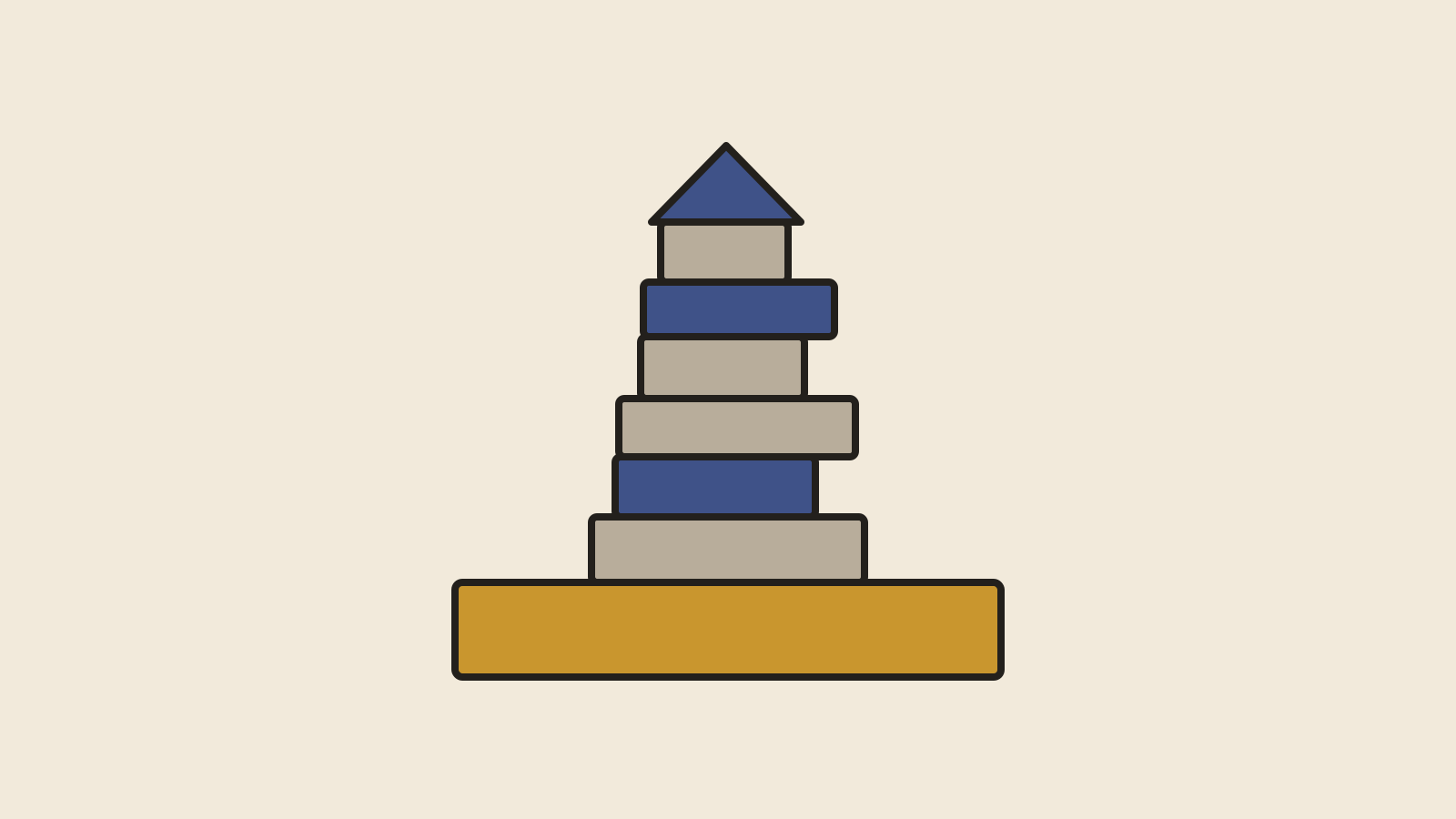
The view that knowledge is built like a house: a few basic beliefs need no support from other beliefs and hold up all the rest.
The idea
Foundationalism is a view about how justification, the ingredient that turns true belief into knowledge on the traditional analysis, is structured. Most beliefs rest on others: you believe the road is icy because you believe the forecast. But the chain of reasons cannot go on for ever, and it should not loop back on itself. So the foundationalist holds that it ends in basic beliefs, which are justified without resting on any further belief. Everything else is supported, directly or at some remove, by these.
Justified true belief
The traditional definition of knowledge: you know something when you believe it, it is true and you have good reason for believing it.
A child's run of "why?" shows the structure. Why wear a coat? Because it's cold. How do you know? The window is frosted. How do you know that? At some point the answer is just "I can see it", and the questions stop there. Foundationalists take that stopping point to be legitimate. They disagree among themselves about what belongs at the bottom and how secure it has to be.
Diagram
Foundationalists picture knowledge as a pyramid, coherentists as a raft
Read as text
Two columns divided on how justification is structured. On the left, emphasised, foundationalism: basic beliefs sit at the base and support runs upward from them to every other belief, like a pyramid. On the right, coherentism: there are no basic beliefs, and beliefs support each other, like the planks of a raft.
Key features
- Justified beliefs are of two kinds, basic ones and those inferred from them.
- Support runs one way only, upward from the foundations and never in a circle.
- The main argument is the regress: without basic beliefs, reasons would run on without end, loop or stop arbitrarily.
- Classical versions demand foundations that cannot be mistaken, such as truths of reason or reports of one's present experience.
- Modest versions allow basic beliefs that are reasonable by default and can be overturned by later evidence.
Not to be confused with
| Look-alike | The difference | Differs on |
|---|---|---|
| Coherentism | Coherentists deny that any belief is basic. A belief is justified by how well it fits with the rest, as the planks of a raft hold each other up. Foundationalists hold that such mutual support must be anchored somewhere. | Differs onClaim |
| The cogito | Descartes's certainty that he exists while thinking is one candidate for a basic belief. Foundationalism is the general structure, and many foundationalists choose other foundations, such as sense experience. | Differs onScope |
| Rationalism | Rationalism is about the source of knowledge and names reason, where foundationalism is about its structure. Empiricists such as Locke were foundationalists too, with experience at the base. | Differs onClaim |
- Differs onClaim
Coherentism
Coherentists deny that any belief is basic. A belief is justified by how well it fits with the rest, as the planks of a raft hold each other up. Foundationalists hold that such mutual support must be anchored somewhere.
- Differs onScope
Descartes's certainty that he exists while thinking is one candidate for a basic belief. Foundationalism is the general structure, and many foundationalists choose other foundations, such as sense experience.
- Differs onClaim
Rationalism is about the source of knowledge and names reason, where foundationalism is about its structure. Empiricists such as Locke were foundationalists too, with experience at the base.
Origins and development
The regress argument is ancient. Aristotle used it in the Posterior Analytics to show that demonstration must start from premises known without proof, and the sceptic Agrippa turned it into a weapon. The modern form comes from René Descartes, whose Meditations (1641) cleared away every doubtful belief to rebuild on certainties. Empiricists from Locke to the logical positivists kept the structure and put experience at the base. Through heavy criticism in the mid twentieth century Roderick Chisholm kept defending it, and William Alston and Robert Audi later developed modest versions.
Aristotle
Plato's pupil, who founded logic and biology and wrote the works on ethics, politics and nature that organised learning for two thousand years.
René Descartes
A French philosopher and mathematician who doubted everything he could, then rebuilt knowledge on the one certainty that he was thinking.
Why it matters
The picture of knowledge as a building is everywhere: we speak of grounds, of well-founded claims and of arguments that collapse. Mathematics is taught this way from axioms up, and so is any audit trail that traces a figure back to a source document. Asking what a claim finally rests on, and whether that resting place deserves trust, is foundationalist thinking applied.
Critiques and limits
Wilfrid Sellars attacked what he called the myth of the given in 1956. A raw experience, he argued, cannot justify anything unless it is already shaped by concepts, and then it depends on other knowledge. Laurence BonJour pressed a dilemma on the same lines in 1985, though he later became a foundationalist himself. Otto Neurath's image, taken up by Quine, has us as sailors rebuilding a ship at sea with no dry dock. This is a conceptual dispute and it is still open, with modest foundationalism widely held.
W. V. O. Quine
An American logician and philosopher who denied that any truths hold by meaning alone and treated philosophy as continuous with science.
Connections
Belongs to
It is one of the main theories of how justification is structured, set against coherentism.
Originated by
His Meditations gave the modern model of clearing away doubtful beliefs and rebuilding on certainties.
Influenced by
Aristotle argued that proof must begin from premises known without proof, or it could never begin.
Agrippa's regress argument poses the problem that basic beliefs are meant to solve.
Critiques
Foundationalism answers the sceptic's regress of reasons by holding that some beliefs are justified without support from other beliefs.
Contrasts with
Differs on scope. The cogito is one proposed foundation, while foundationalism is the general view that knowledge has foundations.
Differs on claim. Rationalism names reason as the source of knowledge, while foundationalism describes its structure and suits empiricists too.
Critiqued by
Peirce rejected the demand to rebuild knowledge from indubitable foundations, arguing that inquiry starts from the beliefs we already hold.
Cross with
Two distant entries to read beside this one, each with the question the pairing opens.
Grounded theorySociology
Grounded theory builds theory up from compared data, not from prior deduction: does it assume observations can be a foundation that needs no theory? Set them side by side
General equilibrium theoryEconomics
In general equilibrium every price depends on the others and none comes first: is that a working picture of knowledge without foundations? Set them side by side
Further reading
- BonJour, L. (1985). The structure of empirical knowledge. Harvard University Press.
- Descartes, R. (1996). Meditations on first philosophy: With selections from the objections and replies (Rev. ed.). Cambridge University Press. https://doi.org/10.1017/CBO9780511805028 (Original work published 1641)
- Nagel, J. (2014). Knowledge: A very short introduction. Oxford University Press. https://doi.org/10.1093/actrade/9780199661268.001.0001
- Sosa, E. (1980). The raft and the pyramid: Coherence versus foundations in the theory of knowledge. Midwest Studies in Philosophy, 5(1), 3–25. https://doi.org/10.1111/j.1475-4975.1980.tb00394.x
Cite this entry
Scholia. (2026). Foundationalism. In Scholia: Notes in the margin of the human sciences. Retrieved November 28, 2026, from https://scholia.zennia.sg/ideas/foundationalism