IdeaPolitical theory & scienceAlso in Philosophy
Friend-enemy distinction
Schmitt's claim that politics is defined by one division, between a people and the public enemy it might have to fight.
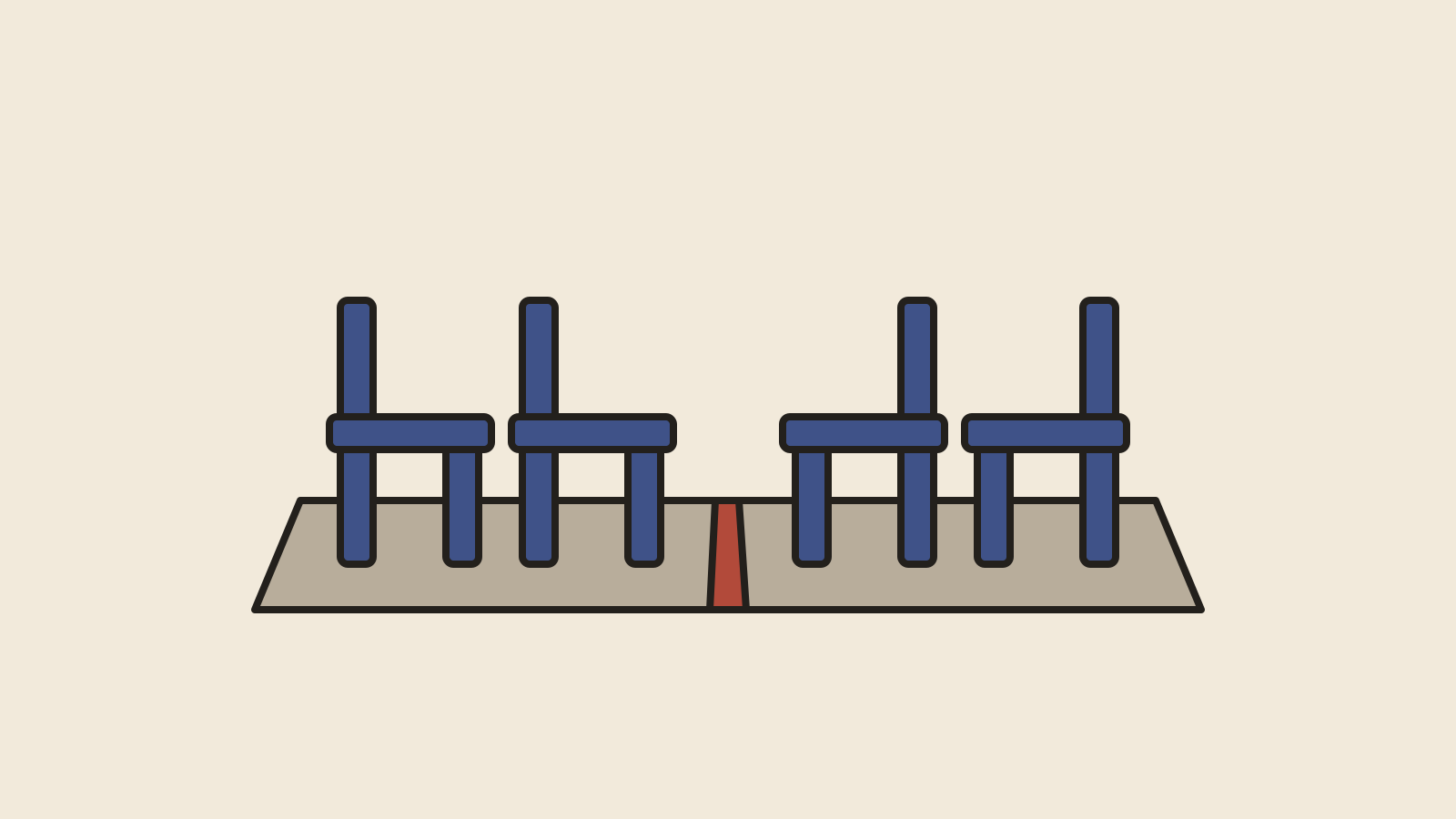
The idea
The friend-enemy distinction is Carl Schmitt's answer to the question of what makes something political. Morality sorts things into good and evil, aesthetics into beautiful and ugly, economics into profitable and unprofitable. Politics, he argued, has its own pair: friend and enemy. A matter becomes political when it divides people into groups that could, in the extreme case, fight and kill one another.
The enemy here is public. A neighbour you can't stand after a quarrel over a fence is a private opponent, and you might still serve beside him in the same army. A political enemy is another collective, and its members need not be hated, ugly or wicked. They are the others, whose way of life is felt to threaten one's own. Schmitt did not say that war is good or frequent. He said the real possibility of it is what gives political life its seriousness.
Diagram
Schmitt's political enemy is a public opponent, never a private one
Read as text
Two columns divided by the kind of opponent. On the left is the private adversary, marked by personal dislike or by being a rival or competitor. On the right, emphasised, is the public enemy, which is another organised people with whom fighting is a real possibility. Only the right-hand column is political in Schmitt's sense.
Key features
- Any difference, whether religious, economic or ethnic, turns political once it is strong enough to group people as friend and enemy.
- The enemy is a public opponent, a collective that could fight, and private dislike has nothing to do with it.
- A people exists politically only while it can decide for itself who its enemy is.
- Liberalism tries to dissolve enmity into economic competition and debate, which hides politics without ending it.
- A war fought in the name of humanity is the most dangerous kind, since it casts the enemy as inhuman.
Not to be confused with
| Look-alike | The difference | Differs on |
|---|---|---|
| Security dilemma | The security dilemma says that states wanting only safety can slide into hostility through mutual fear, and that reassurance can ease it. Schmitt says enmity belongs to politics as such. | Differs onClaim |
| Social identity theory | A psychological account of how individuals come to favour their own group, even an arbitrary one. Schmitt's distinction concerns organised peoples who can wage war, and he denies that it rests on feeling. | Differs onLevel |
| Populism | Populism sets a virtuous people against a corrupt elite inside one country. Schmitt's distinction is a general test for what counts as political, between states first of all. | Differs onScope |
| Totalitarianism | Totalitarianism is a theory of one kind of regime. The friend-enemy distinction claims to describe politics under any regime. | Differs onScope |
- Differs onClaim
The security dilemma says that states wanting only safety can slide into hostility through mutual fear, and that reassurance can ease it. Schmitt says enmity belongs to politics as such.
- Differs onLevel
A psychological account of how individuals come to favour their own group, even an arbitrary one. Schmitt's distinction concerns organised peoples who can wage war, and he denies that it rests on feeling.
- Differs onScope
Populism sets a virtuous people against a corrupt elite inside one country. Schmitt's distinction is a general test for what counts as political, between states first of all.
- Differs onScope
Totalitarianism is a theory of one kind of regime. The friend-enemy distinction claims to describe politics under any regime.
Origins and development
Schmitt set the idea out in a 1927 article, "The Concept of the Political", and expanded it into a book in 1932, in the last months of the Weimar Republic. He altered the text again in 1933 to suit the new regime. He drew on Thomas Hobbes, for whom the fear of violent death is the ground of the state. After 1945 the idea travelled widely. Hans Morgenthau, who had argued against it as a young jurist, went on to found realist international relations, and since the 1990s Chantal Mouffe has reworked it for the democratic left.
Thomas Hobbes
An English philosopher who argued that people without government would live in fear, and would rationally agree to obey a sovereign.
Hans Morgenthau
The German-born scholar whose Politics Among Nations made realism the starting point for the study of international relations in the United States.
Why it matters
The idea is a standing challenge to the hope that politics can become administration, trade or reasoned talk. Readers meet it whenever commentators say that voters in a polarised country treat opponents as enemies of the nation and no longer as rivals. It also explains a recurring worry about humanitarian war. A state that claims to fight for all mankind leaves its opponent nowhere to stand.
Critiques and limits
Leo Strauss objected in 1932 that Schmitt stays inside the liberalism he attacks, since he affirms conflict without saying what is worth fighting for. Hannah Arendt drew the opposite picture: politics is acting together among equals, and violence marks its failure. Mouffe accepts permanent conflict and aims to turn enemies into adversaries who share democratic rules. The claim is a definition, so it rests on argument and no evidence settles it. Many also judge it by Schmitt's service to the Nazi state.
Leo Strauss
German-born political philosopher who called for a return to the ancient question of the best life, and read old books for hidden teachings.
Hannah Arendt
A German-born political theorist who analysed totalitarianism and defended politics as people acting together in public.
Connections
Belongs to
It answers the field's question of what marks politics off from morality, economics and law.
Originated by
Schmitt set out the distinction in a 1927 article and expanded it into a book in 1932.
Influenced by
Hobbes grounded the state in the fear of violent death, the same extreme case Schmitt uses to define the political.
Critiques
It charges liberalism with turning enemies into trade rivals and debating partners and so hiding conflict without ending it.
Contrasts with
Differs on claim. The security dilemma makes hostility an accident of mutual fear, where Schmitt makes enmity part of what politics is.
Social identity theoryPsychology
Differs on level. Social identity theory explains individuals favouring their group, where Schmitt's distinction concerns organised peoples able to wage war.
Differs on scope. Populism sets a people against an elite inside one country, where Schmitt's distinction is a general test of the political.
Differs on scope. Totalitarianism is a theory of one kind of regime, where the friend-enemy distinction claims to describe politics under any regime.
Critiqued by
As a young jurist he argued against Schmitt's test and treated the political as a degree of intensity any dispute can reach.
Strauss objected in 1932 that Schmitt stays inside the liberalism he attacks, affirming conflict without saying what is worth fighting for.
Further reading
- Mouffe, C. (2005). On the political. Routledge.
- Müller, J.-W. (2003). A dangerous mind: Carl Schmitt in post-war European thought. Yale University Press.
- Schmitt, C. (2007). The concept of the political. University of Chicago Press. https://doi.org/10.7208/chicago/9780226738840.001.0001 (Original work published 1932)
Cite this entry
Scholia. (2026). Friend-enemy distinction. In Scholia: Notes in the margin of the human sciences. Retrieved November 28, 2026, from https://scholia.zennia.sg/ideas/friend-enemy-distinction
This topic is contested. The entry sets out the main positions rather than settling them.