School or branchPolitical theory & scienceAlso in Philosophy
Political philosophy
The branch that asks how people ought to live together under shared power: who may rule, what is just and how free we should be.
Overview
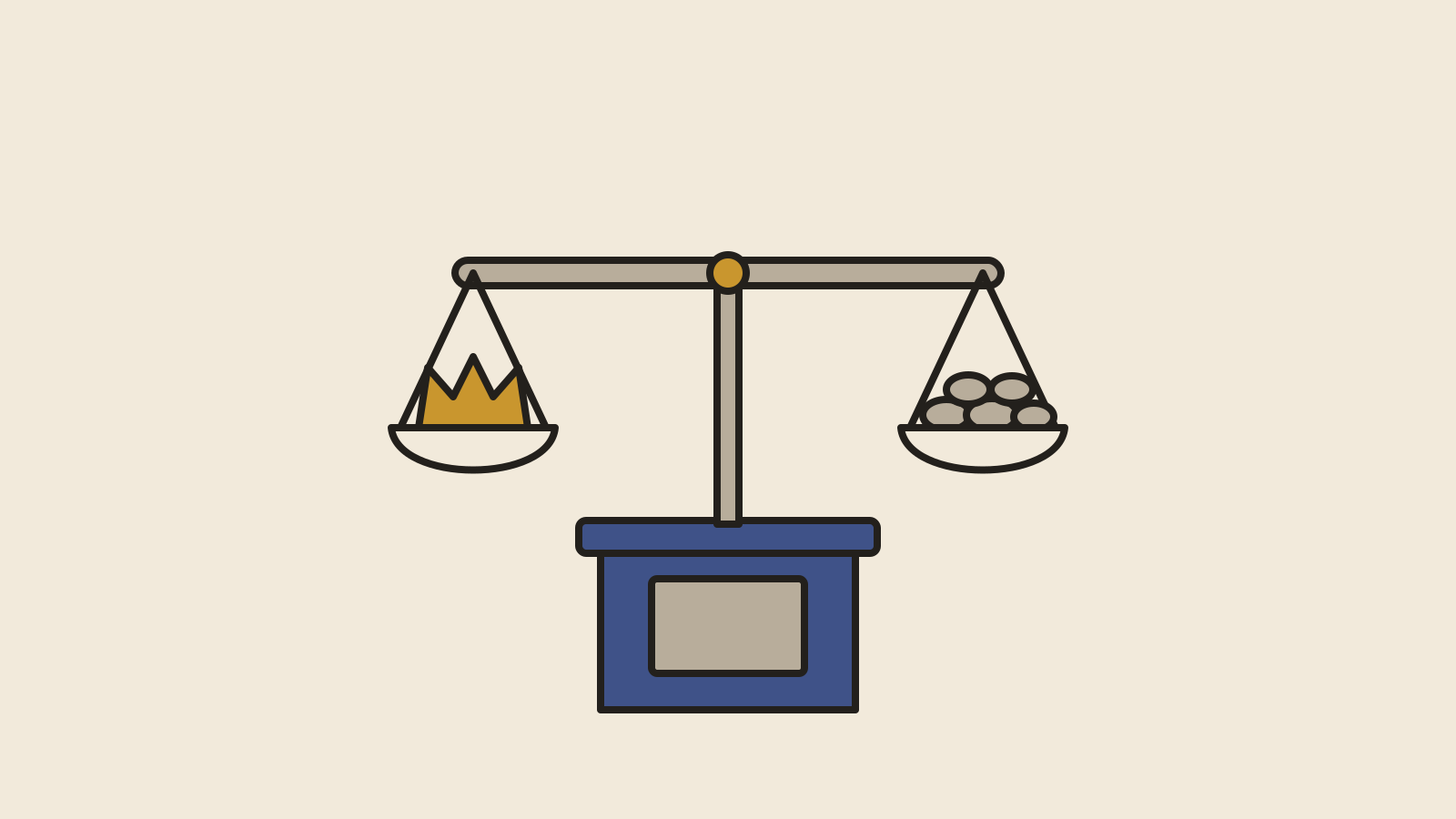
Political philosophy asks how people ought to live together under shared rules and power. Its questions are about what should be the case: who may rightly rule, what a government owes its citizens, how freedom and equality should be balanced and when, if ever, disobedience is justified. It weighs arguments for the answers, where political science studies how institutions in fact behave.
A dispute over a new expressway shows the kind of question. Engineers can say what the road will cost, and economists who will gain. Whether the state may take a family's home to build it, and what the family is owed, is a matter of political philosophy. So is the prior question of why the state's decision binds anyone at all.
The branch borders ethics, law and economics. Every political tradition, liberalism, socialism and conservatism among them, rests on answers to its questions.
Ethics
The branch of philosophy that asks how we should act and what makes a life good, and tests the answers by argument.
Liberalism (political)
A political tradition holding that individuals are free and equal, so power over them must be limited, justified and answerable.
Diagram
Political philosophy is organised round four families of questions
Read as text
A tree with political philosophy at the root and four branches. Legitimacy leads to the question of why anyone should obey the state. Justice leads to the question of who is owed what. Liberty leads to the question of what may be restricted. Rule leads to the question of who should decide.
Core commitments
- Legitimacy: what gives some people the right to make rules for others, and why those others should obey.
- Justice: how the benefits and burdens of living together, such as income, opportunity and tax, should be shared.
- Liberty: what individuals should be free to do, and where the state or the majority may interfere.
- Rule: who should hold power, whether the many, the wise or the law itself.
- Method: claims are tested by argument, example and thought experiment, with facts about how societies work as a constraint.
Not to be confused with
| Look-alike | The difference | Differs on |
|---|---|---|
| Political science | Political science explains how governments, parties and voters actually behave, using data and comparison. Political philosophy asks how political life ought to be arranged and why. | Differs onDescriptive or normative |
| Ethics | Ethics covers how anyone should act and live. Political philosophy covers the narrower set of questions raised by collective power: law, coercion and institutions. | Differs onScope |
| Comparative politics | Comparative politics sets actual regimes side by side to explain how they work and why they differ. Political philosophy asks what a just or legitimate order would be. | Differs onDescriptive or normative |
| Political ideology | An ideology is a package of beliefs and goals meant to guide action and win support. Political philosophy examines the arguments behind such packages, including the ones the philosopher favours. | Differs onMethod |
- Differs onDescriptive or normative
Political science
Political science explains how governments, parties and voters actually behave, using data and comparison. Political philosophy asks how political life ought to be arranged and why.
- Differs onScope
Ethics covers how anyone should act and live. Political philosophy covers the narrower set of questions raised by collective power: law, coercion and institutions.
- Differs onDescriptive or normative
Comparative politics sets actual regimes side by side to explain how they work and why they differ. Political philosophy asks what a just or legitimate order would be.
- Differs onMethod
Political ideology
An ideology is a package of beliefs and goals meant to guide action and win support. Political philosophy examines the arguments behind such packages, including the ones the philosopher favours.
Origins and development
The Western line begins in Athens with Plato's Republic, written about 375 BCE, and Aristotle's Politics. Other traditions asked the same questions independently: Confucius and Mencius on virtuous rule, Han Feizi on law and power, Kautilya on statecraft, and later al-Farabi and Ibn Khaldun in the Islamic world. Early modern Europe recast the subject around consent and rights through Hobbes, Locke and Rousseau. A Theory of Justice (1971) by John Rawls set the agenda for the current period.
Confucius
The teacher from Lu who held that a good society grows from cultivated character, shared ritual and rulers who lead by example.
Mencius
The Confucian thinker who argued that human nature is good and that rulers who ruin the people lose their right to rule.
Why it matters
Every argument about taxes, free speech, immigration or the limits of protest uses ideas from this branch, usually without naming them. Knowing the positions helps a reader see what a disagreement is about. Often it is a clash between two defensible values, such as liberty and equality, and no further fact would settle it.
Critiques and limits
Karl Marx treated political philosophy as ideology that dresses up class interests as universal principles. Realists such as Bernard Williams and Raymond Geuss object that much of the field is applied ethics, blind to power and to what politics can achieve. Charles Mills argued that ideal theories of justice ignore the racial domination that shaped real states. Amartya Sen holds that comparing actual injustices is more useful than designing a perfectly just society.
Karl Marx
The German thinker who argued that the way a society produces its living shapes its classes, its conflicts and its ideas.
Amartya Sen
Indian economist and philosopher who argued that development means widening what people are free to do and be.
Key figures
- Platoc. 428–348 BCE
- Aristotle384–322 BCE
- Confucius551–479 BCE
- Thomas Hobbes1588–1679
- John Locke1632–1704
- Jean-Jacques Rousseau1712–1778
- John Stuart Mill1806–1873
- John Rawls1921–2002





Connections
Originated by
PlatoPhilosophy
Plato's Republic, written about 375 BCE, is the earliest surviving systematic work in the Western line of the field.
Influenced by
Falsafa (Islamic Peripatetic philosophy)Philosophy
Al-Farabi recast Plato's philosopher-king as a prophet-lawgiver, opening a line of political philosophy carried on by Averroes and Maimonides.
Contrasts with
Differs on descriptive or normative. One explains how actual regimes work and differ, the other asks what a just or legitimate order would be.
Differs on scope. Political philosophy covers every question of rightful rule, where democratic theory examines one answer, rule by the people.
EthicsPhilosophy
Differs on scope. Ethics asks how anyone should act and live, where political philosophy asks only about collective power, law and institutions.
Social theorySociology
Differs on descriptive or normative. Social theory explains how actual societies hold together and change, where political philosophy asks what a just order would be.
Contains
AristotlePhilosophy
The Politics treats humans as political by nature and sorts constitutions by who rules and for whose benefit.
Augustine of HippoPhilosophy
The City of God denies that any earthly state can be fully just and values government chiefly for keeping peace.
ConfuciusPhilosophy
His answer to who should rule, the morally cultivated, is one of the oldest positions in the branch.
She recast the field's central question as how people can act together in freedom, where others asked who should rule.
His 1958 lecture on two concepts of liberty is among the most assigned texts in the branch.
The Social Contract moved final authority from kings to the people and made freedom, not security, the test of a just order.
A Theory of Justice brought systematic argument about justice back to a field many thought exhausted.
The Arthashastra is the fullest ancient Indian statement of what a king is for and how he should rule.
LaoziPhilosophy
Its advice that the ruler who governs least governs best is an early argument for minimal government.
He turned the field from describing ideal rulers to asking what in fact keeps a state alive.
PlatoPhilosophy
The Republic asks what justice is and who should rule, and answers with a city governed by trained philosophers.
SocratesPhilosophy
In Plato's Crito he argues that a citizen who accepts a city's benefits has agreed to obey its laws.
Leviathan recast the field round one question, why free and equal people should accept anyone's authority.
It is one of political philosophy's main answers to how people can obey laws and stay free.
The theory reset the field's agenda, so that later accounts of justice are framed as replies to it.
It is the classical Chinese answer to the branch's first question, what gives anyone the right to rule.
Natural lawPhilosophy
It supplies a test of legitimacy, that a government's commands bind only when they accord with a higher moral law.
It is a theory of resistance, an answer to when and how citizens may defy an unjust law.
It is political philosophy's best-known answer to the question of why anyone should obey the state.
Political philosophers treat it as the limiting case of unfreedom, where no private or public space is left.
It set the terms in which political philosophers have argued about the meaning of freedom since.
Political philosophers use it to separate what is fair from what merely suits the person arguing.
What makes rule rightful, and why anyone should obey it, is the first of the branch's defining questions.
Political philosophy treats it as a basic test of whether power is exercised by rules or by will.
Who holds final authority, and whether it can be divided or limited, is one of the branch's oldest disputes.
It is the baseline against which political philosophers measure what government adds and what it may demand.
Critiqued by
Behaviouralism (political science)
Easton charged in 1953 that political theory had shrunk into the history of ideas and should build testable general theory.
Applications
Arrow's impossibility theoremEconomics
Democratic theorists use it to test what "the will of the people" can mean when there are more than two options.
Capability approachEconomics
Nussbaum turned it into a theory of justice that names the capabilities every state owes each citizen.
Categorical imperativePhilosophy
The formula of humanity underlies appeals to human dignity as a limit that no majority or public benefit may override.
MeritocracySociology
Philosophers debate it as a question of desert, asking whether talent and effort earn their rewards.
Theory of FormsPhilosophy
The Republic's case for philosopher rulers rests on their knowledge of the Form of the Good.
UbuntuPhilosophy
South Africa's courts and its Truth and Reconciliation Commission invoked ubuntu to favour repair over retribution.
Pareto efficiencyEconomics
Rawls and others treat it as a minimal condition a just arrangement should meet, never as a sufficient one.
PatriarchySociology
Pateman argued that the social contract of Hobbes and Locke hid an earlier sexual contract giving men rights over women.
Public goodEconomics
Arguments for the state's authority to tax often rest on goods that voluntary payment would under-supply.
RenPhilosophy
Mencius made ren a test of rulers, arguing that benevolent government wins the people and cruelty forfeits the throne.
Thought experimentPhilosophy
The state of nature and the veil of ignorance test principles of justice on imagined cases that no one could stage.
Cross with
Two distant entries to read beside this one, each with the question the pairing opens.
Evolutionary psychologyPsychology
If a sense of fairness was shaped by natural selection, does that support our intuitions about justice or undermine them? Set them side by side
The WEIRD problemPsychology
Arguments about justice lean on readers' intuitions. If those readers are mostly Western and educated, whose justice is being described? Set them side by side
Further reading
- Kymlicka, W. (2002). Contemporary political philosophy: An introduction (2nd ed.). Oxford University Press.
- Plato. (1992). Republic (2nd ed.). Hackett. (Original work published -375)
- Wolff, J. (2016). An introduction to political philosophy (3rd ed.). Oxford University Press.
Cite this entry
Scholia. (2026). Political philosophy. In Scholia: Notes in the margin of the human sciences. Retrieved November 28, 2026, from https://scholia.zennia.sg/schools/political-philosophy