IdeaPsychologyAlso in Cognitive science & linguistics
Gestalt principles of perception
Rules for how vision automatically groups separate elements into whole figures: by nearness, likeness, shared movement, smooth lines and closed shapes.
The idea
Look at a night sky and you see constellations where there are only scattered points. The Gestalt principles describe how that happens. They are a set of tendencies by which the visual system sorts a scene into figures and groups before we have thought about it at all.
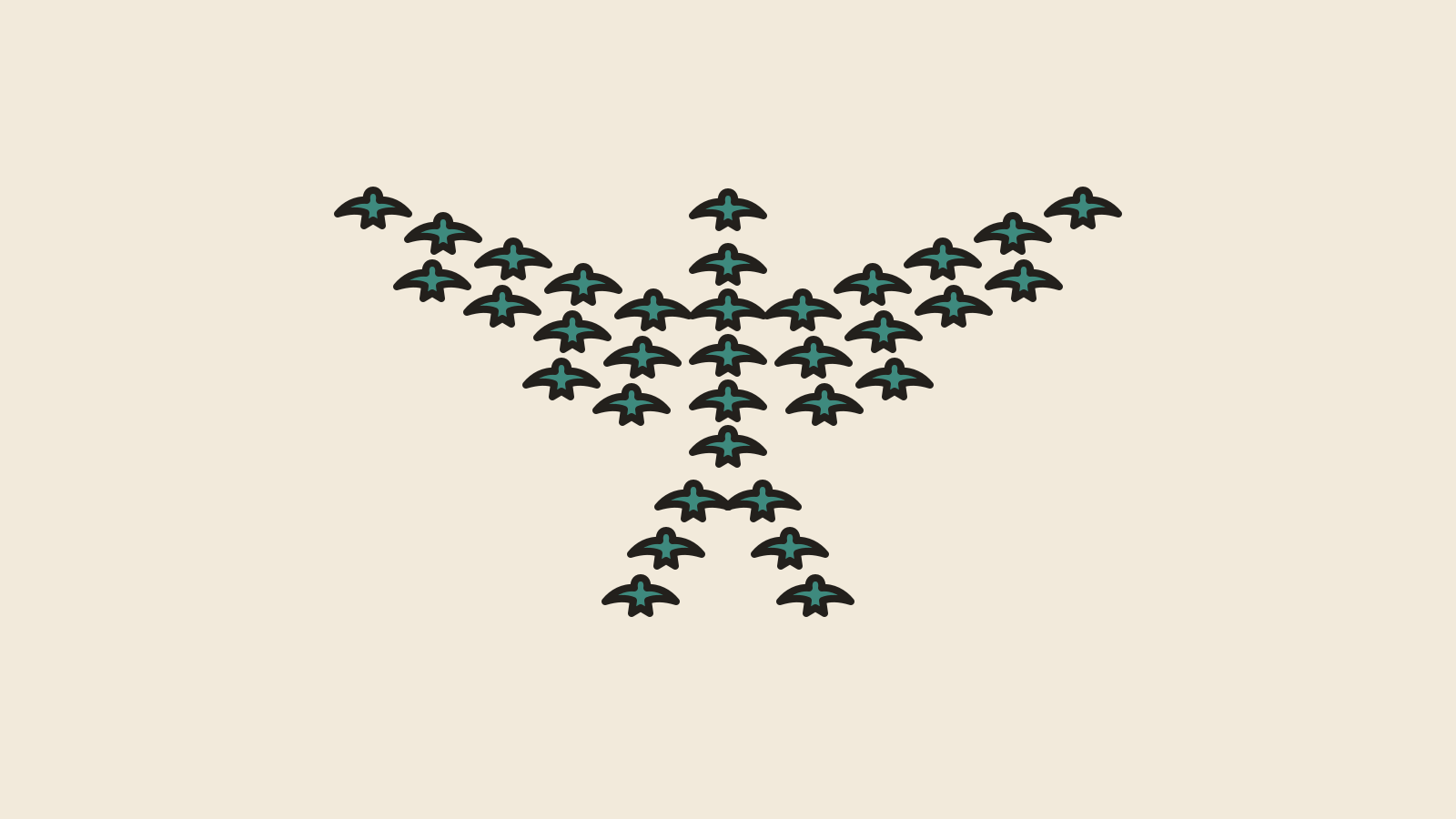
Things that sit close together are seen as belonging together. So are things that look alike, things that move in the same direction and things that lie along one smooth line. A flock of starlings wheeling over a field reads as a single shape because its birds are near one another, alike and turning together. A gap in a familiar outline tends to be filled in.
Max Wertheimer, who set the principles out in 1923, argued that they answer a real puzzle. The eye receives a mosaic of light. Something has to decide which patches go with which, and the answer we get is rarely ambiguous.
Diagram
Vision organises a scene by separating figures and grouping elements
Read as text
A tree with perceptual organisation at the top and two branches. One branch is figure and ground, the separation of a shaped object from its background. The other is grouping, which has five principles beneath it: proximity, similarity, common fate, good continuation and closure.
Key features
- Proximity and similarity: elements that are near each other, or that share colour, size or shape, are grouped.
- Common fate and good continuation: elements that move together, or that follow one smooth path, are seen as a unit.
- Closure: an outline with gaps is seen as a complete figure.
- Figure and ground: every scene divides into a shaped object and a shapeless background, a distinction first analysed by the Danish psychologist Edgar Rubin in 1915.
- Prägnanz, or good form: of the organisations a scene allows, we see the simplest and most regular.
Not to be confused with
| Look-alike | The difference | Differs on |
|---|---|---|
| Gestalt psychology | The principles are the school's best-known findings, a set of rules for how vision groups what it sees. The school was a general psychology with views on thinking, learning and the brain. | Differs onScope |
| Schema | A schema is stored knowledge that shapes what we expect to see, so it works from memory downwards. The Gestalt principles were proposed as built-in tendencies that organise the incoming scene itself, before we know what the objects are. | Differs onMechanism |
| Design guidelines | Design handbooks turn the principles into advice: put related buttons close together. The principles themselves only describe what the visual system does. They say nothing about what makes a layout good. | Differs onDescriptive or normative |
- Differs onScope
The principles are the school's best-known findings, a set of rules for how vision groups what it sees. The school was a general psychology with views on thinking, learning and the brain.
- Differs onMechanism
A schema is stored knowledge that shapes what we expect to see, so it works from memory downwards. The Gestalt principles were proposed as built-in tendencies that organise the incoming scene itself, before we know what the objects are.
- Differs onDescriptive or normative
Design guidelines
Design handbooks turn the principles into advice: put related buttons close together. The principles themselves only describe what the visual system does. They say nothing about what makes a layout good.
Origins and development
Wertheimer worked the principles out with simple arrays of dots and lines and published them in 1923, in the second of two papers on the theory of Gestalt. Kurt Koffka and Wolfgang Köhler spread them in English. Interest faded with the school and revived late in the century, when vision scientists began to measure grouping. In 1992 Stephen Palmer added common region, where elements inside one boundary are grouped. He and Irvin Rock went on to argue that grouping happens later in visual processing than Wertheimer supposed.
Why it matters
Every well-made form, map, dashboard and road sign relies on these tendencies, and interface designers learn them by name. Camouflage turns them against the viewer: a moth's markings break up its outline by continuing the lines of the bark behind it. In computer vision, separating objects from their background is still called the segmentation problem. It is the problem Wertheimer posed.
Critiques and limits
The effects are easy to reproduce and not in doubt. The objections concern explanation. Johan Wagemans and colleagues, reviewing a century of work in 2012, note that the classic principles were shown with simple drawings, hold only when other things are equal and don't say which wins when two conflict. Prägnanz has resisted precise definition. Followers of Hermann von Helmholtz hold that we see the likeliest arrangement, learned from real scenes, where Gestalt theory says the simplest. The principles are well supported as descriptions. Their explanation is still argued over.
Connections
Belongs to
Wertheimer's laws of grouping were the school's main evidence that perception delivers organised wholes.
Perceptual grouping is now studied within cognitive psychology and vision science, with measurement in place of demonstration.
Critiques
If grouping is immediate and lawful, perception can't be a mosaic of sensations joined afterwards by association.
Contrasts with
Differs on scope. The principles are the school's findings on visual grouping, while the school was a general psychology of perception, thought and brain.
Differs on mechanism. A schema shapes perception from stored knowledge, where the principles organise the incoming scene before objects are recognised.
Parallels
Modularity of mindCognitive science & linguistics
Both find perception organising itself automatically and deaf to what we know: Gestalt grouping can't be switched off, and Fodor's modules are sealed from belief.
Occam's razorPhilosophy
Gestalt psychologists found that perception itself settles on the simplest organisation a scene allows.
Applied in
Cognitive linguisticsCognitive science & linguistics
Talmy and Langacker use figure and ground to describe how a sentence picks out one thing against a setting.
Influenced
Prototype theoryCognitive science & linguistics
Rosch's first prototype experiments used Gestalt 'good forms' such as the circle and square as natural best examples that categories form around.
Cross with
Two distant entries to read beside this one, each with the question the pairing opens.
PhonemeCognitive science & linguistics
Do listeners carve a stream of speech into phonemes by the rules of likeness and nearness that group dots into figures? Set them side by side
AestheticsPhilosophy
Do the grouping rules of vision explain any agreement in judgements of beauty, such as a liking for symmetry and closed forms? Set them side by side
Further reading
- Palmer, S. E. (1999). Vision science: Photons to phenomenology. MIT Press.
- Wagemans, J., Elder, J. H., Kubovy, M., Palmer, S. E., Peterson, M. A., Singh, M., & von der Heydt, R. (2012). A century of Gestalt psychology in visual perception: I. Perceptual grouping and figure–ground organization. Psychological Bulletin, 138(6), 1172–1217. https://doi.org/10.1037/a0029333
- Wertheimer, M. (1923). Untersuchungen zur Lehre von der Gestalt. II. Psychologische Forschung, 4(1), 301–350. https://doi.org/10.1007/BF00410640
Cite this entry
Scholia. (2026). Gestalt principles of perception. In Scholia: Notes in the margin of the human sciences. Retrieved November 28, 2026, from https://scholia.zennia.sg/ideas/gestalt-principles