IdeaPsychology
Id, ego and superego
Freud's model of the personality as three agencies in conflict: instinctual drive, an inner judge and a mediator that answers to both and to reality.
The idea
In 1923 Freud redrew his map of the mind as three agencies in permanent negotiation. The id is the oldest part: a pool of bodily drives that wants satisfaction now and knows nothing of consequences. The superego is the voice of parents and society taken inside, which judges, forbids and holds up ideals. The ego stands between them and the outside world, and tries to find a course all three can accept.
Take someone on a diet walking past a bakery. The id wants the cake at once. The superego calls that greedy and recalls the promise made on Monday. The ego brokers a deal: one slice on Saturday. When no deal can be found, Freud held, the result is anxiety, guilt or a symptom.
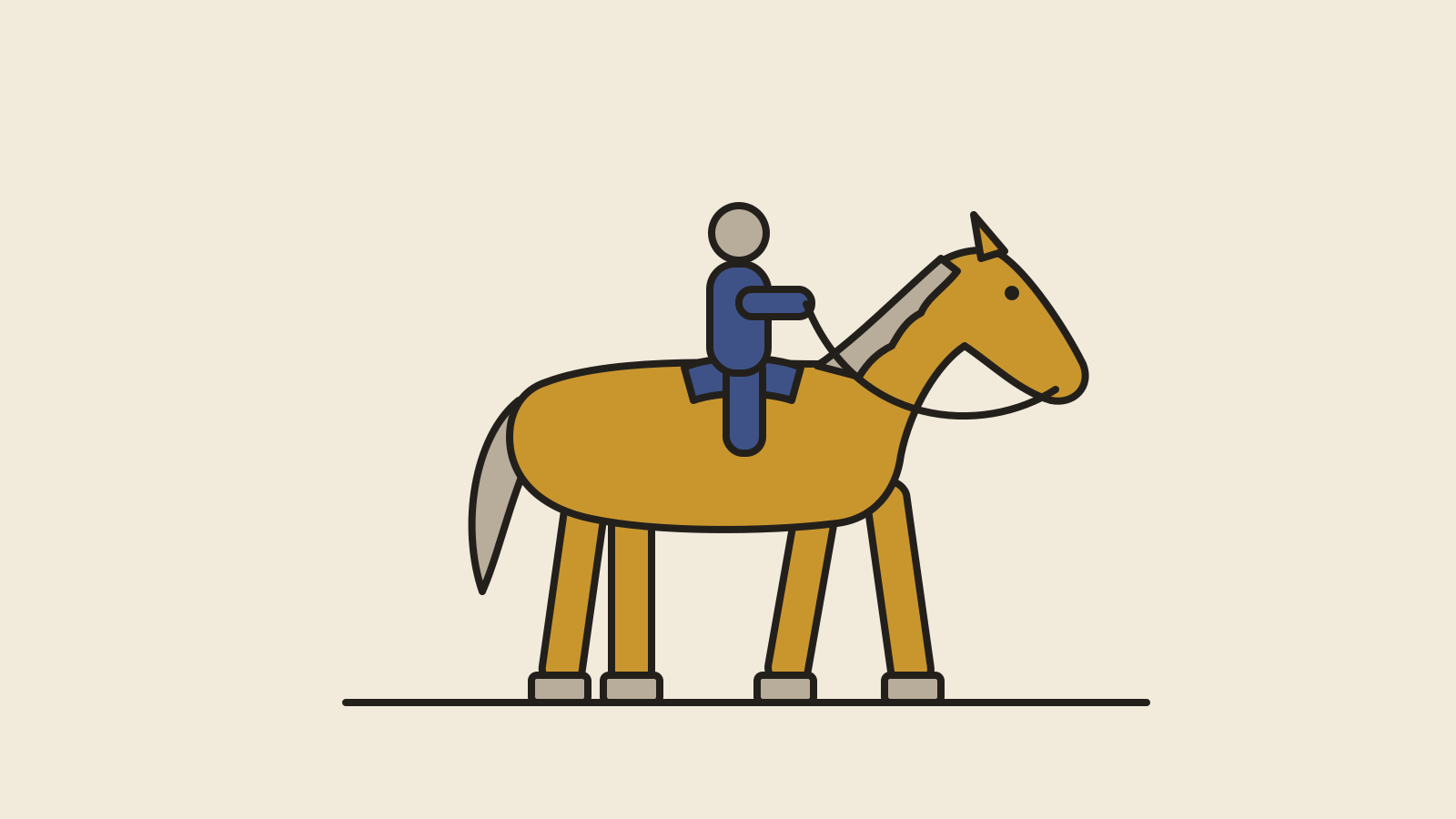
He compared the ego to a rider on a much stronger horse, who often has to guide it where it already wants to go.
Diagram
The ego answers to three masters at once
Read as text
Four elements with the ego in the middle. The id presses on the ego with demands for immediate satisfaction of bodily drives. The superego, the inner judge formed from parental rules, presses on the ego with judgements and prohibitions. The external world presses on the ego by setting limits on what is possible and safe. The ego has to find a course that satisfies all three. The id, the superego and the external world are not linked to each other directly: each acts on the ego.
Key features
- The id is wholly unconscious and runs on the pleasure principle: it seeks release of tension and can't wait.
- The ego grows out of the id through contact with the world and follows the reality principle, weighing what is possible and safe.
- The superego forms in early childhood as the child takes in parental rules. It holds both a punishing conscience and an ideal to live up to.
- Parts of the ego and superego are unconscious too, so a person can feel guilty without knowing why.
- The three are functions described as if they were persons. Freud's German words were plain ones: the it, the I and the over-I.
Not to be confused with
| Look-alike | The difference | Differs on |
|---|---|---|
| The unconscious | Freud's earlier model sorts mental contents by whether they can reach awareness. This one sorts the mind by function. The id isn't another name for the unconscious, because much of the ego and superego is unconscious as well. | Differs onUnit of analysis |
| Dual-process theory | Dual-process theory separates fast, automatic thinking from slow, effortful thinking. The division concerns how thought runs, and neither type has desires of its own. Freud's parts differ in what they want. | Differs onClaim |
| Conscience | The superego covers more than conscience in the everyday sense. It is largely unconscious, can be far harsher than the parents it copies and carries a picture of who one ought to be. | Differs onScope |
| Plato's three-part soul | Plato also divided the soul in three (appetite, spirit and reason) and gave reason the right to rule. Freud's ego is no such sovereign. It is hard pressed and serves three masters. | Differs onClaim |
- Differs onUnit of analysis
Freud's earlier model sorts mental contents by whether they can reach awareness. This one sorts the mind by function. The id isn't another name for the unconscious, because much of the ego and superego is unconscious as well.
- Differs onClaim
Dual-process theory separates fast, automatic thinking from slow, effortful thinking. The division concerns how thought runs, and neither type has desires of its own. Freud's parts differ in what they want.
- Differs onScope
Conscience
The superego covers more than conscience in the everyday sense. It is largely unconscious, can be far harsher than the parents it copies and carries a picture of who one ought to be.
- Differs onClaim
Plato's three-part soul
Plato also divided the soul in three (appetite, spirit and reason) and gave reason the right to rule. Freud's ego is no such sovereign. It is hard pressed and serves three masters.
Origins and development
Freud set out the scheme in The Ego and the Id (1923). His earlier division into conscious and unconscious had run into trouble, because the forces doing the repressing turned out to be unconscious themselves. He took the word for the id from the physician Georg Groddeck, who had it from Nietzsche. The Latin terms come from the English translation, and Bruno Bettelheim later complained that they made a plain-spoken theory sound like medicine. Anna Freud and Heinz Hartmann went on to make the ego the main object of study.
Why it matters
The vocabulary is everywhere: a big ego, an overactive superego, a politician who is all id. The model set a pattern for later accounts that split the self into parts with competing aims. Ruth Benedict's contrast of guilt and shame cultures borrows the superego as its picture of guilt, and Roy Baumeister's ego depletion takes its name from Freud's ego.
Guilt and shame cultures
The claim that some societies keep order mainly through shame before others and some through private guilt, now accepted only as a difference of emphasis.
Ego depletion
The claim that self-control runs on a limited resource that gets used up, which large replication attempts have mostly failed to confirm.
Critiques and limits
Karl Popper objected that Freudian theory can assign any behaviour to one agency or another after the fact, so nothing could count against it. The analyst Roy Schafer argued in 1976 that the scheme turns a person's actions into little persons inside the head, and proposed describing what people do instead. Drew Westen finds good evidence for conflict between motives but none for this particular anatomy. Its status is interpretive: a way of reading inner conflict, with no agreed test.
Connections
Belongs to
It became the school's standard map of the mind and the basis of ego psychology.
Originated by
Freud set out the three agencies in The Ego and the Id in 1923.
Extends
It replaced the earlier map of conscious and unconscious regions once the repressing forces proved unconscious themselves.
Influenced by
Friedrich NietzschePhilosophy
The word for the id reached Freud through the physician Georg Groddeck, who had borrowed it from Nietzsche.
Contrasts with
Differs on claim. Freud divided the person by what each part wants, while dual-process theory divides thinking by how it runs.
Differs on unit of analysis. The earlier model sorts mental contents by access to awareness, while this one sorts the mind into agencies by function.
Applied in
Psychological and cognitive anthropologyAnthropology
Culture-and-personality writers used the superego to explain how a society plants its rules inside its children.
Influenced
After 1923 defences were recast as unconscious work of the ego, which is how Anna Freud described them.
Guilt and shame culturesAnthropology
The picture of guilt as an inner judge borrows Freud's superego, parental authority taken inside the person.
Cross with
Two distant entries to read beside this one, each with the question the pairing opens.
Collective consciousnessSociology
Is the superego Durkheim's collective consciousness installed in one person, or does each child build a private judge? Set them side by side
General willPolitical theory & science
Rousseau set a citizen's private will against the general will: is that Freud's conflict of drive and inner judge moved into politics? Set them side by side
Further reading
- Freud, S. (1960). The ego and the id (J. Riviere, Trans.; J. Strachey, Ed.). W. W. Norton. (Original work published 1923)
- Laplanche, J., & Pontalis, J.-B. (1973). The language of psycho-analysis (D. Nicholson-Smith, Trans.). Hogarth Press. (Original work published 1967)
- Westen, D. (1998). The scientific legacy of Sigmund Freud: Toward a psychodynamically informed psychological science. Psychological Bulletin, 124(3), 333–371. https://doi.org/10.1037/0033-2909.124.3.333
Cite this entry
Scholia. (2026). Id, ego and superego. In Scholia: Notes in the margin of the human sciences. Retrieved November 28, 2026, from https://scholia.zennia.sg/ideas/id-ego-and-superego