School or branchPsychologyAlso in Philosophy, Sociology, Anthropology
Psychoanalysis
A theory of mind and a talking treatment, begun by Freud, which hold that unconscious conflicts rooted in childhood drive adult feeling and behaviour.
Overview
Psychoanalysis is two things under one name: a theory of how the mind works and a method of treatment built on it. Both rest on the claim that people are moved by wishes, fears and memories they are unaware of, that these took shape in childhood and that bringing them into the open can relieve suffering.
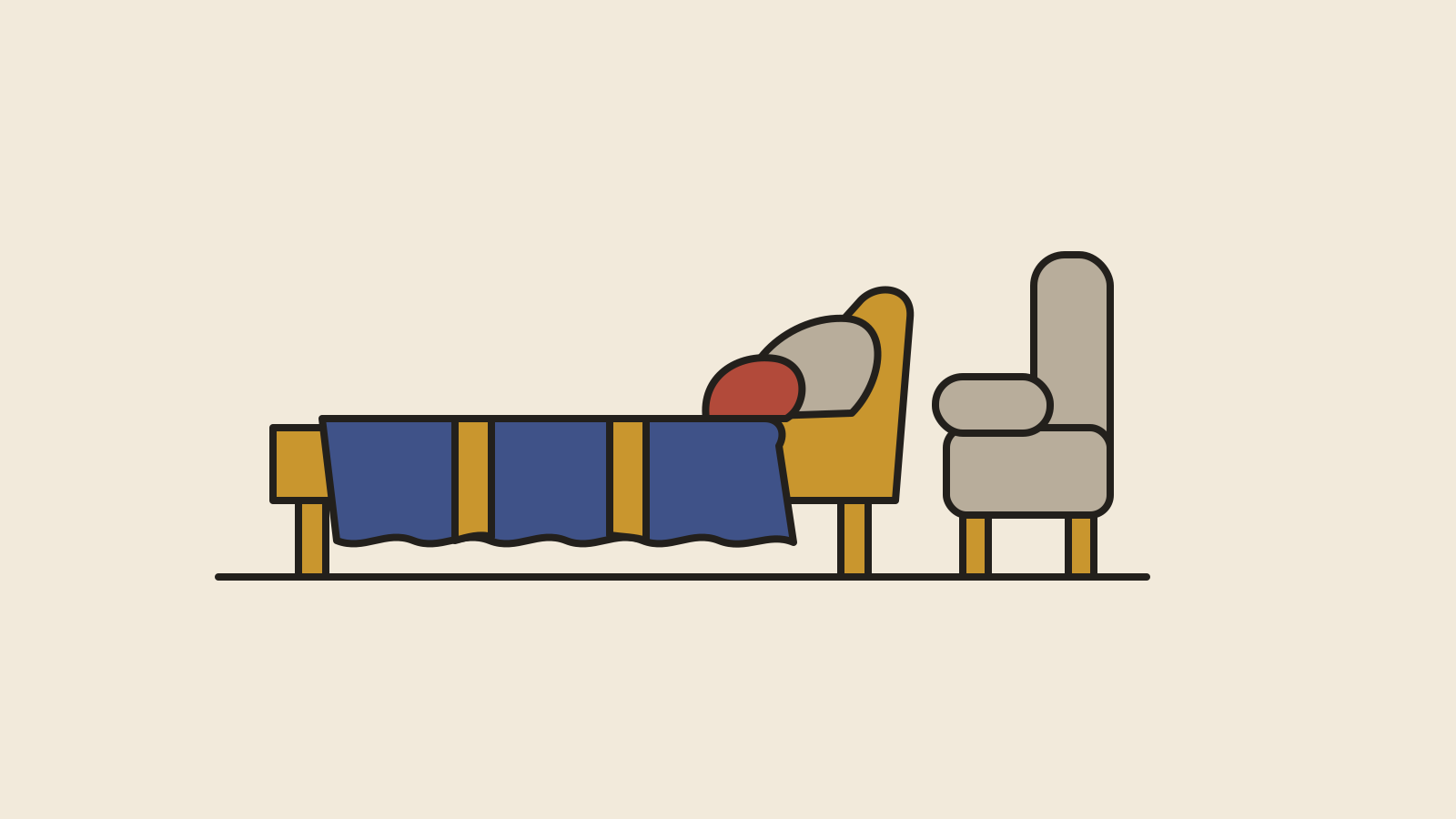
The treatment is easy to picture. The patient lies on a couch, with the analyst out of sight, and says whatever comes to mind without censoring it. This is free association. Sessions run several times a week, often for years. The analyst listens for what the patient circles round, avoids or repeats. Interpretations follow. A man who keeps arriving late and apologising too much may find that he treats the analyst as he once treated a critical father.
The school has split many times, and its branches disagree on a great deal. They share the starting assumption of the unconscious.
The unconscious
Freud's claim that wishes, fears and memories kept out of awareness go on steering what people think, feel and do.
Diagram
Psychoanalysis grew from one Vienna practice, peaked mid-century and still divides opinion
Read as text
A timeline from 1895 to the present. In 1895 Josef Breuer and Sigmund Freud publish Studies on Hysteria. In 1896 Freud first uses the name psychoanalysis. In 1900 The Interpretation of Dreams appears, having been printed late in 1899. In 1910 the International Psychoanalytical Association is founded. In 1913 Carl Jung breaks away. In 1923 The Ego and the Id sets out the model of id, ego and superego. In 1938 Freud flees Vienna for London. In 1980 the third edition of the American diagnostic manual, DSM-III, drops psychoanalytic terms such as neurosis. A bar marks about 1945 to 1970 as the period when analysts led American psychiatry. Influence rises to a peak in the 1950s and declines afterwards. The school is still active today.
Core commitments
- Much of mental life is unconscious, and what is kept out of awareness still shapes behaviour.
- Early childhood relationships leave patterns that adults repeat without knowing it.
- The mind is in conflict with itself, and symptoms are compromises between a wish and the defences raised against it.
Defence mechanisms
Unconscious mental manoeuvres, such as denial and projection, that protect people from anxiety by distorting what they would otherwise have to face.
- Nothing in mental life is accidental: dreams, slips and symptoms have meanings that can be interpreted.
- The relationship with the analyst, above all transference, is the main instrument of treatment.
Transference
The unconscious redirection onto a present person, classically a therapist, of feelings and expectations formed in an earlier relationship.
Not to be confused with
| Look-alike | The difference | Differs on |
|---|---|---|
| Psychotherapy | Psychotherapy is the general name for treatment by talking. Psychoanalysis is one family within it, the oldest of the modern schools and the most intensive. Most therapists today are not analysts. | Differs onScope |
| Psychiatry | Psychiatry is the branch of medicine that treats mental disorder, mostly with diagnosis and drugs. Psychoanalysis is a theory and a talking method. Many early analysts were psychiatrists, but neither requires the other. | Differs onMethod |
| Cognitive behavioural therapy | CBT is brief and structured, sets homework and works on present thoughts and habits. Analysis is long and open-ended and looks for the origins of a problem in the past. | Differs onMethod |
| Analytical psychology | This is the name of Carl Jung's school, founded after his break with Freud. It adds a collective unconscious with its archetypes and gives sexuality a much smaller part. | Differs onClaim |
- Differs onScope
Psychotherapy
Psychotherapy is the general name for treatment by talking. Psychoanalysis is one family within it, the oldest of the modern schools and the most intensive. Most therapists today are not analysts.
- Differs onMethod
Psychiatry
Psychiatry is the branch of medicine that treats mental disorder, mostly with diagnosis and drugs. Psychoanalysis is a theory and a talking method. Many early analysts were psychiatrists, but neither requires the other.
- Differs onMethod
CBT is brief and structured, sets homework and works on present thoughts and habits. Analysis is long and open-ended and looks for the origins of a problem in the past.
- Differs onClaim
Analytical psychology
This is the name of Carl Jung's school, founded after his break with Freud. It adds a collective unconscious with its archetypes and gives sexuality a much smaller part.
Origins and development
In the early 1880s the Viennese physician Josef Breuer treated a young woman, known as Anna O., whose symptoms eased when she traced them back to their beginnings. She called it her "talking cure". Freud worked with Breuer, replaced hypnosis with free association and named the method in 1896. An international association followed in 1910. Alfred Adler left in 1911 and Jung in 1913. After Freud came ego psychology, the object relations school of Melanie Klein and Donald Winnicott and the French school of Jacques Lacan. Analysts led American psychiatry in the 1950s and lost that place from the 1970s.
Why it matters
Almost every talking treatment keeps something from it: the fifty-minute hour, the confidential room, the belief that speaking about pain can ease it. Its vocabulary of denial, projection, ego and repression is everyday speech. Outside the clinic it shaped literary criticism, film, the Frankfurt School's social theory and the anthropology of child-rearing. A reader meets its assumptions whenever a biography explains an adult by a childhood.
Critiques and limits
Karl Popper argued that psychoanalysis can explain any behaviour after the fact and so forbids nothing. Adolf Grünbaum thought it testable but said its clinical evidence is tainted, since patients may simply come to agree with their analysts. Hans Eysenck claimed in 1952 that analytic patients recovered no faster than untreated ones. Later trials are kinder. Jonathan Shedler's 2010 review found that psychodynamic therapies, most of them far shorter than analysis, work about as well as other treatments. Classical analysis lasting years has rarely been tested in trials.
Key figures
- Sigmund Freud1856–1939
- Josef Breuer
- Carl Jung1875–1961
- Anna Freud
- Melanie Klein
- Karen Horney1885–1952
- Erik Erikson1902–1994
- Jacques Lacan




Connections
Originated by
Freud named the method in 1896 and built both the theory and the treatment over the next four decades.
Critiques
René DescartesPhilosophy
It denies the Cartesian assumption that a mind is fully open to its owner's inspection.
Contrasts with
Differs on method. Analysis explores the past through open-ended talk over years, while this therapy trains new habits of thought in a few structured sessions.
Contains
He was the movement's first international president, then left in 1913 to found his own school, analytical psychology.
He trained as a child analyst under Anna Freud and stayed within the tradition while shifting its weight from drives to society.
He trained and practised as a psychoanalyst, then broke with its view that fantasy matters more than real events.
She trained and taught as a Freudian analyst in Berlin, then led the neo-Freudian revision that put culture before instinct.
He founded the movement, named it in 1896 and led it until his death.
He practised and taught psychoanalysis in Japan and revised its theory of dependence from Japanese clinical material.
Doi was a psychoanalyst, built the theory from clinical cases and tied amae to Michael Balint's idea of passive love.
Anna Freud's 1936 catalogue made the analysis of defences a central task of psychoanalytic treatment.
It became the school's standard map of the mind and the basis of ego psychology.
It is the school's founding assumption, shared by branches that agree on little else.
The term belongs to analytical psychology, the school Jung founded after leaving Freud's movement in 1913.
Freud called repression the foundation on which the whole of psychoanalysis rests.
Analysts treat the patient's transference as the main instrument of treatment.
Influenced
He trained as an analyst, and his attempt to confirm Freud's theory of depression produced the findings that led him away.
Frantz FanonPolitical theory & science
He used its methods and argued that in a racist society neurosis has social causes.
Freud's talking cure supplied the first model of treatment, which clinical psychologists adopted and later tested against rivals.
Freud's claim that early childhood shapes adult character made infancy a serious subject of research.
Personality and individual differences
Freud's account of character formed in childhood set questions that early personality psychologists had to answer or reject.
PostcolonialismPolitical theory & science
Fanon and Bhabha used psychoanalytic ideas of desire, identification and ambivalence to describe what colonial rule does to coloniser and colonised.
Psychological and cognitive anthropologyAnthropology
Culture-and-personality writers borrowed Freud's claim that early childhood sets adult character and looked for it in child-rearing customs.
Social theorySociology
Parsons, Elias and the Frankfurt School each used Freud's account of internalised authority to explain how a society gets inside its members.
It keeps the psychoanalytic view that first relationships shape later ones and replaces bodily drives with an evolved need for protection.
Critiqued by
He held that a psychology built from patients describes sickness and must be completed by the study of health.
His experiments contradicted catharsis, the claim that watching aggression drains the urge to commit it.
He rejected the analyst's interpretations and held that the client, more than any expert, knows what hurts.
She argues there is no good evidence that memories of trauma are repressed and later recovered intact, as Freudian theory supposes.
He argued that healthy adults act on conscious present motives, which digging for childhood conflicts overlooks.
Karl PopperPhilosophy
He argued that Freud's theory fits every possible behaviour, so it forbids nothing and can be tested by nothing.
Michel FoucaultPhilosophy
He argued that the talking cure continues the Christian confession and helps to produce the sexual self it claims to free.
He denied that anxious symptoms hide unconscious meanings and argued against Japan's Freudians at psychiatric meetings.
It holds that lasting change needs no search for unconscious origins and that analysis failed to test its own results.
It charged psychoanalysis with building a picture of human nature from the conflicts of patients.
It holds that searching for the hidden origins of a symptom feeds the self-preoccupation that keeps the symptom alive.
It rejects the analytic view that depression is anger turned inward, which Beck's own studies of dreams failed to support.
FalsificationismPhilosophy
Popper's standing example of a theory that explains every possible behaviour and so risks nothing.
Applications
Incest tabooAnthropology
Freud's Oedipus complex assumes the taboo holds down a child's desire for a parent.
TabooAnthropology
Freud's Totem and Taboo likened taboo to obsessional neurosis, a forbidden wish held down by dread.
Cross with
Two distant entries to read beside this one, each with the question the pairing opens.
Interpretive anthropologyAnthropology
An interpretive anthropologist reads a culture's symbols and an analyst reads a patient's speech: what checks an interpretation in either case? Set them side by side
Conversational implicatureCognitive science & linguistics
Hearers recover what a speaker meant beyond the words: how does that differ from recovering what the speaker did not know they meant? Set them side by side
Further reading
- Freud, S. (1949). An outline of psycho-analysis (J. Strachey, Trans.). W. W. Norton. (Original work published 1940)
- Grünbaum, A. (1984). The foundations of psychoanalysis: A philosophical critique. University of California Press.
- Popper, K. R. (1963). Conjectures and refutations: The growth of scientific knowledge. Routledge & Kegan Paul.
- Shedler, J. (2010). The efficacy of psychodynamic psychotherapy. American Psychologist, 65(2), 98–109. https://doi.org/10.1037/a0018378
Cite this entry
Scholia. (2026). Psychoanalysis. In Scholia: Notes in the margin of the human sciences. Retrieved November 28, 2026, from https://scholia.zennia.sg/schools/psychoanalysis