IdeaPsychologyAlso in Philosophy, Cognitive science & linguistics
The unconscious
Freud's claim that wishes, fears and memories kept out of awareness go on steering what people think, feel and do.
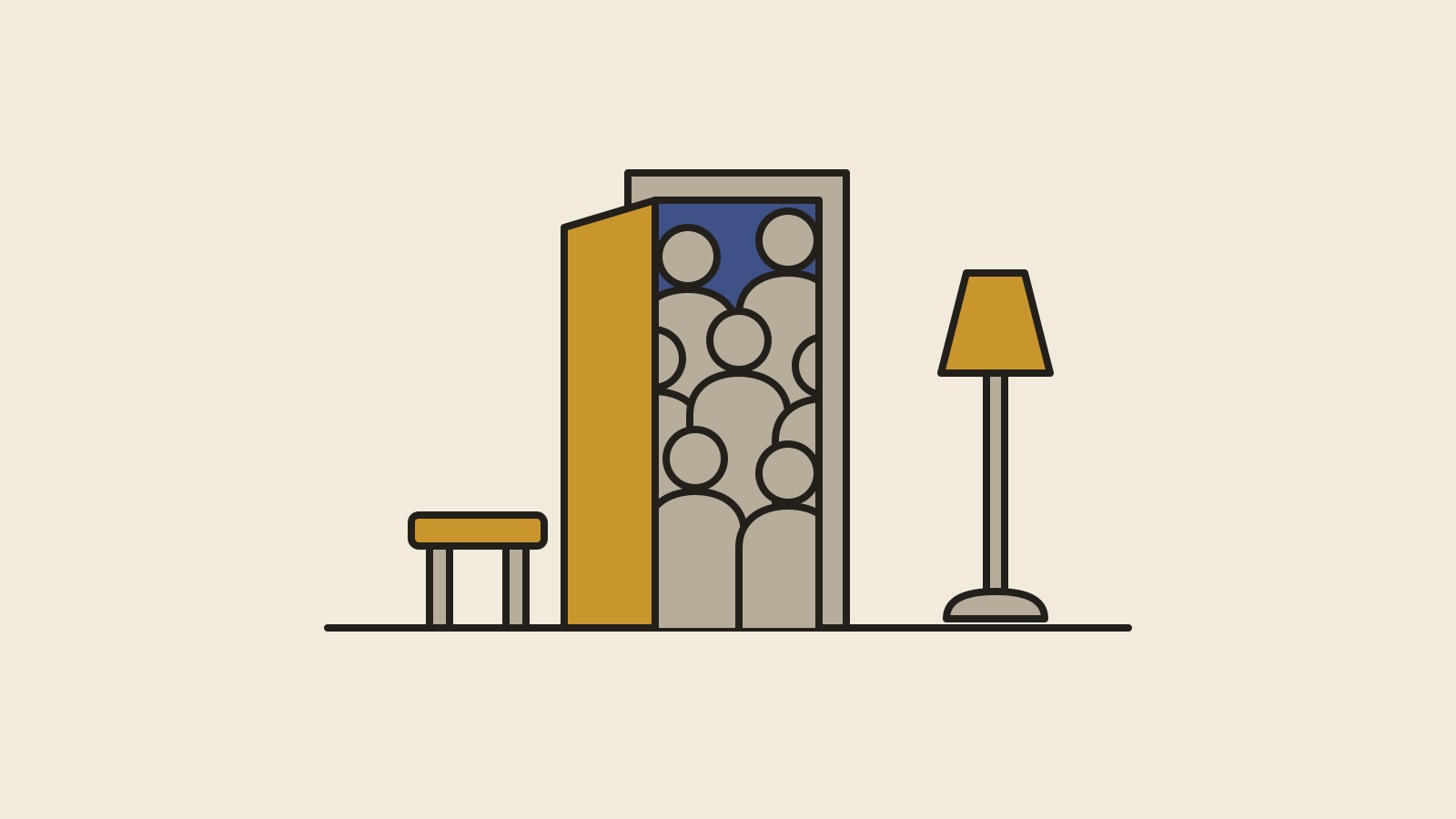
The idea
Freud claimed that most of mental life goes on outside awareness, and that the hidden part does much of the steering. Wishes, fears and memories that a person would find painful or shameful are kept from consciousness. They don't vanish. They press for expression and get it in disguised forms: dreams, slips of the tongue, symptoms, sudden dislikes.
Suppose you take against a new colleague on sight and can't say why. Months later you notice that she laughs exactly like a teacher who once humiliated you. On Freud's account the old memory was at work all along, shaping your reaction while staying out of view.
Two claims are packed together here. One is that mental processes can run unnoticed, which few now dispute. The other is that some material is unconscious because it is actively held down. This second, dynamic unconscious is the part that is distinctly Freud's.
Diagram
Freud's first model sorts the mind by how easily its contents reach awareness
Read as text
Three levels stacked from top to bottom by how easily their contents reach awareness. At the top is the conscious, what a person is aware of at this moment. Below it is the preconscious, which holds what is not in mind now but can be recalled at will, such as a telephone number. At the bottom is the unconscious, which holds wishes and memories kept out of awareness by repression. They cannot be recalled at will and show themselves only in disguise, in dreams, slips and symptoms.
Key features
- Freud sorted the mind into three systems: the conscious, the preconscious (what can be called to mind at will) and the unconscious proper.
- Unconscious material is kept out by repression, and holding it there takes continuing effort.
Repression
In psychoanalysis, the unconscious pushing of a painful thought, wish or memory out of awareness, where it is said to stay active.
- The unconscious follows its own rules: it ignores time, tolerates contradiction and seeks immediate satisfaction.
- It can't be observed directly and is inferred from its effects: dreams, slips and the transference patients form in treatment.
Transference
The unconscious redirection onto a present person, classically a therapist, of feelings and expectations formed in an earlier relationship.
- The iceberg often drawn beside Freud's name isn't his. His own picture was a crowded entrance hall, a small drawing room and a watchman on the threshold between them.
Not to be confused with
| Look-alike | The difference | Differs on |
|---|---|---|
| Dual-process theory | The fast, automatic thinking studied by cognitive psychologists is out of awareness only because it is quick and habitual. Nothing is being held down and no wish is disguised. Freud's unconscious is hidden for a motive. | Differs onClaim |
| Id, ego and superego | This first model divides the mind into regions by access to awareness. Freud's second, of 1923, divides it into three agencies by what each does. The maps don't line up: parts of the ego and superego are unconscious too. | Differs onUnit of analysis |
| Subconscious | A popular word, associated with Pierre Janet, for anything just below awareness. Freud rejected it as vague, since it blurs the line between what is merely unattended and what is repressed. | Differs onClaim |
| Collective unconscious | Carl Jung's addition: a deeper layer that is inherited, common to everyone and home to the archetypes. Freud's unconscious is personal and built from one individual's history. | Differs onScope |
- Differs onClaim
The fast, automatic thinking studied by cognitive psychologists is out of awareness only because it is quick and habitual. Nothing is being held down and no wish is disguised. Freud's unconscious is hidden for a motive.
- Differs onUnit of analysis
This first model divides the mind into regions by access to awareness. Freud's second, of 1923, divides it into three agencies by what each does. The maps don't line up: parts of the ego and superego are unconscious too.
- Differs onClaim
Subconscious
A popular word, associated with Pierre Janet, for anything just below awareness. Freud rejected it as vague, since it blurs the line between what is merely unattended and what is repressed.
- Differs onScope
Collective unconscious
Carl Jung's addition: a deeper layer that is inherited, common to everyone and home to the archetypes. Freud's unconscious is personal and built from one individual's history.
Origins and development
The idea is older than Freud. Leibniz wrote of perceptions too faint to notice, Schopenhauer of a blind will beneath reason, and Eduard von Hartmann's Philosophy of the Unconscious was widely read from 1869. Freud's contribution, set out in The Interpretation of Dreams (1900) and a paper of 1915, was a method for exploring it and the claim that repression fills it. Since the 1980s cognitive psychologists have described an unconscious of their own, made of automatic processes. John Kihlstrom surveyed it in 1987 under the name the cognitive unconscious.
Why it matters
The idea changed what counts as an explanation of behaviour. Biographers, novelists, advertisers and courts now take for granted that people can have motives they don't know about. Research on implicit bias, on habit and on snap judgement rests on the weaker version of the claim. Anyone who has said "I must have wanted to forget" is using the stronger one.
Implicit bias
The claim that attitudes and stereotypes about social groups can shape judgement automatically, without a person's awareness or intent.
Critiques and limits
William James warned in 1890 that appeals to unconscious mental states let a psychologist believe whatever he likes. Jean-Paul Sartre argued that a censor must know what it hides, so repression looks like self-deception by a single mind. Adolf Grünbaum held that the clinical evidence is shaped by the analyst's suggestions. The evidence is contested. Unconscious processing is well established in the laboratory, but Kihlstrom and others find little support there for a store of repressed wishes.
Connections
Belongs to
It is the school's founding assumption, shared by branches that agree on little else.
Originated by
Freud did not discover the unconscious, but in 1900 he gave it a method of study and a mechanism, repression.
Contrasts with
Differs on claim. Freud's unconscious hides threatening wishes by repression, while Type 1 processes are out of awareness only because they are automatic.
Differs on unit of analysis. The earlier model sorts mental contents by access to awareness, while this one sorts the mind into agencies by function.
Differs on claim. Freud's unconscious holds wishes repressed because they are painful, where implicit bias involves only learned associations that run unattended.
Applied in
Critical theorySociology
Frankfurt School writers used unconscious attachment to explain why people accept authority that harms them.
Extended by
Defences are how the unconscious stays unconscious: each works outside awareness to keep an unwelcome wish or memory there.
It replaced the earlier map of conscious and unconscious regions once the repressing forces proved unconscious themselves.
Critiqued by
Jean-Paul SartrePhilosophy
He denied a Freudian unconscious, arguing that a censor must know what it represses, and put bad faith in its place.
ExistentialismPhilosophy
Sartre argued that a censor must know what it hides, so repression is self-deception, which he called bad faith, not an unconscious mechanism.
Cross with
Two distant entries to read beside this one, each with the question the pairing opens.
Competence and performanceCognitive science & linguistics
Speakers follow grammar rules they cannot state: is that unconscious knowledge the same kind of thing as Freud's unconscious wishes? Set them side by side
CompatibilismPhilosophy
If wishes kept out of awareness steer what a person does, is that person still acting freely in the compatibilist's sense? Set them side by side
Further reading
- Ellenberger, H. F. (1970). The discovery of the unconscious: The history and evolution of dynamic psychiatry. Basic Books.
- Freud, S. (1953). The interpretation of dreams (J. Strachey, Ed. & Trans.; The standard edition of the complete psychological works of Sigmund Freud, Vols. 4–5). Hogarth Press. (Original work published 1900)
- Kihlstrom, J. F. (1987). The cognitive unconscious. Science, 237(4821), 1445–1452. https://doi.org/10.1126/science.3629249
Cite this entry
Scholia. (2026). The unconscious. In Scholia: Notes in the margin of the human sciences. Retrieved November 28, 2026, from https://scholia.zennia.sg/ideas/unconscious-mind