IdeaPolitical theory & scienceAlso in Philosophy
Just war theory
The view that war can sometimes be morally justified, but only for the right reasons and only if it is fought within moral limits.
The idea
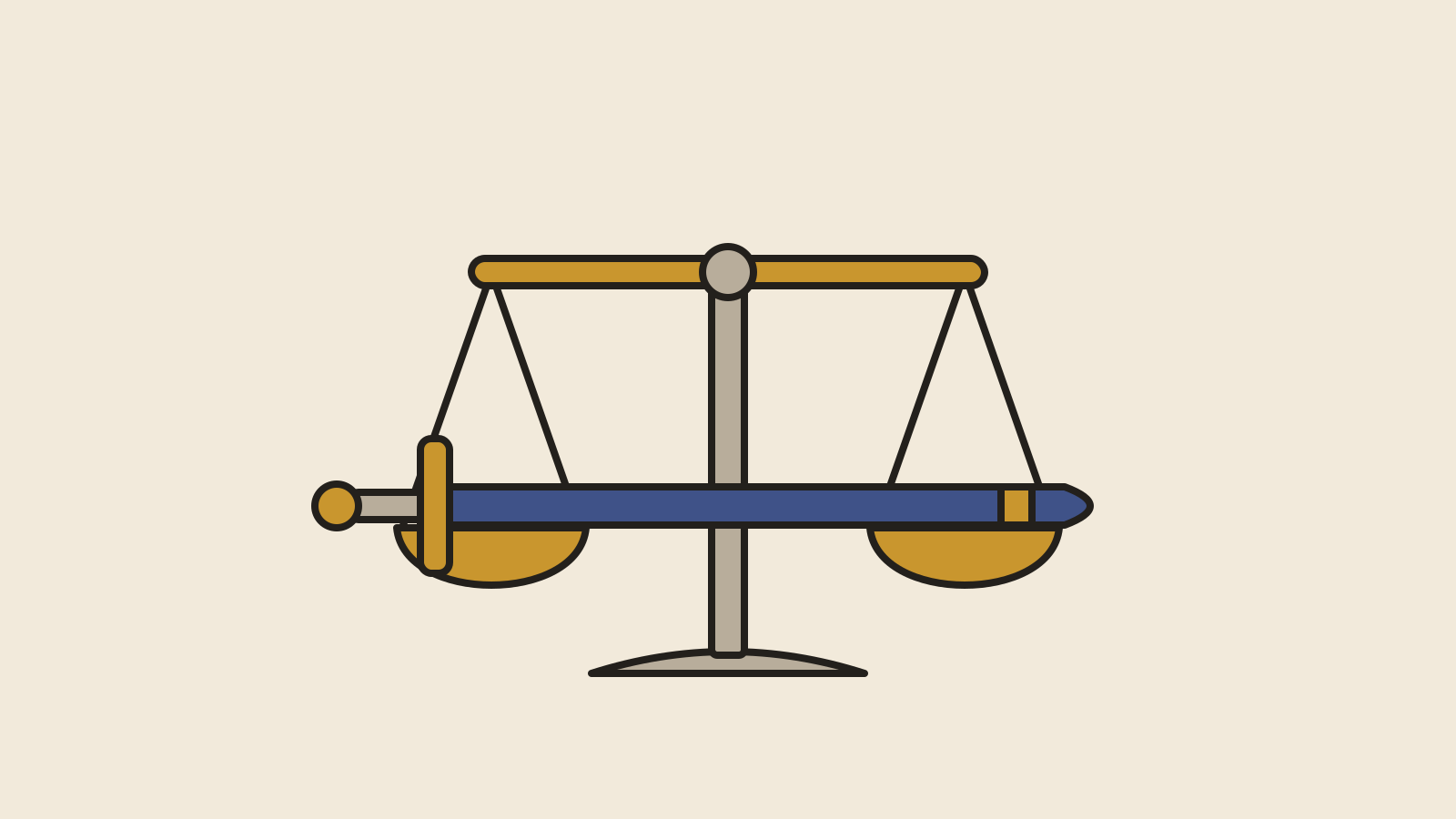
Just war theory holds that war is sometimes permissible and occasionally required, but that it is always under moral judgement. It asks two separate questions: when a political community may go to war, and how it may fight once at war.
Most people already reason this way about smaller conflicts. A shopkeeper who wrestles an armed robber to the ground has acted rightly. If he then beats the robber senseless after the knife is gone, he has done wrong, even though his cause was good. Just war theory applies the same two tests to states. A country invaded by a neighbour has a just cause to resist. It may still fight unjustly, for instance by bombing towns to break civilian morale.
The theory sits between two rivals. Against pacifism, it allows force. Against the view that anything goes in war, it insists on limits.
Diagram
Just war theory judges separately whether to fight and how to fight
Read as text
Two columns set side by side on one question: what is being judged. The left column, jus ad bellum, concerns whether to go to war, and lists just cause, legitimate authority and last resort. The right column, jus in bello, concerns how the war is fought, and lists discrimination between soldiers and civilians, proportionality and necessity. A war can pass one set of tests and fail the other.
Key features
- It separates the justice of going to war, jus ad bellum, from justice in waging it, jus in bello.
- The traditional tests for going to war are just cause, legitimate authority, right intention, a reasonable hope of success, proportionality and last resort.
- In fighting, combatants must distinguish soldiers from civilians and use no more force than the military aim requires.
- Many recent writers add a third part, jus post bellum, on the duties of victors once the fighting ends.
Not to be confused with
| Look-alike | The difference | Differs on |
|---|---|---|
| Realism (international relations) | Realists doubt that moral rules can bind states whose survival is at stake, and judge war by national interest. Just war theory holds that moral limits apply in every war, whatever the stakes. | Differs onClaim |
| Pacifism | Pacifists hold that war is always wrong, or that modern war can never meet the tests. Just war theory holds that some wars are permissible and some are required. | Differs onClaim |
| Doctrine of double effect | Double effect is a single principle: harm foreseen but not intended can be allowed if it is proportionate. Just war theory uses it to judge civilian deaths, but its tests also cover when to go to war at all. | Differs onScope |
| Holy war | A holy war is justified by a religious command or goal. Just war theory judges war by reasons any person can assess, such as defence against aggression. | Differs onStandard of judgement |
- Differs onClaim
Realism (international relations)
Realists doubt that moral rules can bind states whose survival is at stake, and judge war by national interest. Just war theory holds that moral limits apply in every war, whatever the stakes.
- Differs onClaim
Pacifism
Pacifists hold that war is always wrong, or that modern war can never meet the tests. Just war theory holds that some wars are permissible and some are required.
- Differs onScope
Double effect is a single principle: harm foreseen but not intended can be allowed if it is proportionate. Just war theory uses it to judge civilian deaths, but its tests also cover when to go to war at all.
- Differs onStandard of judgement
Holy war
A holy war is justified by a religious command or goal. Just war theory judges war by reasons any person can assess, such as defence against aggression.
Origins and development
Cicero required a formal demand and declaration before a Roman war. Augustine, writing in The City of God (413–426), argued that a Christian may fight to restore peace and punish wrongdoing. Thomas Aquinas named three tests: legitimate authority, just cause and right intention. Francisco de Vitoria and Hugo Grotius turned the tradition into law between nations. After Vietnam, Michael Walzer restated it in secular terms in Just and Unjust Wars (1977).
Cicero
The Roman orator and statesman who put Greek philosophy into Latin and defined a republic as the property of its people.
Augustine of Hippo
The North African bishop whose Confessions and City of God gave Western Christianity its account of sin, grace, free will and the inner self.
Why it matters
Its ideas shaped the limits on force in the United Nations Charter, the Geneva Conventions and military manuals. Whenever the news asks whether an invasion was self-defence, whether a strike on a power station was proportionate or whether a humanitarian intervention was legitimate, the questions come from this tradition. Officers are trained in its rules, and war crimes trials apply laws built on its principles.
Critiques and limits
Pacifists such as the philosopher Robert Holmes argue that modern war kills so many innocents that no war can meet the tests. Realists reply from the other side that moral rules give way when survival is at stake. Within the tradition, Jeff McMahan argues that soldiers fighting for an unjust cause cannot fight justly, which rejects Walzer's moral equality of combatants. These are normative claims, settled by argument and not by evidence, and the debate is open.
Connections
Belongs to
It is the main body of thought on when a political community may use force against another and how.
EthicsPhilosophy
It applies general principles about killing, self-defence and responsibility to the case of war.
Originated by
Augustine of HippoPhilosophy
Augustine gave the tradition its first Christian form, holding that war may be waged only to restore peace and punish wrongs.
Influenced by
Cicero held that a war is just only if it follows a formal demand for redress and a declaration, a condition Christian writers took over.
Natural lawPhilosophy
Aquinas and the Spanish scholastics grounded the rules of war in a natural law that binds all peoples, believers or not.
Thomas AquinasPhilosophy
Aquinas set the three classic tests for going to war: legitimate authority, just cause and right intention.
Contrasts with
Doctrine of double effectPhilosophy
Differs on scope. Just war theory is a whole body of rules for war, and double effect is one principle used within it.
Realism (international relations)
Differs on claim. Realists doubt that moral rules bind states fighting for survival, where just war theory holds that they always do.
Influenced
Francisco de VitoriaPhilosophy
He applied Augustine's and Aquinas's tests to Spain's wars in America and added that both sides can believe their cause just.
He restated the medieval tradition in secular terms, as a theory of the rights of states and of persons.
Further reading
- Augustine. (1998). The city of God against the pagans. Cambridge University Press. https://doi.org/10.1017/CBO9780511802300 (Original work published 426)
- Lazar, S. (2016). War. Stanford Encyclopedia of Philosophy. https://plato.stanford.edu/entries/war/
- Walzer, M. (1977). Just and unjust wars: A moral argument with historical illustrations. Basic Books.
Cite this entry
Scholia. (2026). Just war theory. In Scholia: Notes in the margin of the human sciences. Retrieved November 28, 2026, from https://scholia.zennia.sg/ideas/just-war-theory